
Arizona Democrats Are Winning By Building the Future


Arizona has quietly become one of the Democratic Party’s most successful laboratories for technology policy. Arizona Democrats are finding ways to attract investment, create good jobs, train Arizona workers, protect consumers, and give new technologies room to prove themselves. That formula is helping turn Arizona into a center for semiconductor manufacturing, autonomous vehicles, and other emerging industries. It also appears to be a political winner in one of the country’s most competitive states.
Stanton Beats the Socialist Challenge

Representative Greg Stanton has made Arizona’s semiconductor economy central to his work in Congress. When President Trump called the CHIPS and Science Act “a horrible, horrible thing” and urged Congress to repeal it, Stanton publicly defended the law, saying:
“The CHIPS Act is not just subsidizing the semiconductor industry… It’s an investment in workforce training, and it’s an investment in the science behind … this most important technology.”
“Since we’ve done the CHIPS Act, we have had more foreign direct investment — including TSMC — in Phoenix, more than any other place in the United States of America. It has been a massive success.”
Arizona has been one of the CHIPS Act’s largest beneficiaries, with Intel, TSMC, suppliers, universities, and workforce programs building a semiconductor ecosystem across the Phoenix area. TSMC announced in July that it plans to invest another $100 billion in Arizona, bringing its total commitment to the state to $265 billion, and TSMC Arizona currently employs more than 3,500 people in the state. The company said the expansion will likely include four additional advanced semiconductor plants in Arizona, on top of the six fabrication facilities it had already planned there.
Stanton embraced the relationship with industry even as he faced his first congressional primary challenge. He leaned into his record of supporting infrastructure, semiconductor manufacturing, water security, and economic development. His opponent, Kai Newkirk, attacked him as a “corporate Democrat” and won the endorsement of Our Revolution, the progressive organization created after Bernie Sanders’s 2016 presidential campaign.
Newkirk, a democratic socialist, hoped to replicate the left-wing primary victories that had defeated incumbent (usually also left-wing, safe seat) Democrats in New York and Colorado. A core message of his campaign was supporting Bernie Sanders’ proposed moratorium on data centers:
But in the end, Stanton defeated Newkirk by over 24 points in the primary. Clearly, Arizona Democratic primary voters were choosing a pragmatic tech jobs agenda over anti-tech blame.
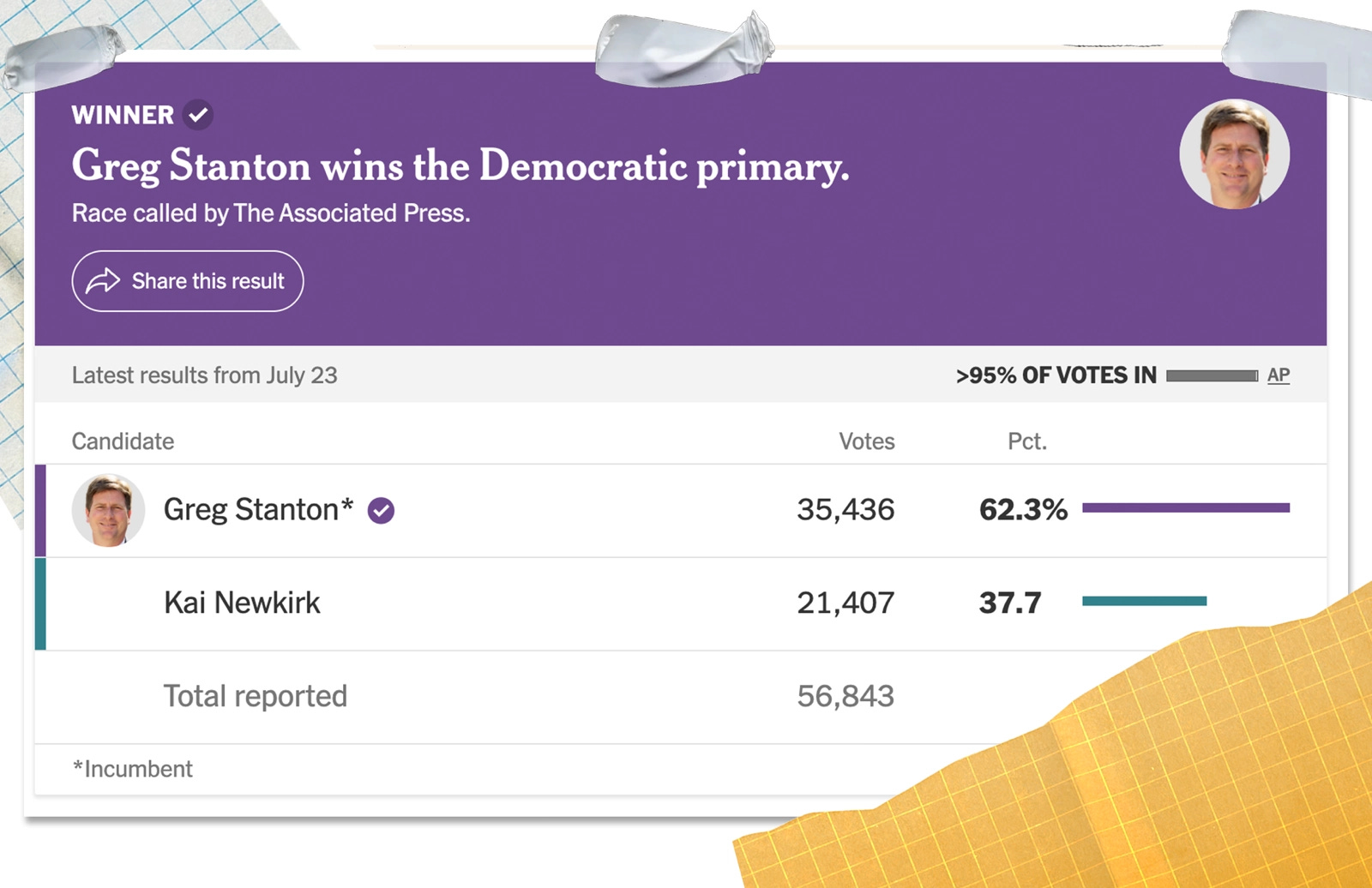
Of course, the result does not show that semiconductor policy alone decided the race – but it does demolish the theory that an Arizona Democrat becomes vulnerable by working with technology companies, welcoming investment, or emphasizing economic growth. Presented with a clear factional choice, Democratic primary voters overwhelmingly chose the candidate associated with building things and creating jobs.
Senator Mark Kelly has reinforced the same message. A lead negotiator of the CHIPS Act, Kelly introduced bipartisan legislation in June to better coordinate semiconductor workforce programs and connect Americans with the thousands of technical jobs being created by new domestic manufacturing.
Arizona Democrats are for these investments and they are campaigning on them.
Autonomous Vehicles Deliver
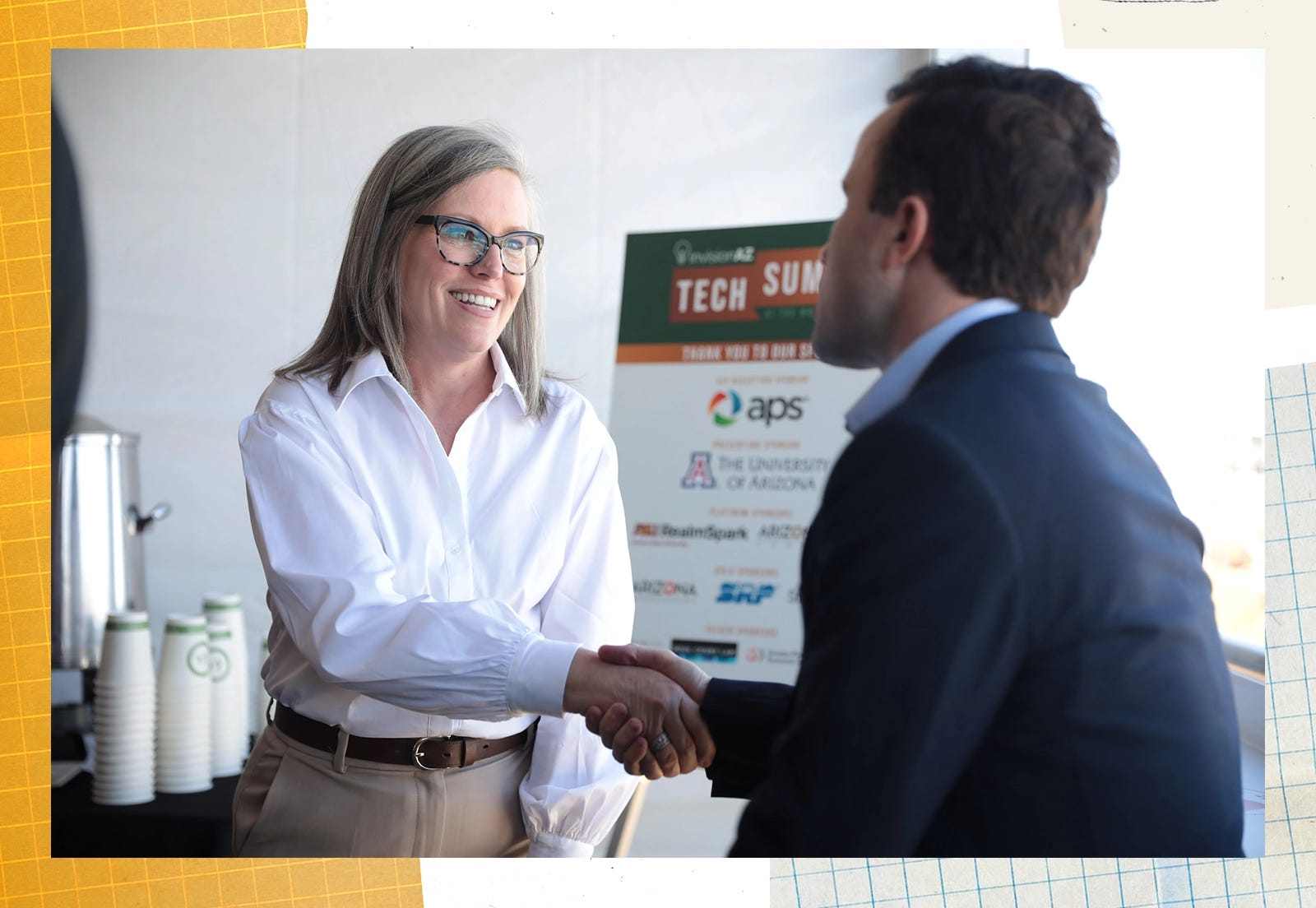
Governor Katie Hobbs and Phoenix Mayor Kate Gallego have applied the same approach to autonomous vehicles. Arizona became the first state in the nation to allow commercial, fully driverless ride-hailing service (offered by Waymo). Under Hobbs’ leadership, Arizona has built on that foundation, helping make Arizona the national leader in autonomous vehicle deployment and manufacturing.
Waymo and manufacturing partner Magna opened a 239,000-square-foot vehicle integration facility in Mesa that is expected to produce thousands of autonomous vehicles and has already created hundreds of jobs. Hobbs welcomed the project, saying:
“The new Waymo and Magna manufacturing facility in Mesa is the latest example of Arizona being the new home for technology to innovate and grow. I’m proud to see autonomous vehicles on our streets every day, helping get people where they need to be safely. The new manufacturing facility will enhance this presence, and the local jobs it’s creating will help Arizona’s tech economy continue to rise on the world stage.”
Mayor Kate Gallego has helped make Phoenix the country’s most important real-world autonomous-vehicle market. Waymo began offering fully driverless public rides there in 2020, and the network has since expanded to include freeways, the East Valley, and Phoenix Sky Harbor International Airport. In an interview with Fast Company, she said:
“It’s a point of pride for us that we were the first in the world to have autonomous vehicle service at the airport. We think it really shows we’re a technology-forward city and that we’re willing to embrace innovation.”
That willingness to deploy the technology has produced information that regulators elsewhere can use. An Insurance Institute for Highway Safety analysis found that Waymo vehicles experienced 68 percent fewer police-reportable crashes per mile than human drivers across four cities, with a 76 percent reduction in Phoenix.
A Pragmatic View on Crypto
At the national level, Senator Ruben Gallego has taken a largely positive, and pragmatic, approach to digital assets and cryptocurrency. He recognized the potential for crypto to help people who have been left out of traditional finance, Speaking at the Blockchain Association’s inaugural Summit Series in June 2025, he said:
“What got me interested in crypto was the fact that other people were interested in crypto. My old congressional district is largely working class, Hispanic, also the largest African American community in Arizona. And the fact that there were young Black men and Latino men that were talking about crypto, interested in crypto … As a legislator, I think that’s your job, right? If your constituents are showing interest in this, then you should show interest in it too.”
As the ranking Democrat on the Senate Banking Committee’s digital-assets subcommittee, Senator Ruben Gallego is at the center of the national debate over crypto rules.
Ruben Gallego has been a lead legislator in helping craft bipartisan cryptocurrency legislation that provides clarity, while also pressing for stronger national-security, anti-money-laundering, and consumer-protection provisions. Even as he supports crypto legislation in principle, he is working to ensure that Trump and other politicians are less able to profit off of digital assets.
That is a better political model than choosing between hostility to the entire industry and unconditional support for whatever the industry, and Trump, wants. Ruben Gallego’s position is that innovation should remain in the United States, but it should operate under clear and enforceable rules.
Voters Want the Jobs
Arizona Democrats’ actions on tech match what voters say they want.
Our battleground state polling prior to the 2024 presidential election across eight battleground states found that 80 percent of Arizona voters wanted the president to focus on expanding technology jobs and services, while 20 percent preferred a focus on regulating companies such as Amazon, Google, and Apple.
The same survey found that many voters who expressed concerns about technology companies nevertheless wanted more technology jobs and opportunities in their communities.
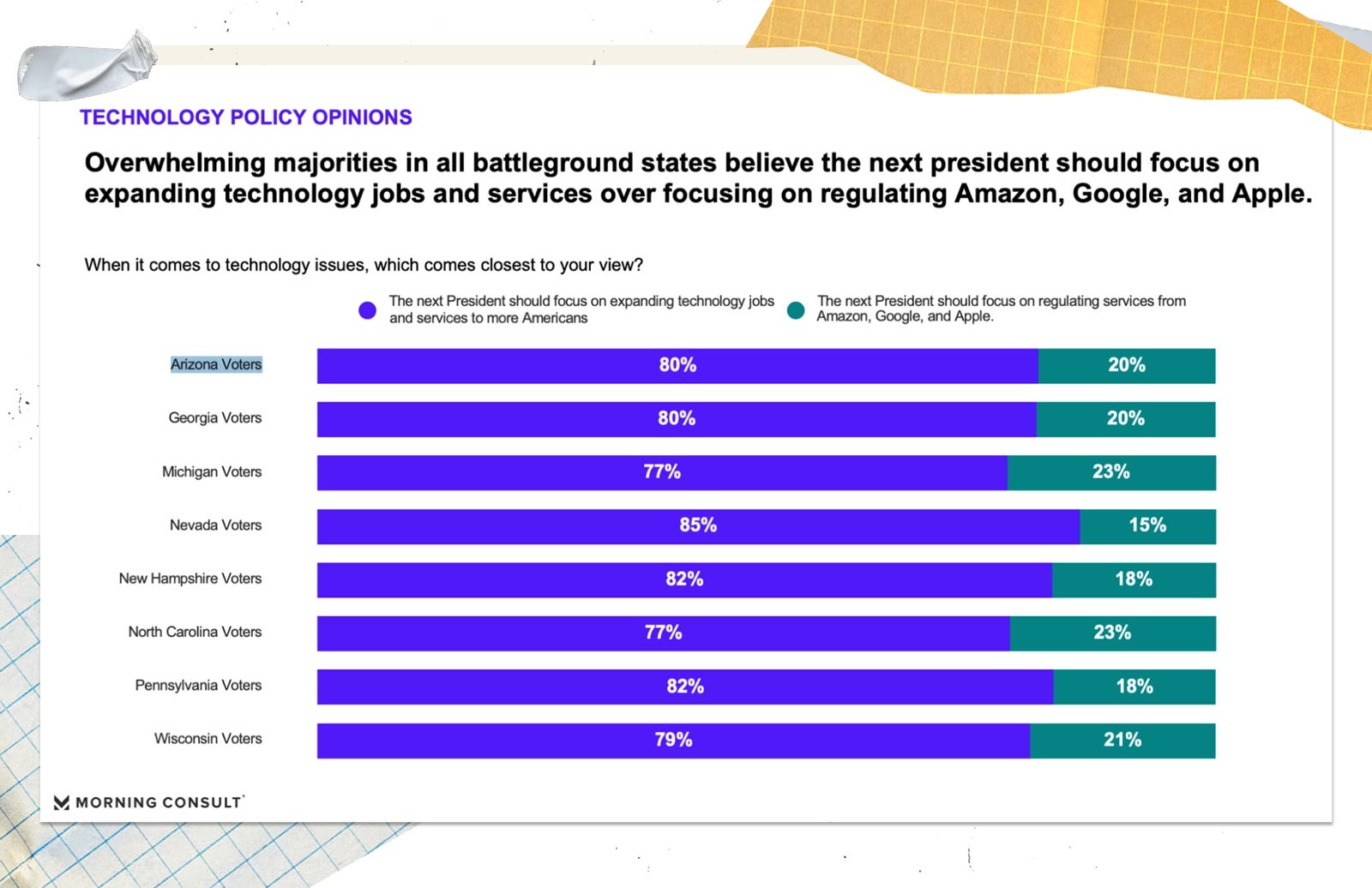
Stanton, Kelly, Hobbs, Kate Gallego, and Ruben Gallego have turned that preference into a governing agenda. Chips mean factories and skilled careers. Autonomous vehicles mean manufacturing, mobility, and safer streets. Crypto policy means innovation paired with consumer protection.
Arizona Democrats have figured out making technological progress can deliver visible benefits for ordinary people.