

President Biden filled his tech policy ranks with elite academics and nonprofit veterans who championed a bold, theoretical version of anti-corporate populism. Rooted in Ivy League law schools and advocacy circles like Yale, Columbia, and Open Markets, they arrived in Washington eager to convert academic theories into government action.
During an administration that faced intense backlash from voters frustrated with high inflation, they favored ideological experimentation over practical gains for consumers.
These academic theories prompted Biden’s tech policymakers to target three areas far from voters’ priorities: corporate mergers, targeted advertising, and an obscure and abandoned anti-discounting law.
A Default Hostility Towards Mergers
Prior to the Biden Administration, most corporate mergers and acquisitions had been allowed by the government to proceed. Some large mergers would go through a “second review” process by the FTC or DOJ, where the merging parties would have to produce documents and answer questions about the deal. And some mergers would be either challenged by the government in court, or allowed to proceed with conditions attached.
Biden’s “Neo-Brandeisian” antitrust appointees, FTC Chair Lina Khan and DOJ’s Jonathan Kanter, reversed the default presumption towards mergers, and immediately adopted the posture that most mergers should be deterred.
To achieve this goal, Khan and Kanter took two significant steps:
Ending the agencies’ practice of “clearing” deals in an initial stage, by sending a letter to merging parties indicating a lack of government concerns with the deal; and
Replacing that process with “warning letters” for all merging parties, warning them that the government could bring a legal challenge to the deal at any time, and that the merging parties would close the deal at their own risk.
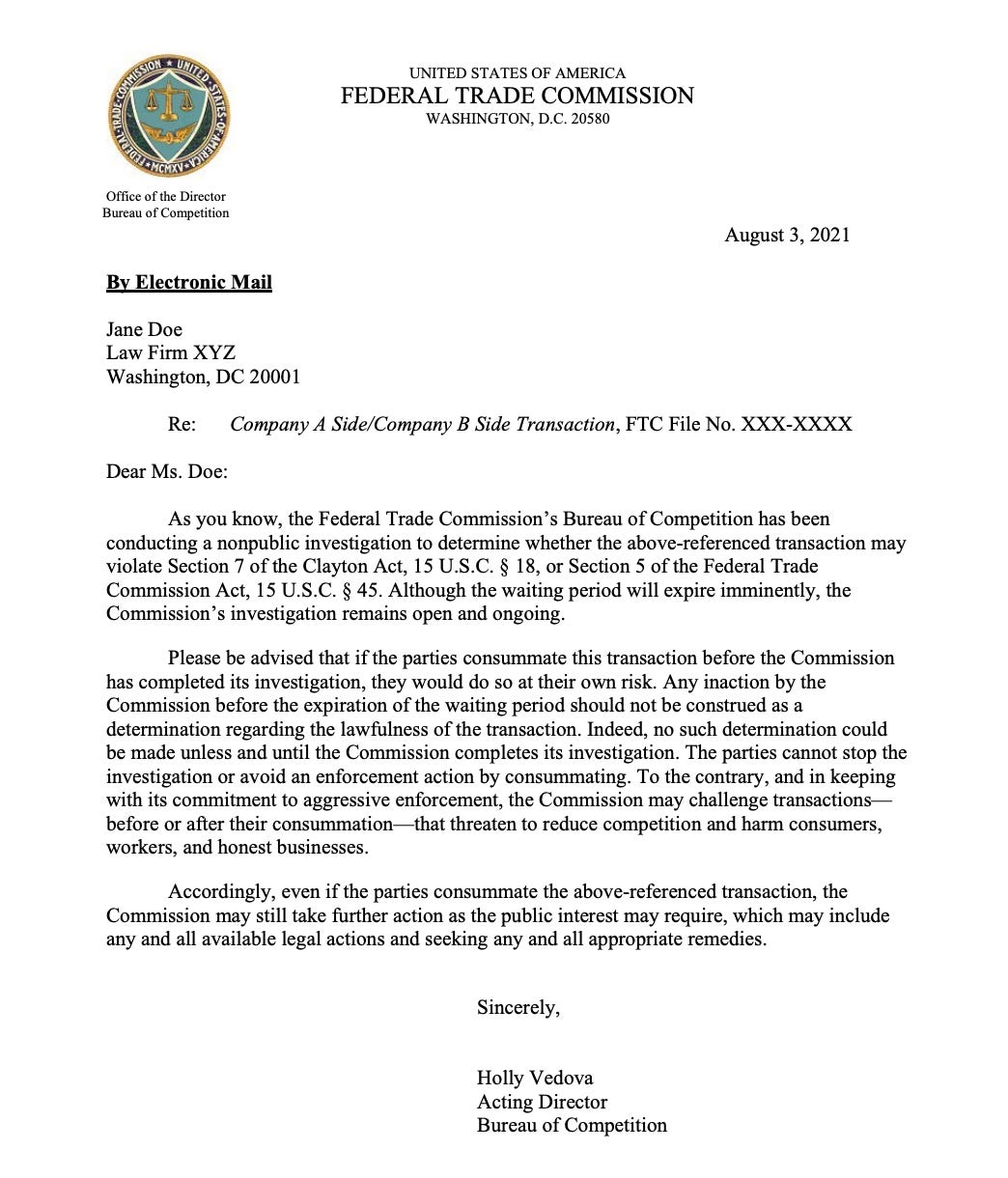
Khan and Kanter’s posture was rooted in academic theory: that acquisitions by large firms primarily serve to kill off potential competitors, and that acquired firms could alternatively instead go public and challenge today’s large firms. This posture also substituted the judgment of the government for the judgment of the acquired company’s leadership, suggesting a “we know what’s best for you attitude” - despite the reality that many startup founders saw acquisition as the best option available to them.
From 2020 to 2023, federal agencies challenged 14 startup acquisitions, up from just three between 2012 and 2019. Several high-profile deals were blocked or abandoned, and many more were deterred by aggressive scrutiny.
This resulted, unsurprisingly, in a sharp decline in the number of mergers.
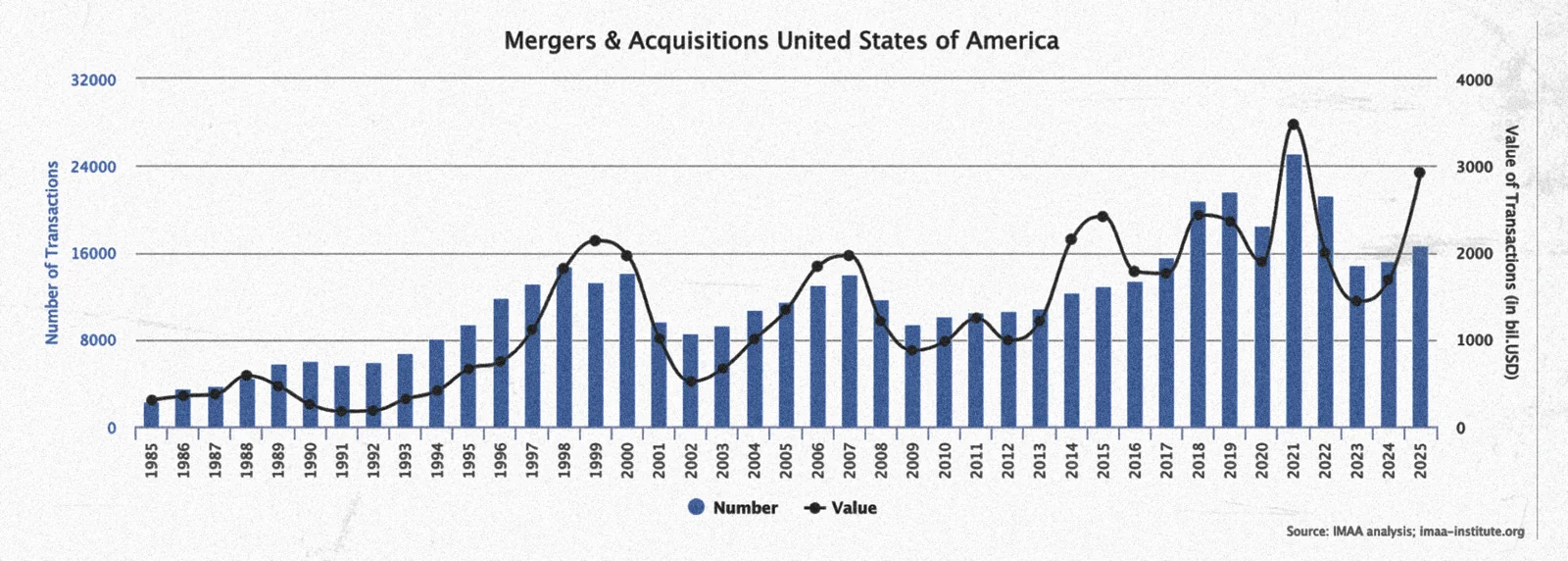
This merger enforcement chill came at a cost. Fewer mergers meant fewer exit options for startups, which in turn dampened venture investment. As tech insiders warned, when acquisition is off the table, many great ideas may stay just that—great ideas. Founders and venture capital investors need to see a path to an exit in order to invest, regardless of how good the idea is.
To adapt, companies resorted to “license-and-hire” deals—acquiring technology licenses while absorbing most of a startup’s staff. In one case, Microsoft paid $650 million for such a deal, avoiding formal acquisition review. Ironically, these deals - a byproduct of Khan and Kanter’s reflexive hostility towards mergers – resulted in sometimes worse outcomes for the rank-and-file workers in the “licensed” company.
CCIA, an industry association, released a report in January that examined this period of aggressive enforcement. In their summary, the report finds (emphasis mine):
During an increasingly aggressive antitrust enforcement paradigm from mid-2021 through 2024, smaller startups have had fewer opportunities to be bought out. As smaller startups generally lack the option to exit via an IPO, reduced access to exit via acquisition led to more businesses shutting down, fewer startups selling for more than they raised, and lower overall returns for investors. These are all bad outcomes for startup founders and venture capital (VC) investors. Since the U.S. is a global leader in Artificial Intelligence (AI), which plays a big role in about one third of recent VC investments, overly strict antitrust enforcement could harm future economic growth, weaken the U.S. in global competition, and harm U.S. national security.
The “Commercial Surveillance” Rule That Stalled
Another ivory-tower assumption embraced by Biden’s appointees was that the public deeply loathes targeted advertising and would happily pay premiums for subscription based services instead of free, ad-supported services.
FTC Chair Khan sought to redefine online advertising as “commercial surveillance,” pushing a sweeping rulemaking to curb data-driven marketing.
This push had its roots in academia, notably the work of Harvard Professor Shoshanna Zuboff, who coined the phrase “surveillance capitalism.” Zuboff was cheered by fellow neo-Brandeisian academic Tim Wu.
But public sentiment told a different story. Surveys found 80% of consumers prefer ad-supported services to paying out-of-pocket, and nearly 90% favor ads tailored to their interests. The FTC’s ambitious proposal lacked buy-in from the very consumers they are ostensibly protecting.
After an initial burst of headlines, the rulemaking effort stalled. Faced with legal complexity, industry pushback, and tepid consumer enthusiasm, the initiative failed to produce concrete results. It became another case of regulators treating agencies as ideological sandboxes, experimenting with theories unrooted in public demand.
Reviving Robinson-Patman at Consumers’ Expense
The clearest case of theory over pragmatism may be the administration’s revival of the Robinson-Patman Act, a 1936 law prohibiting price discrimination in favor of large buyers. Progressive academics argued that enforcement could protect small retailers—even at the cost of higher prices for consumers.
In 2025, the Biden FTC sued PepsiCo for allegedly giving Walmart better prices and promotional perks than smaller grocers. In other words, Biden’s regulators deliberately took on a case whose theory of harm was that consumers were paying too little at a dominant retailer – a striking inversion of the usual antitrust focus on consumer prices. Scholars from the Mercadus Center at George Mason University concluded:
Net welfare is likely to be maximized by an outright repeal of the RPA, which will prevent ideologically motivated officials from expending public resources in RPA lawsuits that are likely to diminish consumer welfare and make the American economy less competitive.
Equalizing terms meant raising prices at mass retailers like Walmart; a tough sell during inflation. Khan defended the move, saying such favoritism “tilts the playing field”, but if the policy worked as intended, the result would hike consumer costs to protect small retailers.
The lawsuit fizzled. Trump’s FTC dropped the case in May 2025, labeling it a “legally dubious partisan stunt”. The episode revealed the Biden-era disconnect: instead of delivering savings, the FTC pursued abstract fairness at the expense of affordability.
Ideology Over Impact
Across these cases, a clear pattern emerges. Biden’s tech regulators often treated their roles as vehicles for intellectual fulfillment rather than tools for real-world protection. Their campaigns—against mergers, targeted ads, and price differentials—frequently produced headlines, but not enduring benefits for consumers.
The merger crackdown chilled startup activity while spurring workaround deals like license-hires.
The surveillance rulemaking stalled due to weak public demand for costly privacy trade-offs.
The Robinson-Patman revival risked higher prices for working families in pursuit of small-retailer equity.
These were not policies built from the ground up, an effort to meet consumer demands at a time of rising inflation. They were top-down impositions of academic models.
As Democrats make the case to voters that they should trust us with their economic interests, we need to keep a key idea in mind: Bold ideas must still deliver practical results. Otherwise, we will alienate the very people we aim to serve.