
Democrats Should Be Economic Patriots in Combating Foreign Bullying


The European Union has sent the U.S. tech sector a message. On July 23, the European Commission issued two Digital Markets Act decisions against Google, imposing fines of €460 million and €430 million. Together, the penalties total €890 million. Do these numbers equate to some specific harm? No. Converted to U.S. dollars, it is a round and symbolic $1 billion.
While Europe describes the DMA as neutral competition policy, Americans should look at who is covered. The seven designated gatekeepers are Alphabet, Amazon, Apple, Booking, ByteDance, Meta, and Microsoft. Six are headquartered in the United States, including Booking’s parent company, Booking Holdings, while ByteDance is Chinese. Not one is an EU-headquartered corporate parent.
During Barack Obama’s presidency, his administration stood up against this kind of European bullying of America’s tech sector. More recently, Donald Trump’s Administration has threatened the EU for its singling out of American firms. But the Biden Administration largely stood aside against Europe’s discrimination - because some far-left Democrats in Congress wanted a workaround after their failed efforts to adopt European-style tech regulation here in the United States.
But the reality is that American leaders have a duty to recognize economic self-interest and insist on fair treatment. When it comes to the fair treatment of American companies, Democrats should not be chumps.
Congress Said No
During the Democratic trifecta of 2021 and 2022, Congress considered the American Innovation and Choice Online Act, targeting platform self-preferencing, and the Open App Markets Act, targeting app-store restrictions. Both advanced from the Senate Judiciary Committee, but they were never passed into law. Even a late White House push could not get the bills enacted.
That was a democratic outcome. Supporters of the bills can argue Congress was wrong, revive the bills, and campaign on them. What they should not do is lose the argument in the United States and then look to foreign regulators to impose a similar regime on American companies. And for Democrats in particular, who are generally seen as too far left on economic issues and as indifferent to economic growth, it is an especially bad look to support European regulations that are not popular enough to pass in the United States.
Yet in March 2023, Biden’s Federal Trade Commission and Justice Department – under pressure from Senators Amy Klobuchar and Elizabeth Warren – announced that each would send experts to Brussels “to assist with implementation” of the DMA. The FTC’s press release quotes European Commission Executive Vice President Margrethe Vestager, clearly showing that the U.S. regulators were assisting their efforts to constrain U.S. companies, not defend U.S. interests:
“Today’s meeting has proven once again how fruitful it is to keep engaging in a close cooperation between the European Commission and the U.S. competition authorities. Exchanging our experiences and ideas on how best to anticipate and address the fast-moving trends in tech markets is vital for achieving the shared goal of a fair, inclusive and pro-competitive digital transformation, to the benefit of consumers and businesses in both the EU and U.S.”
Europe Is Practicing Economic Nationalism
Europe’s interests here are straightforward. American technology companies built the world’s most successful digital platforms. European policymakers want more of that economic value to flow to European firms. The danger American regulators need to recognize is that regulation can become industrial policy by another name, especially when the regulated list contains no EU-headquartered parent company.

We should expect countries to protect their own industries from being singled out by foreign regulators. If the United States singled out the French handbag industry for special regulations, France would object. Part of being taken seriously in the world is that you stand up for your country’s economic interests. This type of economic patriotism is to be expected. It should be a bipartisan principle in the United States that we will defend our business and economic interests abroad. Because we failed to do so during the Biden Administration, and at times actively assisted the European regulators, Europe treated us as chumps and created an advantage for its own tech industry.
Europe recognizes its technology problem. Mario Draghi’s report for the European Commission concluded that Europe must close its innovation gap with the United States, describing an industrial structure with too few new companies developing growth engines. Europe should study the conditions that produced America’s technology sector, not seek to hobble the companies that succeeded in America.
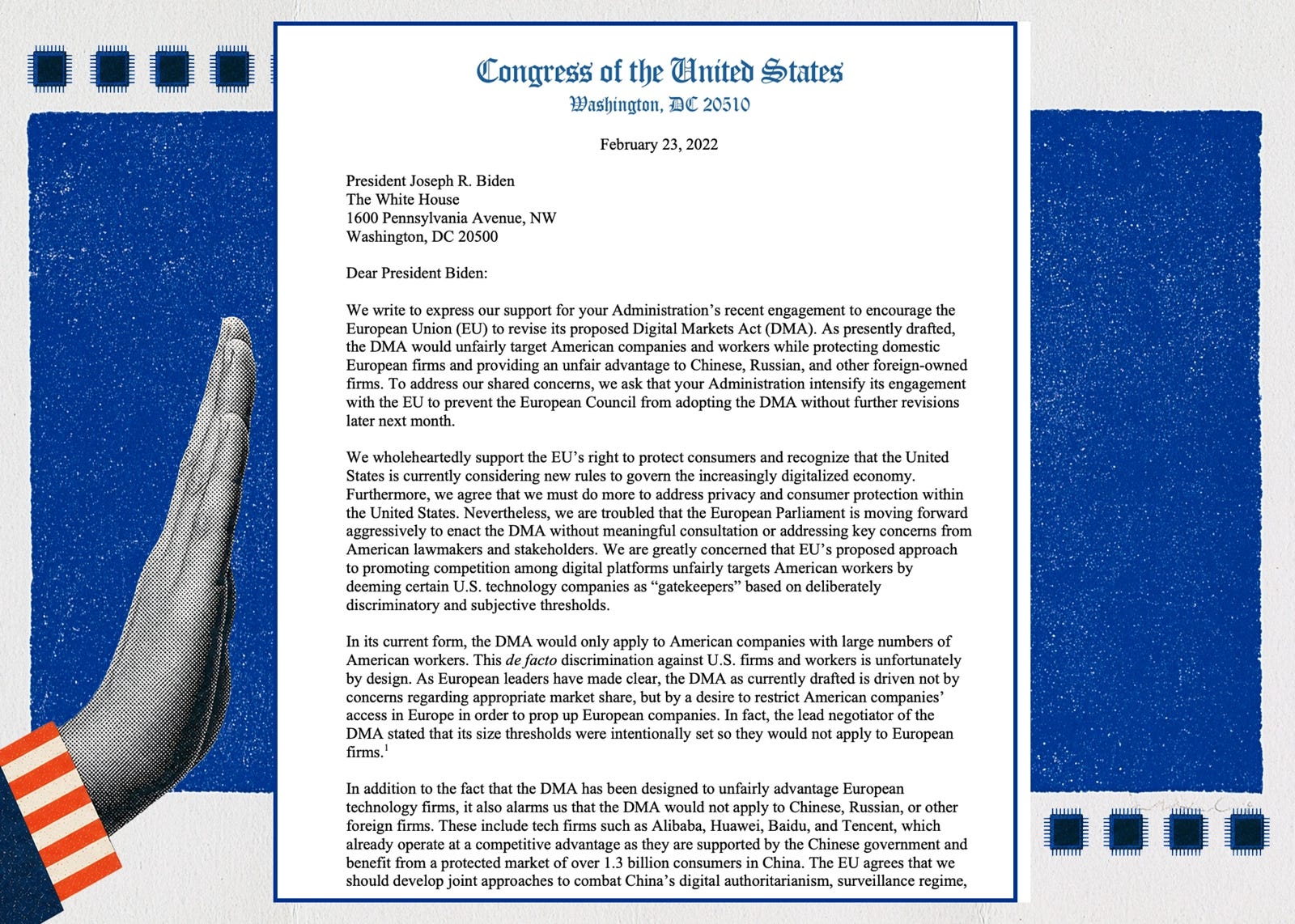
Many Democrats recognized this danger at the time. In February 2022, a bipartisan group of 30 House members led by Suzan DelBene and Darin LaHood warned President Biden that the DMA would target American companies and workers while advantaging foreign competitors. Then-Senate Finance Committee Chair Ron Wyden joined Republican Mike Crapo in calling the DMA and Digital Services Act discriminatory digital trade policies.
Democrats Can Defend Our Principles
Defending an American company from discriminatory foreign treatment does not require defending every corporate practice. Democrats can support privacy, competition, worker protections, and consumer safeguards at home while insisting that American rules be written by American lawmakers and that foreign governments treat U.S. firms fairly.
Politically, the alternative is poisonous. When Democrats applaud foreign regulators for imposing rules that could not pass a Democratic Congress, they reinforce the perception that the party is anti-business and more comfortable with punishment than growth. It is a strategy that will hobble America’s most globally competitive industry, making the country poorer, less innovative, and less capable of competing with China.
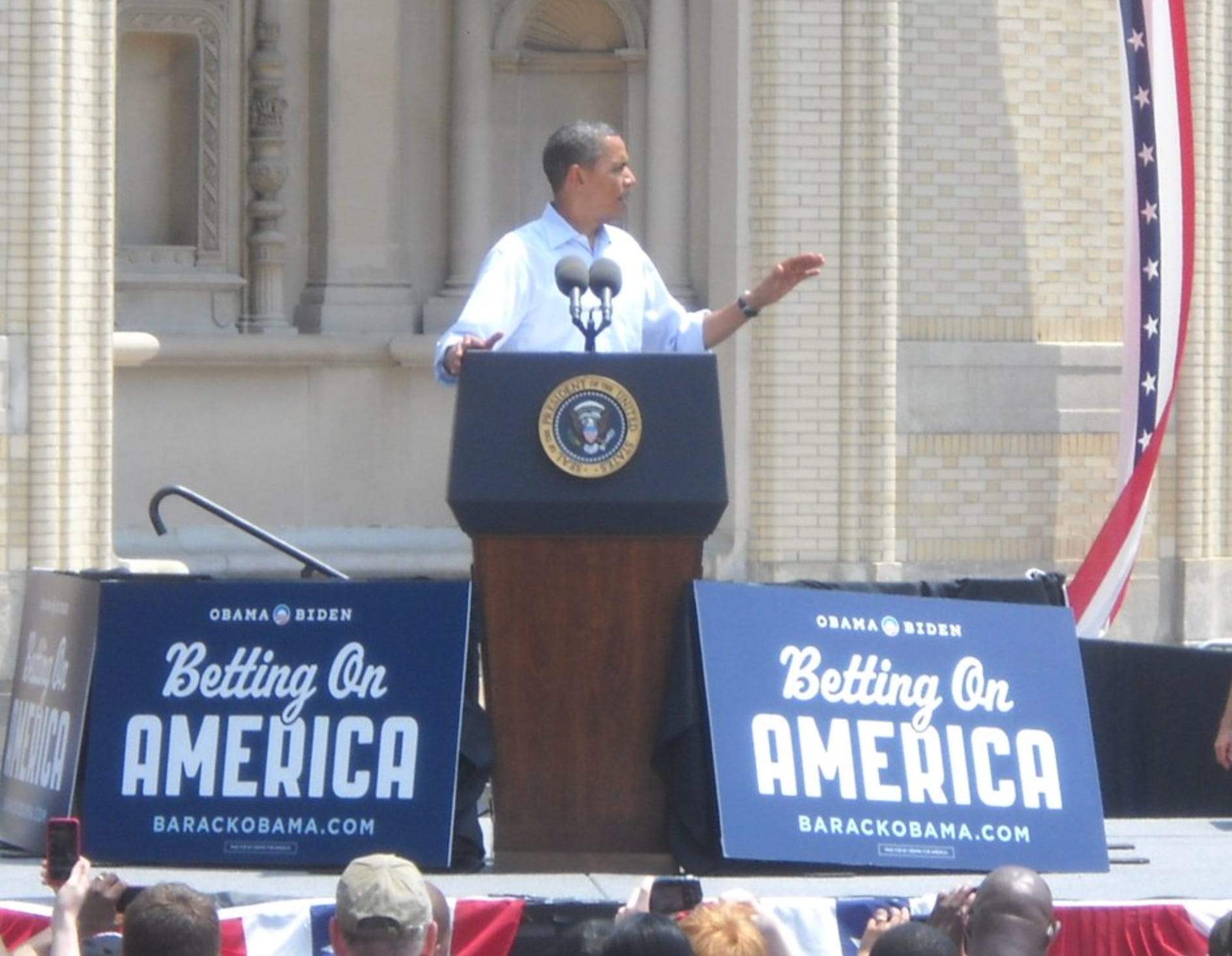
During his 2012 reelection campaign, President Obama focused on economic patriotism themes, such as the “Betting on America” tour.
So where should Democrats land on tech trade policies? The good news is that we have examples of Democrats recognizing the distinction between regulating our own industries and letting foreign governments set and enforce the rules on American industry.
In 2015, President Obama argued that some European attacks on American technology companies were “more commercially driven than anything else” and that weaker European competitors were using regulation to create roadblocks. Obama went on to say:
“There are some countries like Germany, given its history with the Stasi, that are very sensitive to these issues. But sometimes their vendors — their service providers — who can’t compete with ours, are essentially trying to set up some roadblocks for our companies to operate effectively there.
We have owned the Internet. Our companies have created it, expanded it, perfected it, in ways they can’t compete. And oftentimes what is portrayed as high-minded positions on issues sometimes is designed to carve out their commercial interests.”
With a Obama on record saying that European regulators were trying to give their own industry a competitive advantage, American regulators could work on enforcing U.S. laws and regulations without having to help Europe tie our hands.
Biden’s Treasury Secretary Janet Yellen followed the same principle when she negotiated a transition away from unilateral European digital services taxes and toward a multilateral framework. The agreement led the United States to terminate planned retaliatory trade actions.
Do Not Cede Economic Patriotism to Trump
President Trump responded to the Google fines by launching a trade investigation and threatening retaliation. Clearly, Democrats do not need to endorse reckless tariffs or every Trump threat. But what we should be able to do is offer smarter economic patriotism: forceful diplomacy, enforceable digital trade commitments, challenges to discriminatory regulation, and coordinated pressure with partners who share our interest in open digital trade.
American technology leadership is good for America. U.S. tech firms are driving worldwide research and development investment and driving a boom in high-quality, and often unionized, blue-collar jobs across the country in an unprecedented infrastructure buildout. When American companies win abroad, they support investment, research, high-value employment, and the next generation of products built here.
America’s tech industry employs more than 6 million people in jobs that pay six figures on average. The industry is expected to grow at over twice the rate of the rest of the economy. Global trade in U.S. tech products and services is especially important because the marginal cost of serving one more user is near zero, nearly all revenue from overseas users flows back to the United States, so having the world use American tech is a major economic windfall for America. The American stock market has been buoyed by the tech industry, adding money to the 401(k)s of every American with a retirement plan.
Democrats should be able to take credit for facilitating that success.
Democrats rightly criticize Trump when he undermines democratic norms. We should apply the same respect for democratic legitimacy to economic regulation. Stand up for American workers. Stand up for American innovation. Stand up to foreign bullying.