
The Democrats' Tech Brunch Bubble
How a narrow slice of the party dominates Democratic thinking on technology


In his recent article for The Argument, Milan Singh wrote about the findings of their tech and politics polling, concluding that anti-tech populism isn’t actually popular. At the same time, he provided several examples of the left wing of the Democratic party bashing tech companies in service of their political agenda. Why are they doing this?
Digging into The Argument’s polling data helps to illustrate why the populist left wing of the party is using such unpopular messaging. The anti-tech populists are falling victim to the Democrats’ Tech Brunch Bubble: the mistaken belief that the concerns of the party’s most vocal white, progressive faction – a faction overrepresented within the Democratic staffer class – are shared by the broader electorate.
The Staffer Class Is Not the Democratic Coalition
The professional Democratic party that fills the ranks of campaigns, Hill offices, advocacy organizations, donor briefings, consultant meetings, and progressive policy organizations is a curated selection of people that can feel representative of the party but is not representative of the Democratic coalition. They are highly educated, very liberal, and disproportionately white. They also have enormous influence over what Democrats say, which ideas get treated as respectable, and which fights become litmus tests.
Data for Progress surveyed more than 3,500 political elites (including government officials and influential professionals such as lobbyists, media figures, judges, military officers, scientists, and business leaders) about 10 policy proposals. Because these elites help shape, implement, and communicate public policy, their views are important to democratic decision-making. The survey also asked likely voters the same questions, allowing for a direct comparison of policy preferences between political elites and the public.
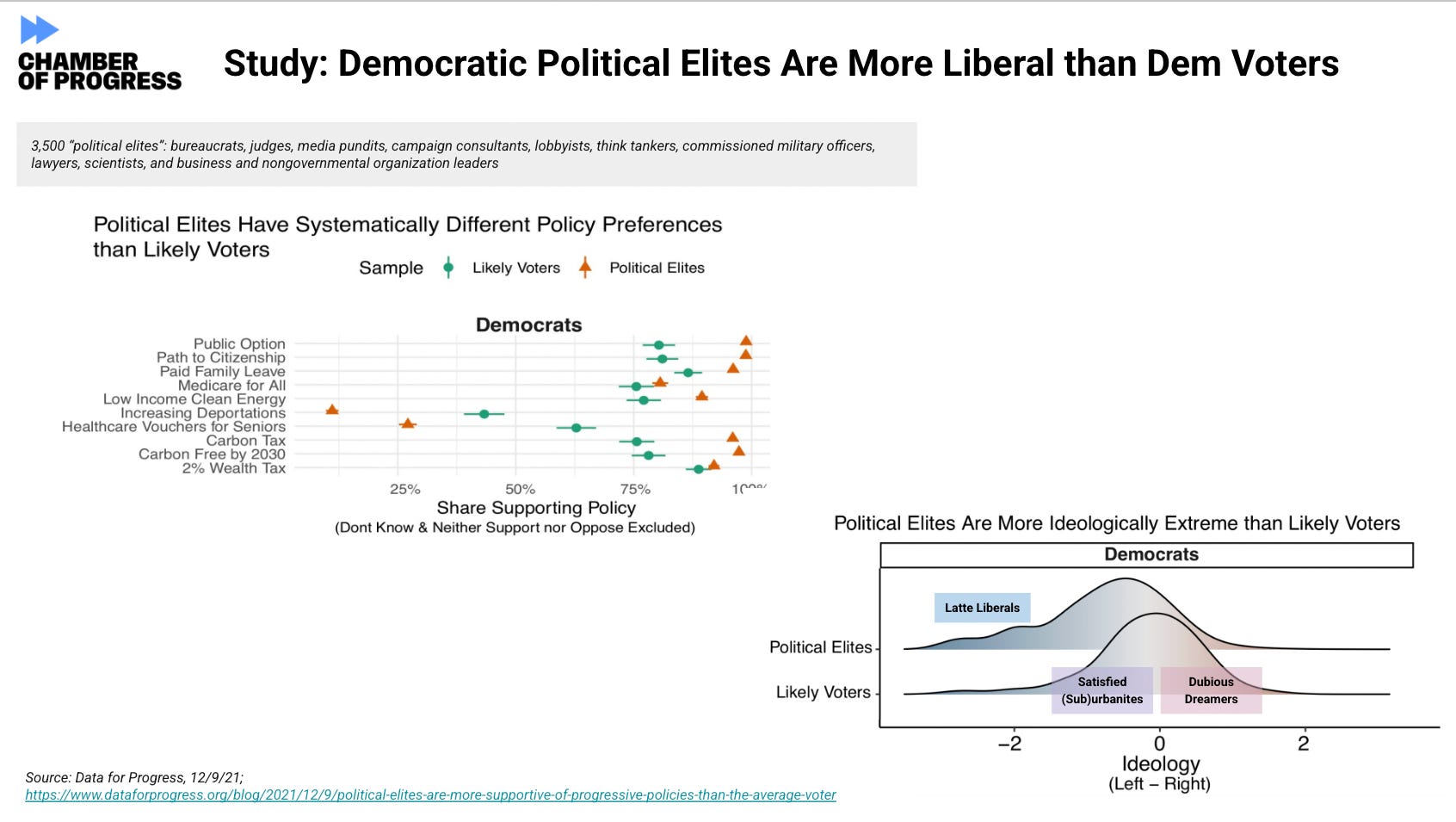
The staffer class comes in greater contact with the opinions of white liberals in the party than they do with Black or Hispanic Democratic voters, who are typically more conservative. So a brunch-table consensus inside the professional staffer class in DC can easily be a minority view even within the broader Democratic coalition. When staffers and elected officials on the left flank of the party develop a consensus that a tech company (or the tech industry) is bad, that consensus can travel quickly through Democratic politics and will start to show up in talking points, oversight letters, hearings, platform fights, and campaign rhetoric.
The Brunch Bubble is reinforced in elite institutions, especially within the Capitol. Congress remains disproportionately white: Pew found that 74% of voting members of the 119th Congress are non-Hispanic white, compared with 58% of the U.S. population. Hill staff are even more concentrated. The Joint Center found that nonwhites are 42.9% of the U.S. population but only 21.6% of top House staff; in the personal offices of white Democratic members, just 18.7% of top staff aren’t white, even though those districts feature an average nonwhite population of 43.1%.
The Argument polling fielded between May 29 and June 3, 2026, which surveyed 3,008 registered voters across the nation. Response to: Which of the following categories would you say best describes your views and ideology?
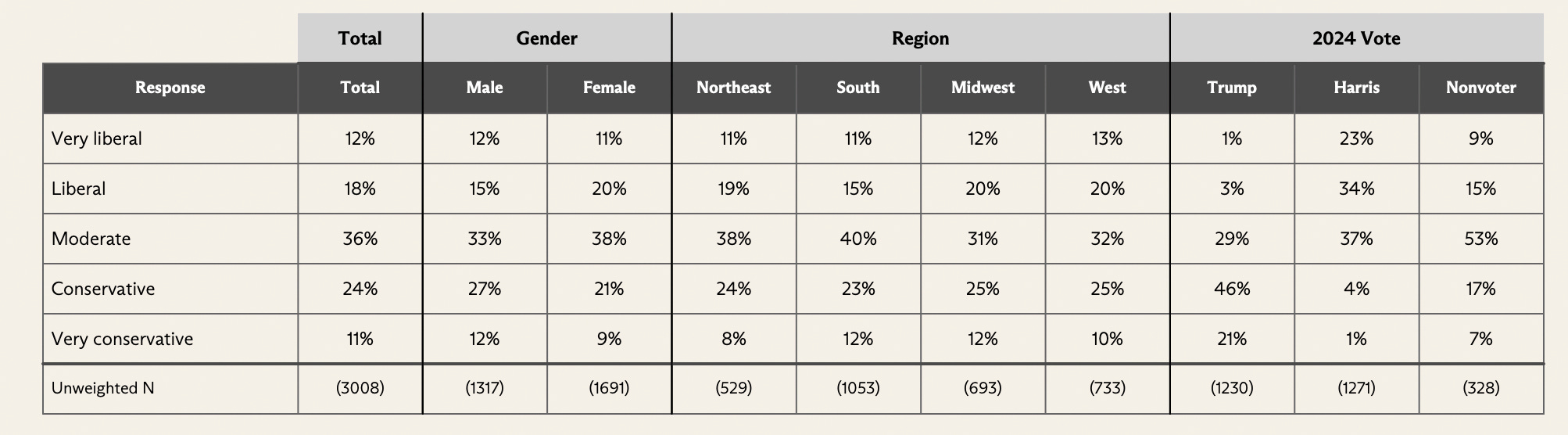
The Argument survey found that very liberal voters are only about one in eight registered voters, while Harris voters are 23% very liberal and 34% liberal. Pew similarly finds that a comparably small share, 8% of registered voters identify as very liberal, while Democrats are far more moderate than many professional Democrats assume: 45% of Democratic voters identify as moderate, compared with 16% very liberal.
None of this means white liberals are monolithic, and it certainly doesn’t mean they’re the enemy. Having worked on multiple Democratic campaigns, served as an appointee in two administrations, and attended plenty of DC brunches, I am really just describing myself and my friends.
What it does mean is that as we sip our bloody marys through DC-approved paper straws, we must be very careful not to mistake the demographics and ideology of agenda-setters within a narrow slice of the party for the views of a winning coalition.
Tech Skepticism Is Strongest Among White Voters
The Argument’s May 2026 survey gives Democrats a specific warning about technology. The survey of over 3,000 registered voters shows that white voters are generally more skeptical of major tech companies than any other demographic.
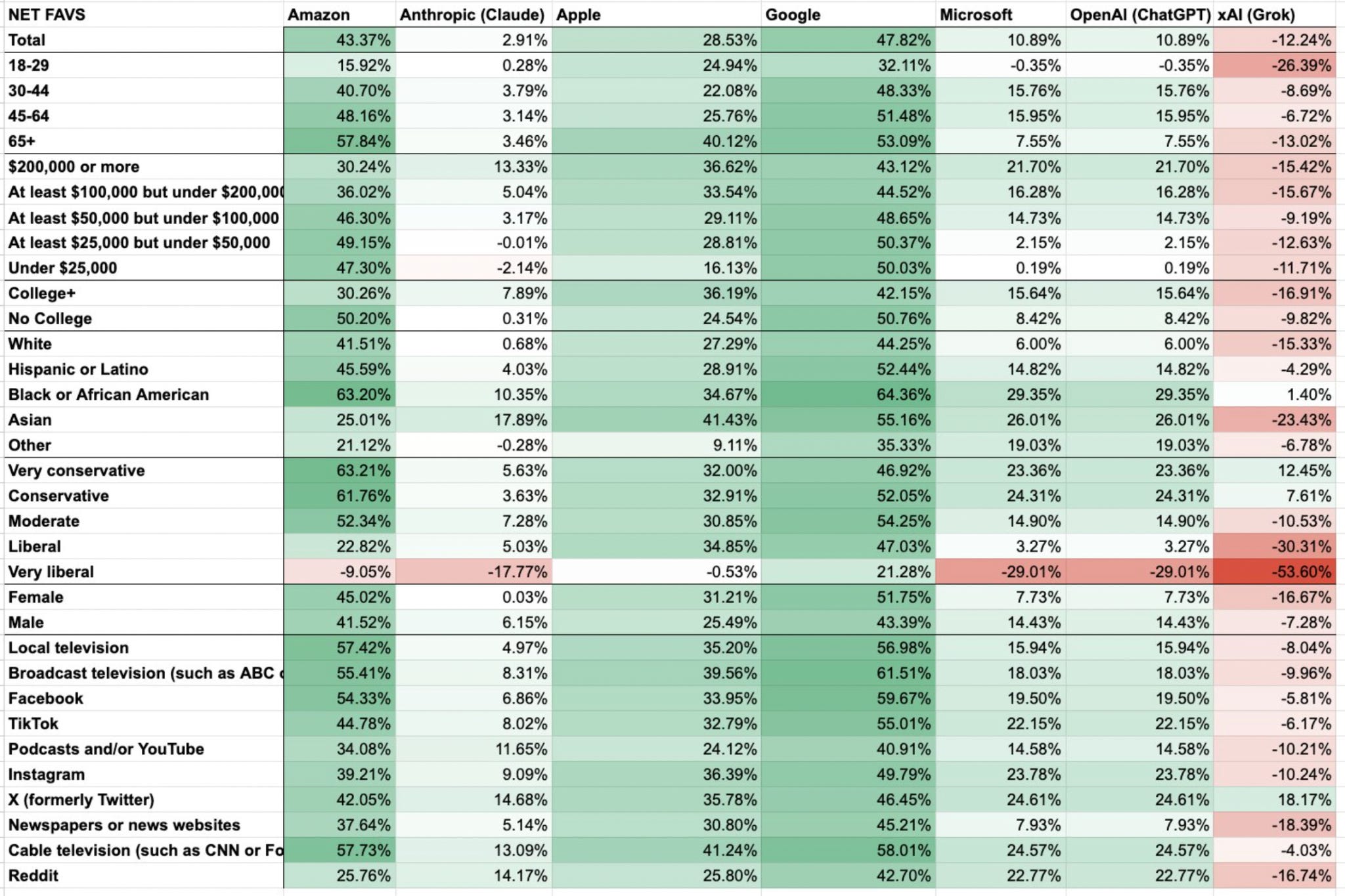
Net Favorability crosstabs from The Argument polling fielded between May 29 and June 3, 2026, which surveyed 3,008 registered voters across the nation.
Some examples:
OpenAI is net favorable overall, but white voters are much less positive than Black, Hispanic, or Asian voters: 35% of white voters view OpenAI favorably, compared with 46% of Black voters, 42% of Hispanic voters, and 51% of Asian voters.
Google is broadly popular, but white voters are roughly twice as unfavorable as Black and Asian voters: 19% of white voters view Google unfavorably, compared with 9% of Black voters and 9% of Asian voters.
Amazon is the most telling. Voters overall view Amazon favorably by 62% to 19%. Black voters view Amazon favorably by 71% to 8%; Hispanic voters by 65% to 19%; white voters by 61% to 21%.
Very liberal voters hold by far the most negative views of tech companies, with only Google and Apple having positive net favorability.
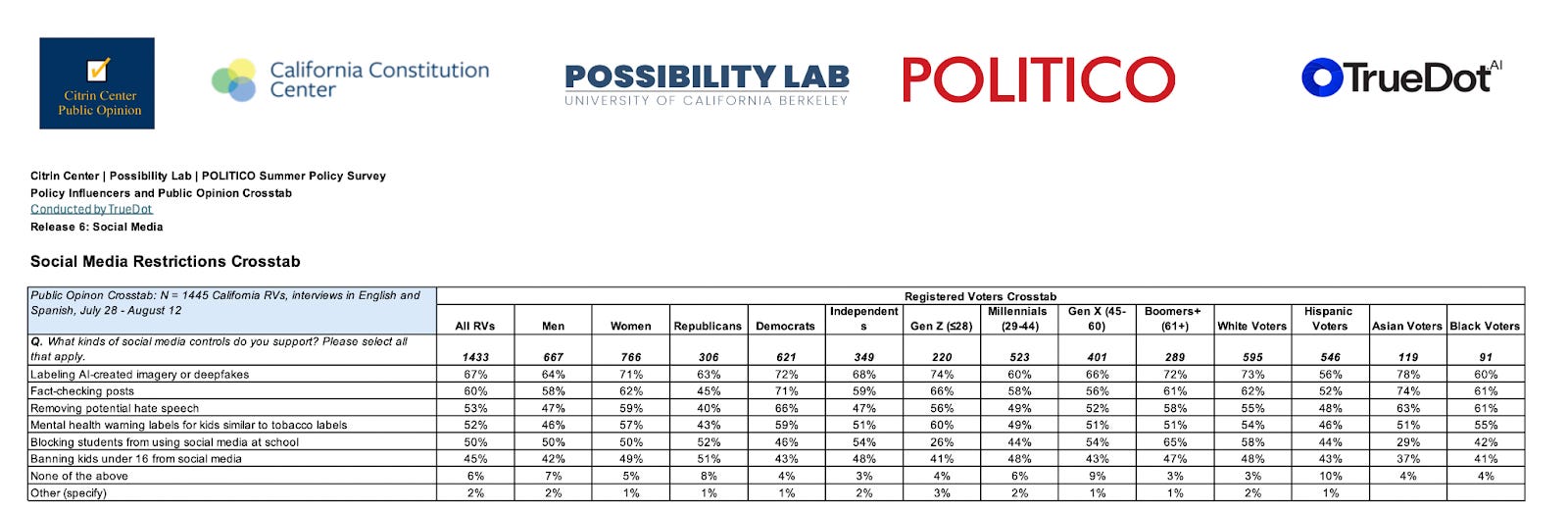
A recent Citrin/Politico poll of California voters shows a similar story. Proposals to ban young teenagers from social media have become popular among Democratic politicians ranging from Gavin Newsom to Rahm Emanuel. One might think this idea is broadly popular - but when asked their opinion of proposals to ban kids under 16 from social media, white voters were the most supportive racial group (48%), while support from Hispanic voters (43%), Black voters (41%) and Asian Voters (37%) was lower.
It’s possible that Hispanic, Black, and Asian voters are more focused on increasing access to technology than in any proposals that would decrease access.
Following a Biden-Harris Administration that often treated the tech industry as the enemy, Politico’s 2024 post-election analysis showed that Harris saw a significant drop in turnout among Black and Hispanic voters – key constituencies within the Democratic coalition that cost her the margin she needed for victory in key battleground states. In discussing the drop in turnout, the article quotes Kevin Olasanoye, the executive director of the Democratic Party of Georgia:
“We missed something here, everybody did. What we were talking to voters about, they told us with their votes that those were important, but they wanted something different. People have the right to feel like we let one slip away here. Legitimately.”
Democrats ought to consider whether that misalignment extends to how we approach technology policy.
Building a Pro-Innovation Democratic Agenda
People like things that work. They like Amazon because packages arrive quickly, prices are often low, returns are easy, and small businesses can reach customers. They like Google because it helps them find things. They like Microsoft because it helps them work. They are optimistic about AI because they use the technology and see it provide them useful information for their work and personal lives. And they’re interested in policies that expand access to tech jobs and opportunity.
A winning Democratic tech agenda should start by understanding the views of the Democratic coalition beyond the loudest white, progressive voices. Democratic staffers should bring The Argument’s poll results to their next brunch (and to their day jobs) and debate how to deliver on what the median voter wants from technology: lower costs, better jobs, safer kids, more convenience, stronger communities, better health care, more opportunity, and an America that can compete and win on the international stage.
A lot of what you are saying here can be put in two buckets. 1) The tech products aren’t very good and should be better. 2) Companies aren’t good to their workforce.
On 1, I want them to be better, too. I think the best way to do this is market competition so that people can choose the best product.
On 2, this is a good place for government to set and enforce standards. Additionally, a strong economy and lower cost of living makes gives labor power to get better jobs and forces employers to make jobs better. (Cost of living is what The Rebuild is all about.)
Nobody you know being optimistic about AI might be a symptom of the bubble I am writing about. I have concerns about the future of AI, but I am very optimistic. The research and reasoning power that we can bring to bear on humanity’s greatest challenges is massively increasing. Our great political challenge is employing that effectively for the benefit of America and mankind.
“ They like Amazon because packages arrive quickly, prices are often low, returns are easy, and small businesses can reach customers.”
They overwork and underpay and surveil to an Orwellian level their warehouse workers and drivers, attempt to bust unionization attempts, and those “small businesses” are quite often foreign vendors selling the same product the other 50 people are selling with a different label slapped on it. Foreign vendors that more often than not become impossible to contact if a product is defective and hurts someone. All of that is how they keep prices low and deliver quickly. It’s not right.
“They like Google because it helps them find things.“
Google has increasingly become a garbage search engine that people hate because it wants to shove AI overviews and AI results in their faces rather than actual links. Nobody I know was excited about Google’s idea to turn search into a conversation with a chatbot.
“They like Microsoft because it helps them work.”
People have been genuinely furious at Microsoft for shoving CoPilot into Microsoft Office and everything and Windows 11 being really terrible and an actual liability at times.
“They are optimistic about AI because they use the technology and see it provide them useful information for their work and personal lives.”
Nobody I know online or offline is optimistic about AI. Like I said, people are tired of it being shoved everywhere in the most annoying ways. While apartment hunting, I have been accosted by AI chatbots on nearly every apartment complex’s website. Just as bad as the early Internet’s popups and noisy scam banner ads. There are workers who are forced to use it by their bosses or else their job is at risk. Chip companies are selling so much to AI companies and their data centers that it’s causing the cost of other electronics to skyrocket and become unaffordable for a lot of consumers.
I would love to see Blue Horizon Project & The Rebuild talk to Amazon’s workers on the ground in the vans and warehouses. Talk to people who just want to look up things related to the actual text they search. Talk to office workers up to their eyeballs in AI tools they don’t need or never needed to do their job, or regular Windows users who just want a lean OS without slop. Talk to people who are tired of getting AI bots instead of real humans on the phone or on a website, artists who would like to get paid to make things like actual header art for articles. Talk to companies like Valve and more who are constrained by AI companies slurping up all the chips & components and thus forced to raise prices on consumers.
I’m pretty sure you’d find people less interested in “innovation” and more interested in making sure that disgustingly rich companies are required to treat people like actual people rather than numbers on a spreadsheet.