
How Democrats Can Do Better on AI and Jobs
The party that built the middle class has a chance to reshape the next one

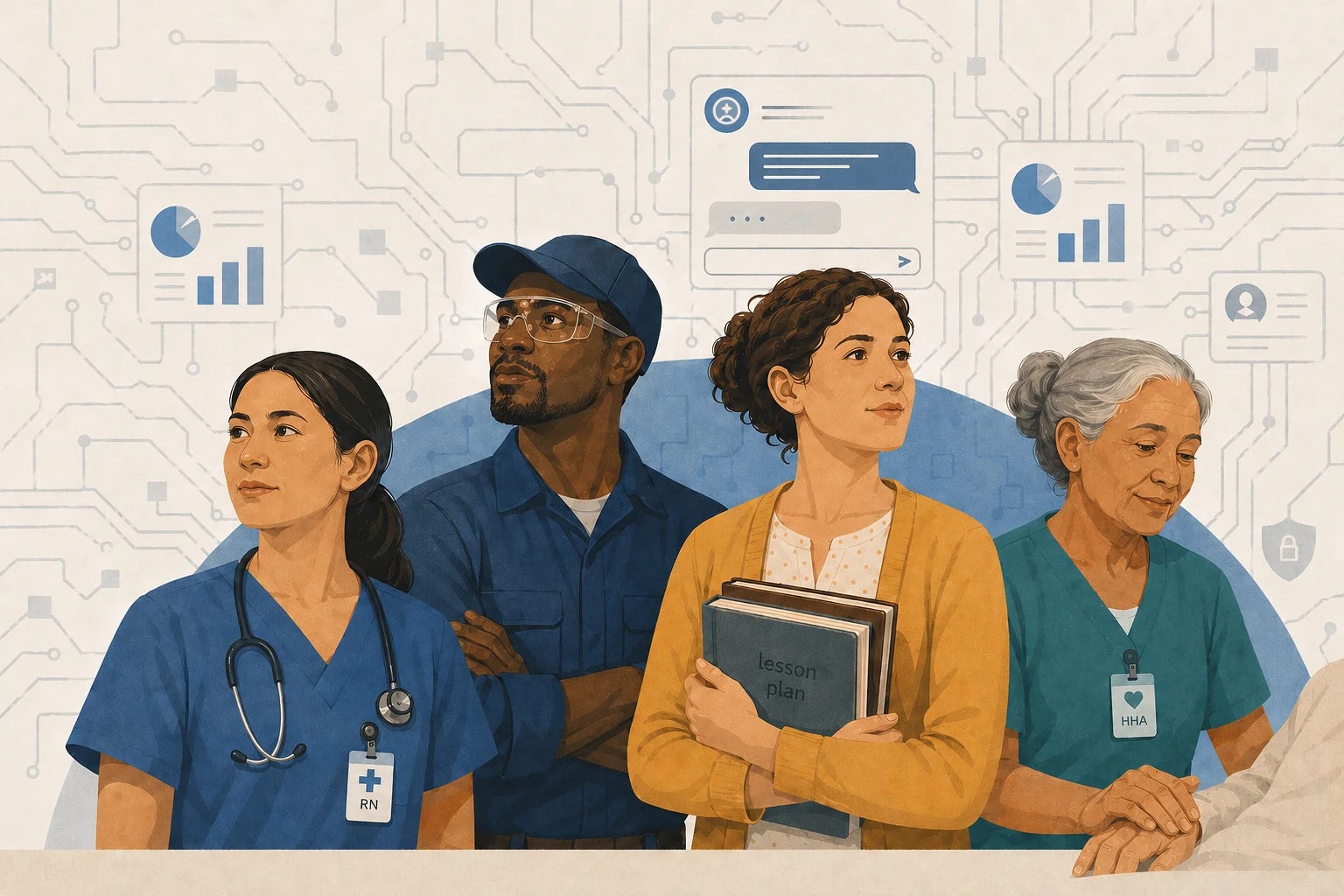
Over the past year, AI has risen in importance faster for voters than any other issue. There’s an opportunity for Democrats to lead on building a future that is inclusive and prepares our current workforce for what comes next. And Democrats have confronted technological transitions and economic disruption before:
FDR’s New Deal helped the country recover from the economic collapse of the Great Depression, which left millions of workers unemployed, by building the country’s safety nets.
JFK’s Manpower Development and Training Act created the first federal programs to retrain workers displaced by machinery.
LBJ’s Economic Opportunity Act built pathways into the workforce through job training and education after postwar prosperity failed to reach millions of Americans.
Clinton’s Workforce Investment Act created a nationwide system of job training and career centers to help workers respond to the changing demands of the new economy.
Obama’s Workforce Innovation and Opportunity Act opened new pathways as globalization and automation hollowed out manufacturing communities.
Biden’s CHIPS and Science Act invested directly in domestic technology manufacturing to keep American workers competitive in the AI era.
Each time, our party’s task was not to resist change but to ensure that the gains were widely shared. This moment is no different.
Here are seven concrete ways Democrats can lead and shape how it shows up in the economy and at work:
1. Incentivize investments in job-connected training
Most training decisions occur within firms rather than in government programs, which means the most effective lever is to shape what employers already do. Democrats should build on this reality by incentivizing employers to implement short, employer-linked programs such as apprenticeships, with clear hiring commitments, wage benchmarks, and transparent outcome reporting.
Lifelong learning accounts, funded by contributions from workers, employers, and government, can support continuous re-skilling as job demands evolve. Tax incentives should reward employers who invest in paid training time, redesign jobs to improve quality, and pass productivity gains on to workers. The goal should be to steer AI adoption toward better outcomes.
2. Expand access to AI education
Workforce programs too often prepare workers for abstract skills rather than specific labor market openings. Preparing workers for an AI-driven economy will require renewed investments in education and training.
At the K-12 level, there is growing momentum to treat AI literacy as a foundational skill alongside reading and math, with a growing focus on ensuring that schools in lower-income communities are not left behind. However, the Trump administration’s closure of the Department of Education’s Office of Educational Technology has weakened the federal government’s ability to support this work, limiting access to resources schools rely on.
Community colleges will also be central to this effort. They serve a large share of students, including adult learners and career changers, and are well-positioned to offer short-term, job-connected AI programs aligned with local demand.
3. Direct job growth toward high-human-value sectors
As Gene Sperling argues, the measure of a successful AI-driven economy is not based on productivity alone. It is also one that expands economic dignity, which he defines as the ability to earn a living, contribute to society, and find purpose in one’s work. This requires actively guiding the labor market toward roles that are both economically valuable and socially meaningful, especially in sectors defined by the relational, judgment-intensive, and fundamentally human work that AI cannot replicate, and where America’s labor shortages are most severe and consequential.
The U.S. currently faces a growing shortage of nurses and care workers as demand rises with an aging population, while a long-standing shortfall of home health aides is already straining access to care. Childcare systems are also under pressure, with staffing declines and persistent shortages limiting supply and raising costs for families. At the same time, teacher shortages remain widespread, especially in high-need subjects and regions. These are not isolated issues but structural gaps in the care economy, and they will deepen without targeted workforce investment.
This presents a clear opportunity. AI-driven productivity gains can reduce administrative burdens, including paperwork, scheduling, and documentation, that drive burnout and attrition in care roles, freeing workers to focus on the human work that drew them to these fields in the first place. Paired with training pipelines, wage support, and workforce incentives, this approach creates a viable path for redirecting displaced workers toward roles that are not only in demand but meaningful – exactly the kind of economy Sperling’s vision of economic dignity demands.
4. Create an ARPA-AI Jobs Initiative
Democrats can take a more active role in shaping how AI is used by launching an ARPA-style initiative focused on job-enhancing innovation. ARPA, or Advanced Research Projects Agency, refers to a model the federal government has used for decades to fund high-impact, experimental projects with clear goals and strong accountability. The most well-known example is DARPA, the Defense Advanced Research Projects Agency, which helped drive breakthroughs like the internet and GPS by funding ambitious, outcome-oriented projects and rewarding what works.
Democrats can apply the same logic to AI and work. An ARPA-style initiative could fund real-world deployments that show how AI can improve jobs, not just replace them. This includes targeted tax credits for companies that raise both productivity and job quality, competitive grants for local governments that develop replicable workforce models, and demonstration projects in sectors such as care, manufacturing, logistics, and education. Public procurement can reinforce this by awarding contracts to vendors that deliver measurable gains for workers.
5. Put targeted guardrails on algorithmic management
AI is reshaping how workers are hired, evaluated, and managed, often leaving them with little recourse or transparency. Democrats do not need sweeping regulation to address this. But the party must be careful not to over-index on regulation without a parallel job strategy. Proposals that focus primarily on restricting AI deployment, increasing compliance burdens, or slowing rollout miss the bigger picture. Without a clear agenda to improve jobs, regulation alone does not deliver better outcomes for workers.
What is needed instead are targeted protections that safeguard workers while preserving room for innovation. Workers will want mechanisms in place to understand how automated decisions will impact them and what their options are should their role be affected. Policy can also set transparency and safety standards for productivity quotas and workplace monitoring systems, especially when these systems risk pushing workers toward unsafe or unreasonable conditions.
6. Make economic security portable
When benefits and credentials are tied to a single employer, workers bear the full cost of labor market volatility – and so does their willingness to take the kinds of risks that a dynamic economy requires. Democrats can make it easier for workers to navigate a faster-changing labor market by ensuring that economic security follows the worker, not the job.
Portable benefits enable health care, retirement savings, and training support to follow workers across employers and work arrangements. Expanding work-sharing programs can help employers reduce hours rather than cut headcount during periods of adjustment, keeping workers connected to their jobs.
Licensing reciprocity and streamlined credentialing also help reduce barriers to mobility across states. A more portable system makes change more manageable and the broader economy more adaptable.
7. Measure what is actually happening
Good AI labor policy depends on good data. For too long, policymakers have been guessing about how technology affects jobs. Democrats should establish a federal-state collaboration to develop a quarterly “AI at Work” dashboard that tracks shifts in tasks, wage trends, hiring patterns, and job displacement in real time.
Improved measurement would enable earlier identification of emerging disruptions and more precise responses, serving as an early warning signal rather than a lagging indicator. Without better measurement, policy will continue to chase headlines instead of evidence.
Democrats have a real opportunity to shape what the next era of work looks like.
These ideas are a starting point.
Done right, AI can be a force multiplier for the important work humans undertake. Taking over routine and administrative tasks frees workers to do more of what only humans do well. This is how human-centered AI adoption can drive better jobs, higher wages, broader opportunities, and a stronger sense of economic dignity.
But this story is still being written. As we learn more about how AI transforms jobs, tasks, and industries, the policies we adopt today must also adapt.
This is not a choice between embracing technology and protecting workers. It is a chance to do both and prove, once again, that the party that built the middle class can advance and reshape the next one.
Hope Ledford is the Director of Civic Innovation Policy at Chamber of Progress, leading work on autonomous vehicles, the gig and sharing economies, workforce issues, delivery, public safety and parking technology, and telemedicine.
 | A guest post by
|