
The Seeds Of Biden’s War On Tech Were Planted in 2016’s Loss

In the next few posts, I’ll explore why President Biden – who served as vice president to perhaps the most tech-optimistic president in U.S. history, and surrounded himself with moderate senior advisors with deep ties to the innovation economy – ultimately governed in ways that alienated large segments of the tech industry.
To start, understanding this evolution requires returning to the political shock of 2016.
Donald Trump’s unexpected victory over Hillary Clinton shattered widespread Democratic assumptions and sent the party into a prolonged period of reflection. In the immediate aftermath, Democrats scrambled for explanations, ranging from Russian interference and FBI actions to the role of social media and disinformation. But beneath those surface narratives, a deeper ideological shift was beginning to take root.
In this post, I’ll look at how Democratic voices critical of Obama-era economic orthodoxy seized on the post-2016 upheaval to advance a new economic narrative, challenging the party’s longstanding alignment with Silicon Valley.
An Unexpected Upset
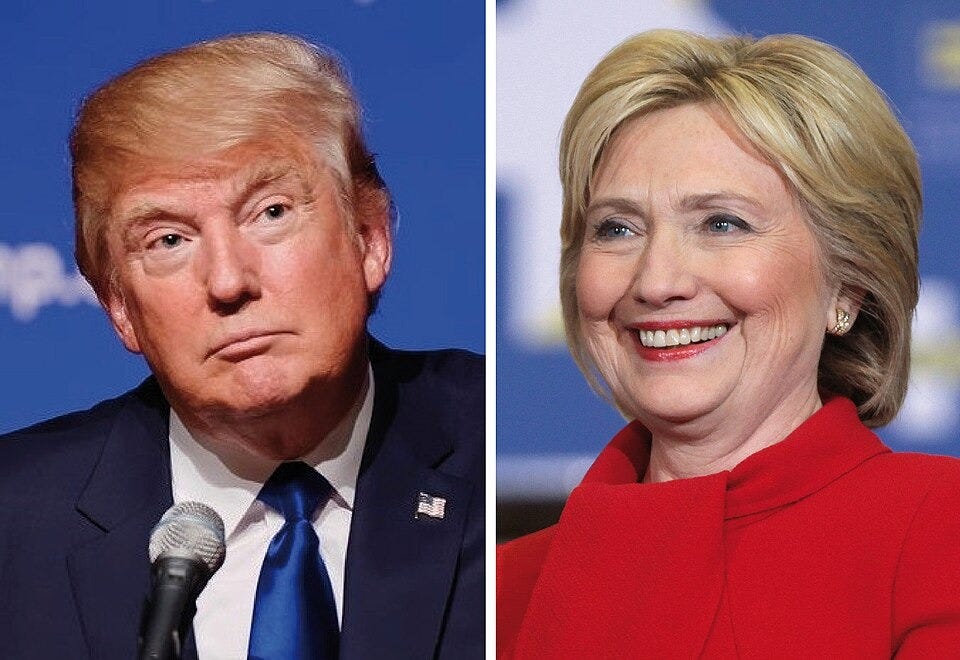
Going into Election Day, virtually all major polls and forecasts showed Hillary Clinton as the clear favorite to become the 45th president. I was serving as an appointee in the Obama Administration at the Pentagon, and I certainly was also among those who believed Clinton was likely to win. I lobbied to be selected as one of the eight-person transition team members who would work with the various offices in the building to put together the transition books, set up meetings for the transition landing team from the winning campaign, and help brief the incoming officials as they arrived. I was lucky enough to be selected to serve on that team.
Instead, our small transition team were all shocked by the result. It turns out we had days of waiting and gallows humor before anyone from the Trump transition team arrived.
Post-Election “Diner” Interviews
Beyond internal analysis and blame-casting, the shock of Trump’s win also prompted a cultural response in political journalism – one that, in retrospect, became something of a cliché.
Determined to understand the mindset of Trump’s supporters in “Middle America,” many reporters from coastal outlets fanned out to rural diners and Rust Belt towns to interview the people who had thrown such a curveball at the political establishment. Reporters would visit small-town diners in Pennsylvania, Ohio, Michigan, and elsewhere, chatting with mostly white, working-class patrons about why they voted for Trump and how they viewed his presidency. These dispatches were meant to provide on-the-ground insight into the voters supposedly “forgotten” or “left behind” in the Obama years.
For Democrats, absorbing these lessons was part of coming to terms with 2016: they had lost touch with a segment of voters. Factions within the Democratic party seized on this concept. The election was not a fluke, but rather an opportunity to rethink the Obama-era and push for an ideological shift in the party.
“Beyond Neoliberalism”
Trump’s victory, fueled in part by discontent among working-class voters, underlined that many Americans were unhappy with the economic status quo. In Democratic circles, the anti-corporate voices in the party used this moment of soul searching to question the party’s economic philosophy – specifically, arguing that the center-left had for too long been wedded to neoliberalism, a market-driven, globalization-embracing framework that had dominated policy since the Clinton and Obama years.
Obama had governed largely in alignment with the tech industry, to the point that some dubbed him America’s first truly digital or ‘tech’ president. A 2016 New York Times Magazine article called Obama, “the first American president to see technology as an engine to improve lives and accelerate society more quickly than any government body could.” He had actively embraced Silicon Valley and its culture: his 2008 campaign was social-media-driven, and once in office he created new government posts like Chief Technology Officer, Chief Data Scientist, and Chief Performance Officer to infuse technological innovation into the federal government.
Obama’s administration maintained a strong relationship with several tech executives, and the White House under Obama was closely aligned with Silicon Valley’s policy priorities, from net neutrality to tech-friendly immigration reforms. Many in Obama’s circle later migrated to jobs at Google, Facebook, Uber and other tech firms.
In short, the Democratic establishment in 2016 was confident in its modern, data-driven approach and its broad coalition. The idea that Trump, a candidate running an openly populist, anti-establishment campaign, could defeat that well-oiled Democratic machine seemed far-fetched. This confidence was buttressed by the reassuring polls and by the sense that America’s changing demographics favored Democrats. Trump’s victory shattered that confidence and would open the door for tech skeptics to capture the direction of the party.
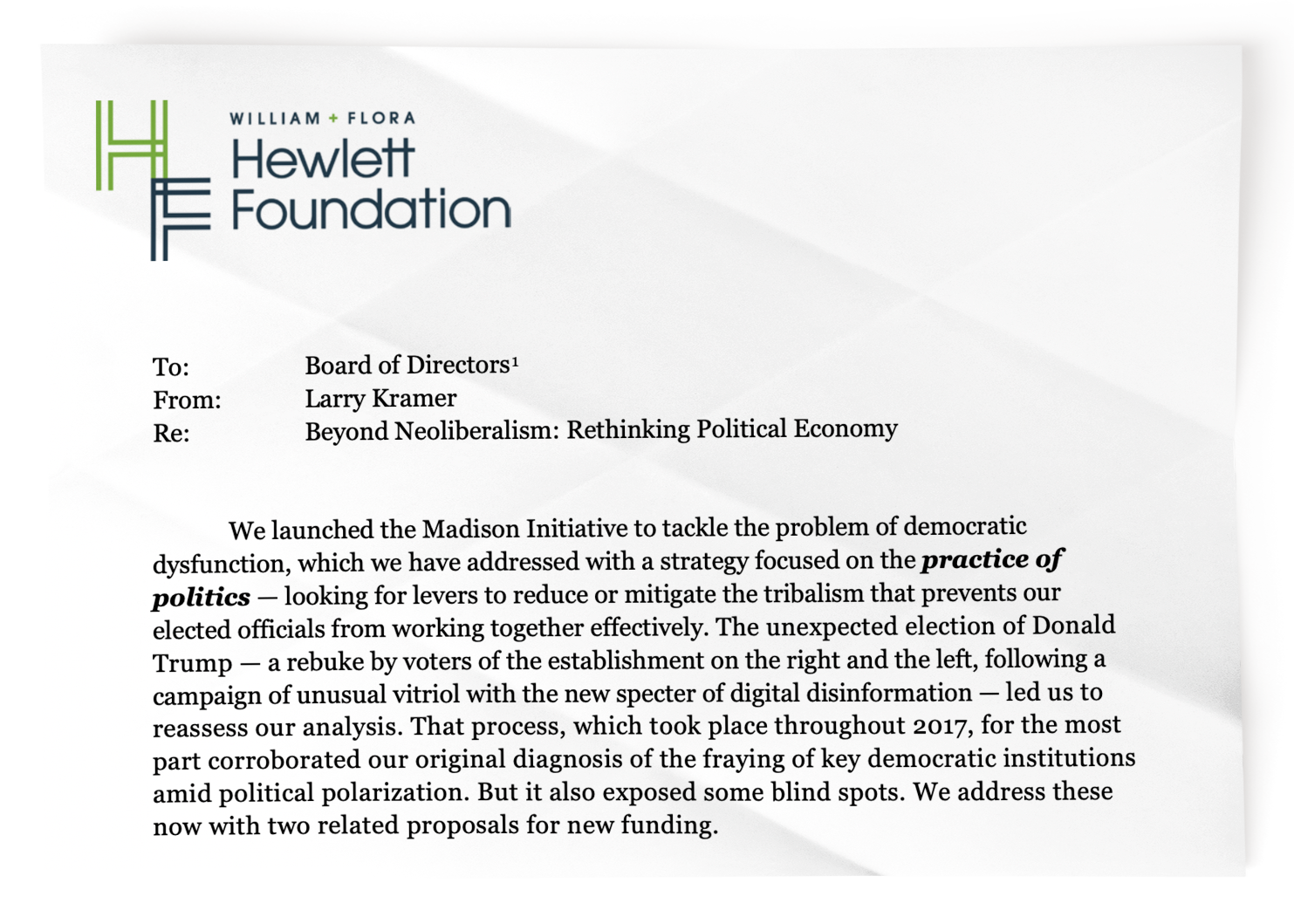
The William and Flora Hewlett Foundation, a major philanthropic funder of policy research often aligned with liberal thought leadership, circulated an influential internal memo titled “Beyond Neoliberalism: Rethinking Political Economy.”
Hewlett’s president Larry Kramer argued that the prevailing “neoliberal” paradigm was no longer up to the task of solving modern problems like rising inequality, wage stagnation, and the upheavals caused by globalization and technology. The memo states that while free-market policies had enjoyed broad acceptance for decades, this orthodoxy had failed to provide satisfactory answers for issues of economic insecurity and had even become a source of partisan conflict. The Hewlett Foundation created the “Economy and Society Program” led by Jennifer Harris (who would be called the “Queen Bee of Bidenomics” in this New York Times profile), providing grants to people and organizations specifically designed to replace neoliberalism, which (in their telling) had dominated U.S. politics for the past 50 years.
The influence of such efforts soon became visible in Democratic rhetoric. By the time of the next presidential primary (2019–2020), several Democratic candidates – not just left-wing figures like Bernie Sanders, but even moderates – were advocating policies focused on tougher regulation on corporations, skepticism of tech companies, bold government intervention in healthcare, etc..
Themes of combating inequality and reigning in unchecked capitalism moved to the forefront of the party’s platform. In essence, the shock of Trump’s win gave momentum to an ideological shift within the Democratic mainstream, one that embraced more critical views of capitalism, market forces, and the role of technology. The “Beyond Neoliberalism” memo in 2018 crystallized this shift, signaling that influential allies were looking for champions of a new economic paradigm.
The crusade against “neoliberalism” turned out to be largely a discussion among Washington elites rather than a response to a groundswell of voter angst. Voters, especially those on the Democratic side of the aisle, never clamored for an end to Obama-era policies. Obama remains the most popular person in the Democratic party and few Americans could even tell you what “neoliberalism” means.
Nevertheless, the Hewlett Foundation emerged as a pivotal benefactor bankrolling the “post-neoliberal” project, pouring millions into left-leaning think tanks to catalyze a new paradigm. Hewlett’s grants encouraged any group willing to break from Obama’s tech-friendly, market-oriented approach – from the Roosevelt Institute’s paradigm-mapping initiative to anti-monopoly outfits like Open Markets that urged tougher stances on Silicon Valley.
Over time, this post-neoliberal campaign took on a distinctly anti-tech flavor, driven in no small part by Democrats’ desire to blame someone for the 2016 upset. Party leaders latched onto Facebook and Cambridge Analytica as convenient villains, and an effective coping mechanism, for Trump’s win. The Democratic reaction to social media and Facebook is a topic I will explore in my next post.