
A Better Democratic Answer on Data Centers: Solve, Don’t Stall
Wisconsin Offers Democrats a Data Center Lesson


Wisconsin’s Democratic gubernatorial primary should not be reduced to a referendum on data centers. But data centers were one of the clearest distinctions between finalists David Crowley and Francesca Hong, as Crowley himself pointed to:

Hong proposed a one-year construction moratorium, while Crowley rejected a moratorium in favor of a set of clear rules for data center construction to benefit the community. In a race this close, it is impossible to isolate one cause of victory, but his upset challenges the assumption that the loudest anti-development position is necessarily the winning one.
Crowley offered something more useful than a pause: an actual solution. His “solve, not stall” approach to data centers argued that developers should pay for their own infrastructure and grid upgrades, bring new clean power online, and prevent costs from being shifted to Wisconsin taxpayers while at the same time protecting air, water and jobs. His approach mirrors the Data Center Development Playbook my colleague Tahra Hoops published here last week, which recommends establishing responsible rules of the road for the AI buildout.
Crowley’s general election opponent, Tom Tiffany, has tried to use Crowley’s data center position against him. But making a Democrat look more business-friendly and supportive of innovation is likely to backfire, especially at a time when the Trump Administration is pushing for data centers with no community benefits or protections.

A Morning Consult poll from July found that 57% preferred enforceable guardrails to a moratorium, which was preferred by only 23% of voters.
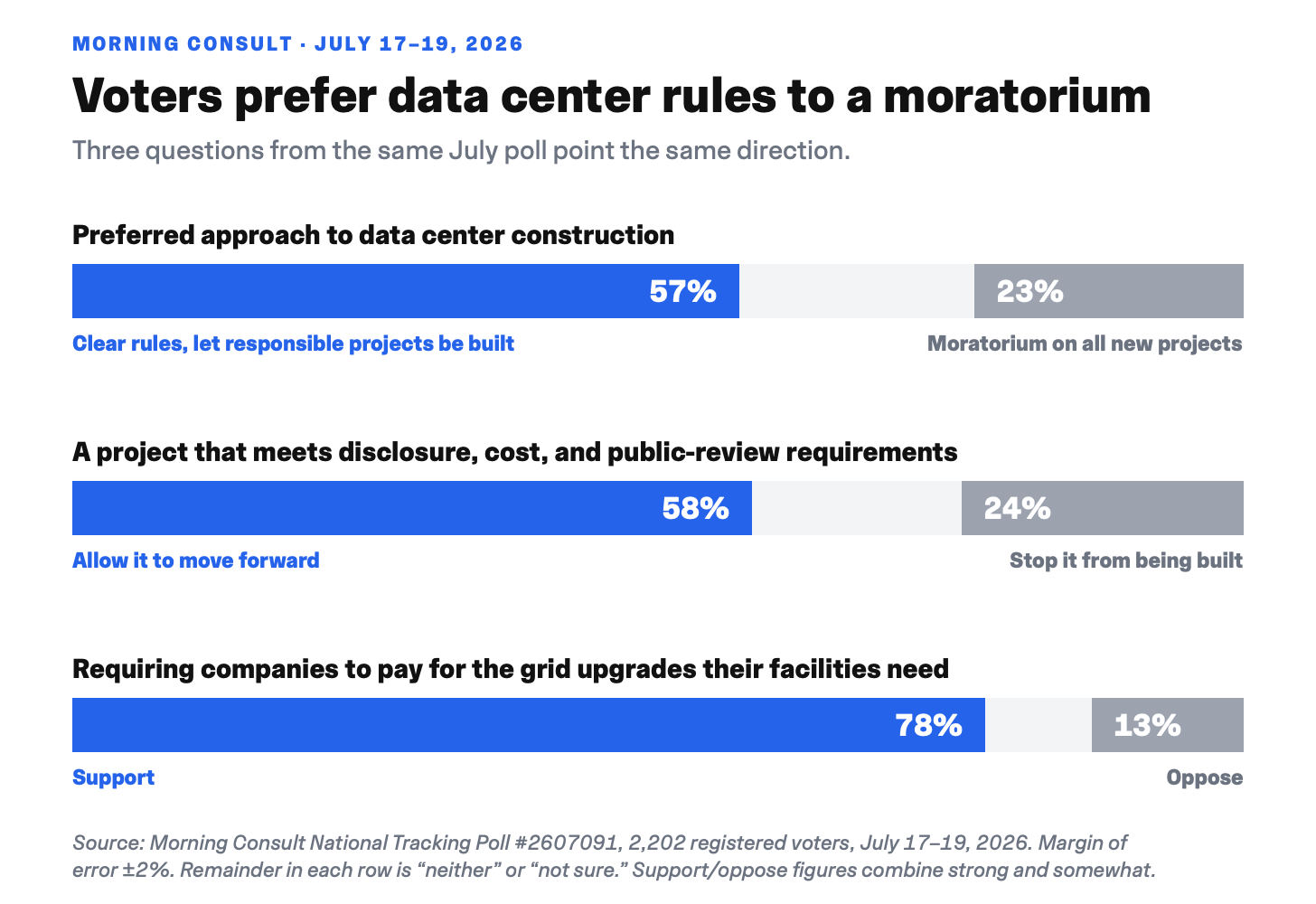
When voters were shown a project with disclosure, infrastructure-payment and public-review requirements, they supported it 58 percent to 24 percent; 78 percent said companies should pay the cost of required upgrades.
Unlike a moratorium, a “solve, not stall” position provides voters with solutions. A moratorium can buy time, but it does not answer the questions residents care about: Who pays for the substation? Will household utility bills rise? How much water will be used? What does the community receive? What happens if the developer breaks its promises? A playbook-based policy can establish transparent answers to those questions before any project gets approved.
Communities Can Choose Benefits of Data Centers
This approach recognizes that many communities will see benefits in welcoming data center development. CNN recently highlighted Quincy, Washington, where roughly 30 data centers generate an estimated 57 percent of city property taxes. That revenue has helped pay for a $120 million high school, a hospital, library, police and fire stations, sidewalks and a $15 million aquatic center. The crucial detail is that Quincy did not purchase that prosperity with tax abatements: the facilities showed up, paid ordinary taxes and expanded the local tax base.
The San Francisco Chronicle found a similarly dramatic story in Ellendale, North Dakota. Before the data center, the town collected about $400,000 in sales taxes over an entire year; in just the first seven months of 2026, it collected $3.5 million. Ellendale can now repave streets, renovate its senior center, build a public-safety complex, add trails and restore its opera house. The project uses closed-loop water, and utility revenue sharing is expected to reduce the average household’s electric bill by $250.
My colleague Kaitlyn Harger’s analysis of Northern Virginia data found that data centers paid an estimated $1.3 billion in direct local property taxes in 2024 and supported more than $2 billion in total local revenue. It estimates that, without that tax base, the bill on an $800,000 Loudoun County home would be about $5,856 higher each year. As a result, Loudon residents are getting better services at lower costs, compared to their neighbors.
Democratic Governors Shifting from Subsidies towards Responsible Development
As data centers and more general concerns about AI have become a political flashpoint, the subsidy-and-recruitment era of data centers embraced by several Democratic governors is giving way to development with conditions to ensure benefits and protections for the communities. Josh Shapiro went from celebrating a $20 billion Amazon recruitment win to conditioning state support on Governor’s Responsible Infrastructure Development (GRID) standards requiring developers to pay fully for new power capacity, grid connections and community benefits.
Gov. Katie Hobbs, who voted for Arizona’s data-center tax exemption in 2013, signed a three-year pause on those incentives while pointing toward bring-your-own-capacity and ratepayer protections. JB Pritzker has paused new agreements under Illinois’ incentive program and proposed a dedicated rate class, company-paid grid and water costs, clean-energy requirements, water disclosures and community protections. But importantly, they are all arriving at these positions without banning the development and implementation of new projects in their states.
Gov. Kathy Hochul’s one-year New York moratorium can follow the same path. Her order explicitly says the pause will end once statewide standards are finalized, and it directs agencies to develop a community-investment framework, make developers fund grid needs and new clean generation, and pursue repeal of sales-tax exemptions. Our playbook is a ready guide for turning that pause into a good-faith path to “yes.”
Some activists will treat any moratorium as the first step toward a de facto ban, but the Wisconsin result should serve as a warning: even in a Democratic primary where data centers were a marquee issue, a moratorium did not produce a winning coalition. The durable Democratic position is neither blank-check development nor indefinite delay. It is a credible path to yes: build on clear, enforceable terms.