
The Consequences of Democrats Blaming Clinton’s Loss on Facebook
We gained an easy foe but fell behind on tech

Hillary Clinton 2016 was so unexpected and difficult to process that many Democrats initially looked to external culprits. Clinton herself argued she had been “on the way to winning” until FBI Director James Comey’s October 28 letter and the Russian-fueled WikiLeaks email dumps swung late-deciding voters.
Another villain Democrats identified was Facebook. The 2016 election was the first in which Facebook served as a major election news source for millions, and Democrats came to believe it had facilitated a flood of misinformation benefiting Donald Trump.
President Obama, days after the vote, warned that the glut of “active misinformation” on social media was undermining public discourse. “If we can’t discriminate between serious arguments and propaganda,” Obama cautioned, “then we have problems”.
To Democrats, Facebook’s failure to stem this “fake news” wave amounted to aiding and abetting Trump’s rise. By 2017, congressional investigators were digging into Silicon Valley’s role in the election, and Facebook itself admitted that Russian troll farms had exploited its platform to inflame voters. In testimony to Congress, Facebook revealed that Russia’s Internet Research Agency reached as many as 126 million Americans with covert posts and ads during the 2016 campaign.
For years, Democrats had seen tech and social media as allies – recall that Barack Obama’s campaigns famously harnessed Facebook and data analytics, earning him praise as the first “social media president.” In 2008 and 2012, Silicon Valley was viewed as a partner and innovation as a core Democratic value. But after 2016, that optimism cracked.
But Democrats’ quest for an easy explanation for Clinton’s loss led too many of them to pin the blame on Facebook particularly. The party that once touted its digital savvy now viewed the tech world with suspicion, even hostility. In the eyes of many Democrats, Facebook had turned from hero to villain – from a tool that helped elect Obama to a tool that helped defeat Clinton.
And this hasty blame ended up significant consequences for Democrats’ approach to tech generally - consequences that still occupy many Democrats’ minds today.
Facebook’s Denial and Fallout
From Facebook’s perspective, the whiplash in Democratic attitudes was jarring. In the immediate aftermath of the election, CEO Mark Zuckerberg publicly dismissed the idea that fake news on Facebook had influenced voters, calling it a “pretty crazy idea”.
But as more revelations emerged, that “crazy idea” took hold as the primary reason Democrats felt like Clinton lost. U.S. intelligence and journalists uncovered extensive Russian meddling on social platforms. Facebook eventually acknowledged that foreign operatives had manipulated its network and the company was soon engulfed in scandal – from the troll farm exposés to the Cambridge Analytica data breach that showed how loosely Facebook guarded user data.
By 2018, Zuckerberg was being hauled before Congress for marathon hearings and forced to apologize for the company’s failings. Yet for all these mea culpas and policy changes, the damage was done. The episode cemented Facebook’s image among Democrats as a platform that had contributed to Democrats’ loss.

From Victors to Victims: Democrats’ Techlash Mindset
The 2016 aftermath set in motion a dramatic shift in how Democrats thought about technology.
Rather than seeing tech platforms as tools that Democrats could harness to advance their goals, a victim mentality took hold: A sense that Democrats had been wronged by Big Tech, and that the strong relationship that Bill Clinton and Barack Obama had built with Silicon Valley was a mistake.
This psychological shift is what we might call the Techlash Trap. Caught in this trap, Democrats became fixated on blaming technology platforms for their political woes, to the point of neglecting strategic shortcomings.
Tech entrepreneur Packy McCormick observed that when Trump won in 2016, “tech became one of the Democrats’ primary scapegoats to blame for a victory they could find no other rational explanation for “without a healthy dose of self-reflection.”
Pointing a finger at Facebook was easier than grappling with tough questions about campaign strategy, messaging, or neglect of key swing voters.
This scapegoating mindset represented a stark reversal. Democrats were the party of tech optimism, applauding innovation and enjoying enthusiastic support from tech leaders.
But after 2016, the party’s rising anti-corporate fervor in the Trump era folded Big Tech into the same villainous category as Big Oil or Big Pharma.
Tech became an easy target for populist outrage, blamed not just for misinformation, but for monopolistic behavior, privacy abuses, and even societal ills like inequality. As the list of the top ten richest people in the world came to be dominated by the tech industry, and with Democrats at least partially blaming Hillary Clinton’s loss on Facebook, Democratic strategists and staffers were willing to listen.
Democratic rhetoric toward Silicon Valley shifted from collegial to combative, and the Techlash Trap became the crutch that blinded some strategists to the party’s own weaknesses and to the political landscape as it really was.
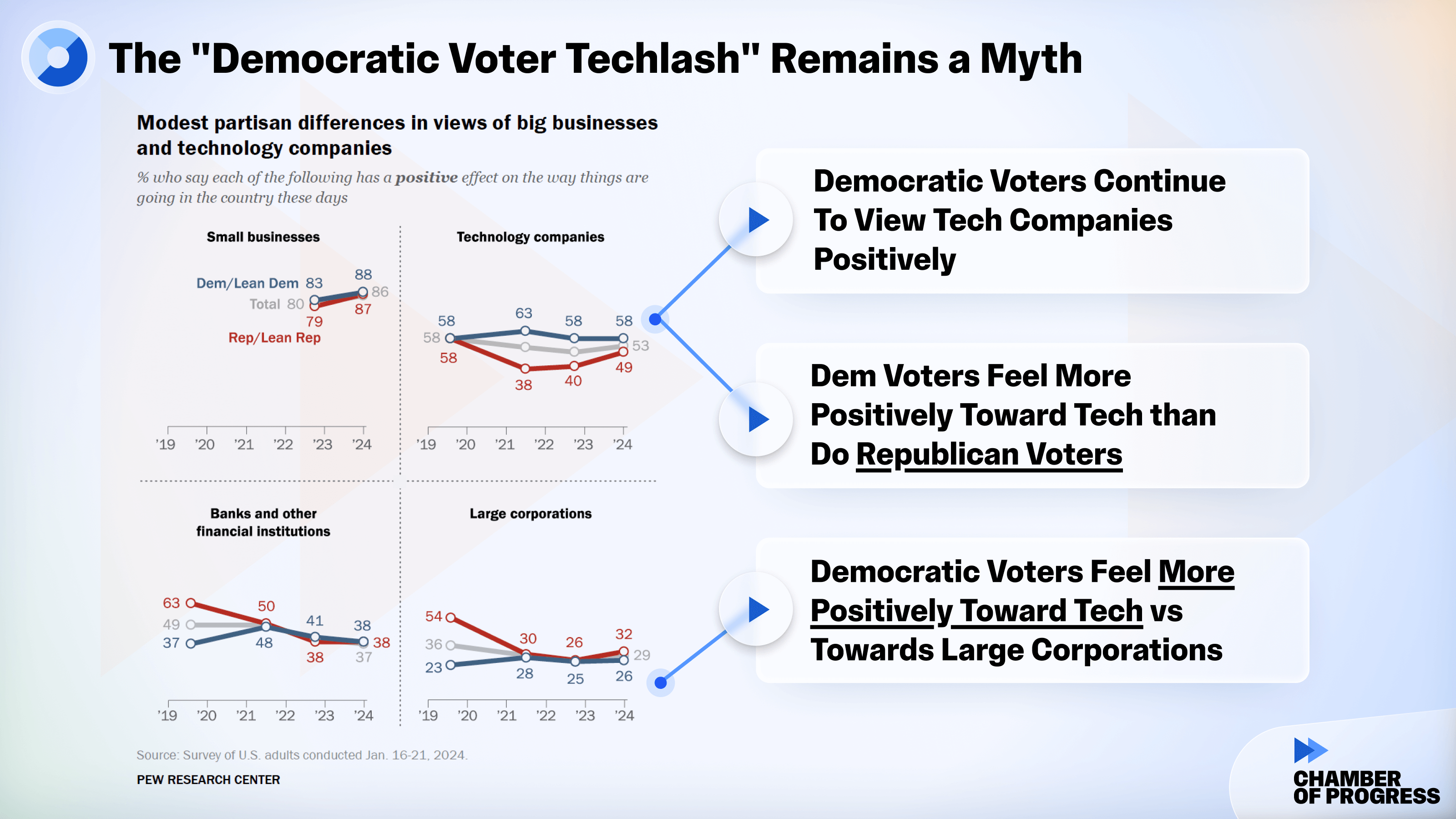
An irony of the Techlash Trap is that Democratic voters themselves were - and still are - still largely pro-tech, even as their leaders grew more hostile.
Public polls consistently showed that rank-and-file Democrats hold favorable views of tech companies. In other words, the Democratic base hadn’t turned on Silicon Valley to the extent that Democratic elites, so the hostile relationship between party and tech elites serves to alienate Democratic-leaning persuadable voters.
Fighting the Tools Instead of Using Them
One major consequence of the Techlash Trap was that Democrats, in practice, stopped playing to their strengths in digital campaigning. Rather than continuing to innovate with the new tools of social media, data, and tech-powered organizing, many in the party turned their focus to fighting those tools.
The results have been self-defeating. By treating platforms like enemies, Democrats essentially ceded certain online battlegrounds to the GOP. While Democratic strategists were publicly lambasting Facebook, Republican candidates doubled down on using it to energize their base.
In recent election cycles, Republicans have often dominated engagement on Facebook and related platforms. Studies in the 2020–2024 period found GOP candidates dramatically outperforming Democrats on social media metrics. For example, an analysis of 2024 U.S. House races showed Republican contenders getting over four times more likes per Facebook post than Democrats, and nearly seven times more shares per post.
That’s an astonishing gap. It suggests that, at least in part, Democrats’ message is failing to penetrate in the arenas where much of the modern political conversation is happening.
You can’t win hearts and minds on platforms you’ve only half-heartedly embraced. This disparity isn’t solely because Democrats “gave up” on social media. Democratic campaigns still use social media, but the intensity and innovation have lagged. The party that pioneered online fundraising and mastered Facebook by 2012 began, after Trump’s victory, to look hesitant and reactive in the digital sphere.
Some Democrats grew wary of aggressive social media outreach altogether, treating Facebook as a tainted space. Meanwhile, conservative media outlets and GOP digital operatives rushed to fill the void, amassing huge followings and perfecting the art of viral content. By the early 2020s, the top-performing political pages on Facebook were overwhelmingly right-leaning.
The Rush to “Do Something” and the Policy Misfires
Politically, the Democratic urge to “do something” about Big Tech after 2016 was understandable. Clinton’s loss was deeply unexpected and wounding, and Clinton herself blamed other factors for the loss rather than her own shortcomings.
By the 2020 presidential primaries, nearly all the Democratic contenders voiced some degree of support for reining in Silicon Valley’s power. Debates in late 2019 featured candidates trying to outdo each other in skepticism toward Big Tech – a remarkable shift for a party that once prided itself on close ties to the tech community.
Democrats expended enormous political capital villainizing Big Tech and proposing crackdowns, yet at the federal level almost none of those proposals became law. The “war on tech” produced plenty of headlines but few tangible victories.
Ultimately, the Democrats’ Techlash Trap has proven to be a cautionary tale.
By casting Big Tech as the all-purpose villain for 2016 and beyond, Democrats gained a convenient scapegoat but lost valuable time and advantages. The party’s alliance with the tech sector frayed, its once-formidable digital operation fell behind, and its legislative salvo against tech produced more gridlock than governance.
It is a trap that, going forward, we will need to escape if it hopes to both win elections and effectively shape effective tech governance.