
The Future Classroom Playbook for the Age of AI
The next installment of the Democratic AI Opportunity Agenda

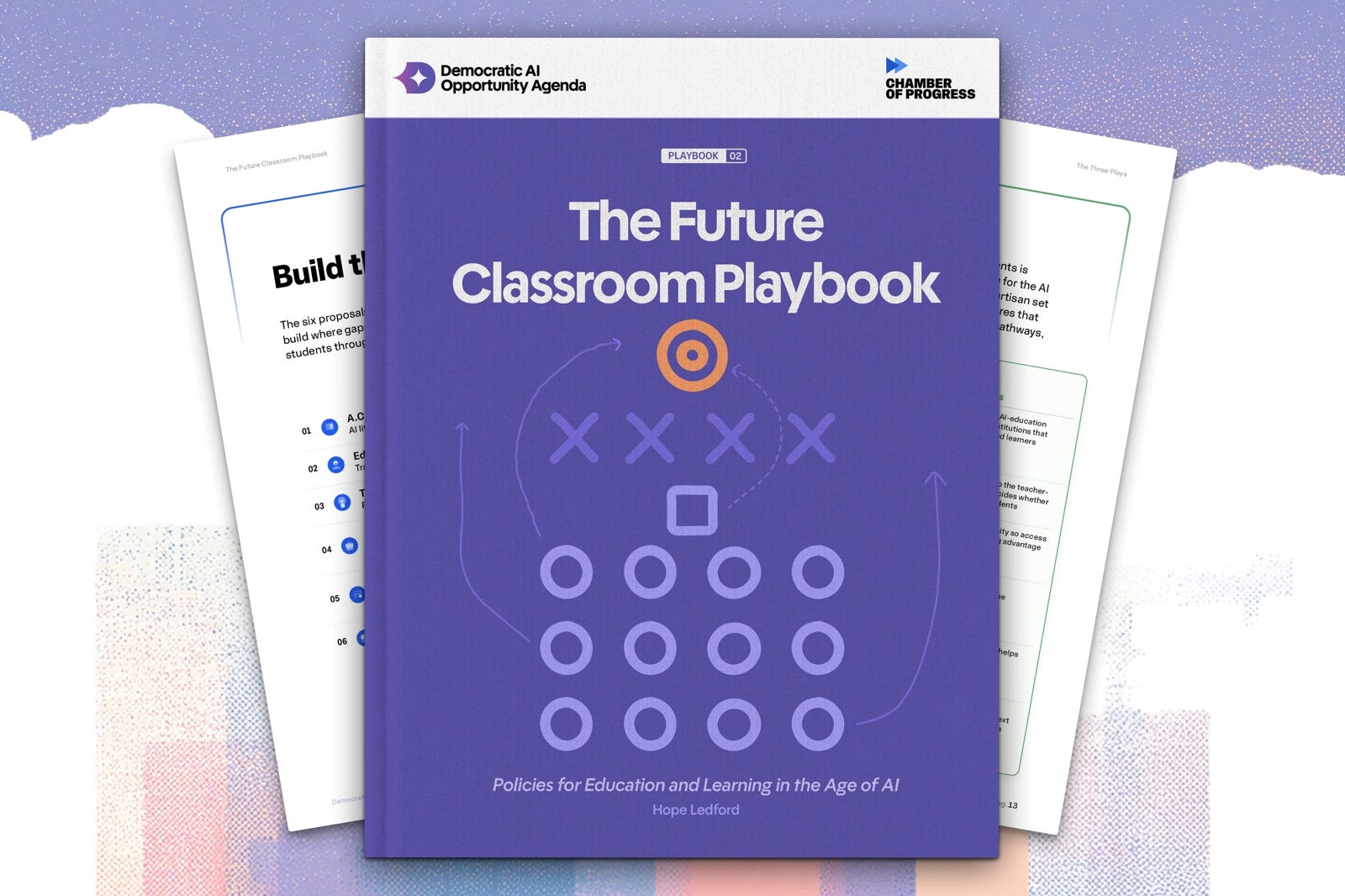
Today we are releasing The Future Classroom Playbook, the newest installment of the Democratic AI Opportunity Agenda, a series of policy proposals released every few weeks, to refocus the party on AI policies that create more economic, personal, and social opportunity.
The first installment, The Human Advantage Playbook, focused on preparing workers for the AI economy. The Future Classroom Playbook looks to the classrooms where the future workforce is taking shape.
The Future Classroom Playbook focuses on helping students build the human skills that remain valuable as AI improves critical thinking, problem-solving, judgment, oversight, and the capacity to keep learning, and on ensuring every student, regardless of background, has the chance to develop them.
A New Era for the Classroom
AI is already in the classroom, and it arrived faster than schools could respond. During the 2024–25 school year, 85% of teachers and 86% of students reported using AI in some capacity. The question is no longer whether students will use these tools; it is whether schools will teach them to use them well and responsibly.
That question lands on an education system already marked by inequality, which means the same tool can either narrow opportunity gaps or widen them, depending entirely on the policy around it. The risks, including unequal access to AI and digital infrastructure, uneven AI literacy, privacy and cybersecurity concerns, and the familiar challenges of hallucinations, bias, and overreliance, are manageable with policies that target the underlying problems rather than the technology itself.
We have been here before. When calculators were first introduced, many educators worried that they would undermine math education. Instead, they shifted the focus from rote calculation to problem-solving and reasoning. The same pattern has played out with new technologies time and again. The takeaway is to focus on the skills that will matter no matter how technology changes. AI can help students think more critically, tackle difficult problems, and strengthen their judgment. The Future Classroom Playbook lays out the policies that can help schools get there.
Build, Back, and Bypass
Every proposal below is designed to be adaptive and to respect local control over curriculum.
Build new policies lawmakers could create or support to close remaining gaps, following students from K-12 into the workforce. Some require Congress, while others are ready for states and agencies to launch now. The six proposals include:
The AI Confidence for Every Student (A. C. E. S.) Initiative to establish AI literacy as a core competency taught alongside reading, writing, and math.
The Educator Readiness Program to invest in teachers— funding professional development, peer mentorship, paid time to redesign lessons, etc., prioritizing underserved schools where training gaps are the widest.
The Technology for Human Inquiry and Nuanced Knowledge (T. H. I. N. K.) Framework to protect productive struggle and redesign assessment around authentic demonstrations of learning rather than answer-generation.
The Credentials, Reskilling, and Apprenticeships for Future Technology (C. R. A. F. T. Act) to build stackable, portable, employer-linked AI credentials through community and technical colleges.
The Professional Pathways Program (P3) to widen graduate and professional access to AI skills, prioritizing underserved learners.
The Student AI Rights Act to set a federal floor for student privacy, transparency, and human oversight while preserving state and local flexibility.
Back the bipartisan bills already moving through Congress that deserve broader Democratic support— on AI literacy, teacher training, apprenticeships, and college access. Among them are:
Rep. Andrea Salinas (D-OR-06) and Sen. Maria Cantwell (D-WA)’s NSF AI Education Act (H. R. 5351/S. 3957)
Rep. Gabe Amo (D-RI-01) and Sen. Adam Schiff (D-CA)’s LIFT AI Act (H. R. 5584/S. 4414),
Rep. Don Beyer (D-VA-08) and Sens. Martin Heinrich (D-MN), Cory Booker (D-NJ), and Chuck Schumer (D-NY)’s CREATE AI Act (H. R. 2385/S. 4441),
Reps. Lloyd Doggett (D-TX-37) and Danny Davis (D-IL-07) and Sens. Sheldon Whitehouse (D-RI) and Don Wyden (D-OR)’s Tax-Free Pell Grant Act (H. R. 2543/S. 1610), and
Rep. Angie Craig (D-MN-02) and Sens. Tina Smith (D-MN) and Amy Klobuchar (D-MN)’s Supporting Apprenticeship Colleges Act (H. R. 4588/S. 2028).
Bypass the responses that appear appealing at first but ultimately leave schools, teachers, and students worse off. Following the foundational principle of the first Playbook to focus regulation on the harm rather than the technology itself, this section highlights several counterproductive reactions:
Blanket bans that push AI out entirely and widen the gap in access to AI.
Unreliable detection software that often produces false positives and erroneously flags the writing of neurodiverse students and non-native English speakers.
Checkbox graduation mandates that mistake exposure to AI for true skill and subject competency.
Teacher-replacement schemes that treat teaching as a cost to cut rather than a relationship to support.
Vendor lock-in that grants private platforms disproportionate power over curriculum choices and student data privacy.
Broad chatbot bans that inadvertently block the everyday tools students use to learn instead of targeting the actual harms.
Preparing today’s learners for tomorrow’s workforce
Every generation faces its own educational challenge. For this one, the challenge is teaching students to think in a world where AI can generate almost anything. AI may make knowledge more accessible, but in doing so it raises the value of the distinctly human skills schools have always sought to build: critical thinking, judgment, and problem-solving. Those capabilities will outlast any particular model or breakthrough.
The best AI policy begins with better education policy. By investing in educators, making AI literacy universal, and protecting students, policymakers can ensure AI strengthens teaching and learning rather than replacing it. The future belongs to the students who can think alongside and beyond the tools they use, and every student should get that chance.
Read The Future Classroom Playbook in full here. New to the series? Start with The Human Advantage Playbook. And watch for the next installment in the coming weeks.
 | A guest post by
|