
The Nanny Party: Democrats Alienated Young Men on Tech


Jim Messina, the longtime Democratic strategist who ran Barack Obama’s 2012 presidential campaign, argued in a recent article that Democrats are developing a major relationship problem with young men as we try to regulate emerging technologies they like.
As they see Democrats try to enact bans and tech regulations, many young men increasingly experience the party as the “scolding” side of politics, functioning as the HR department of American life intent on seeking to critique, regulate, or restrict their lives. That perception is leading to resentment and has real political consequences.
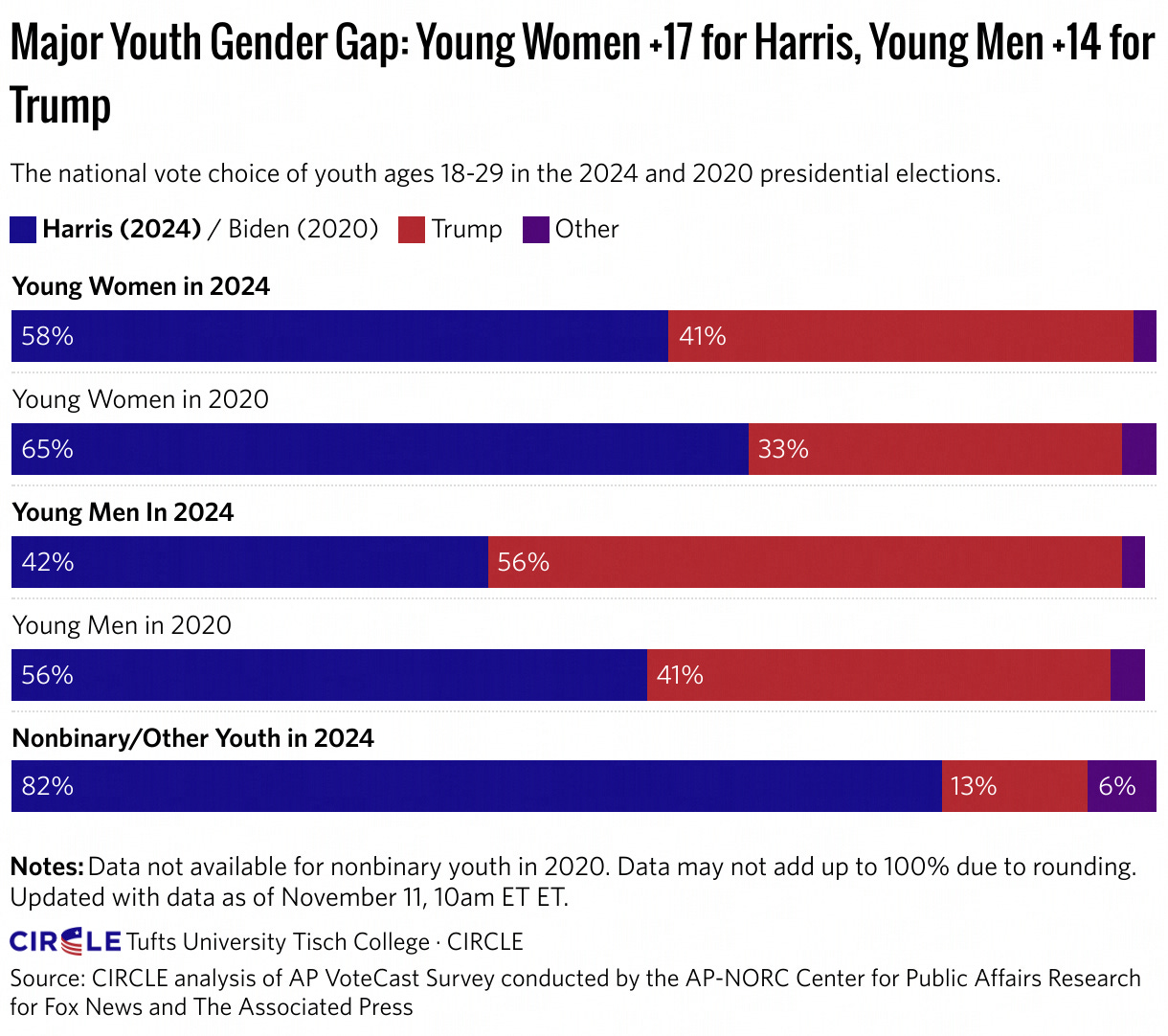
Between 2020 and 2024, Democratic support among men aged 18–29 fell sharply and the youth gender gap widened significantly, representing a shocking 31-point difference between young men and women. This is even greater than than the 18-point gap between voters of all ages, indicating that the issues behind the divergence are especially resonant with young men.
Comparing the overall vote count makes the shift between 2020 and 2024 look even worse since turnout was lower overall in 2024. Joe Biden received roughly seven million more votes for president than Kamala Harris did four years later. Given that young people are less likely to show up to vote, alienating a younger demographic has serious electoral consequences.
This shift could come to represent a structural change in the Democratic coalition and it coincides with a period when many of the most visible cultural and political fights centered on technology. The technology angle is crucial because young men disproportionately live in and build the digital economy.
The Gender Divide on Tech
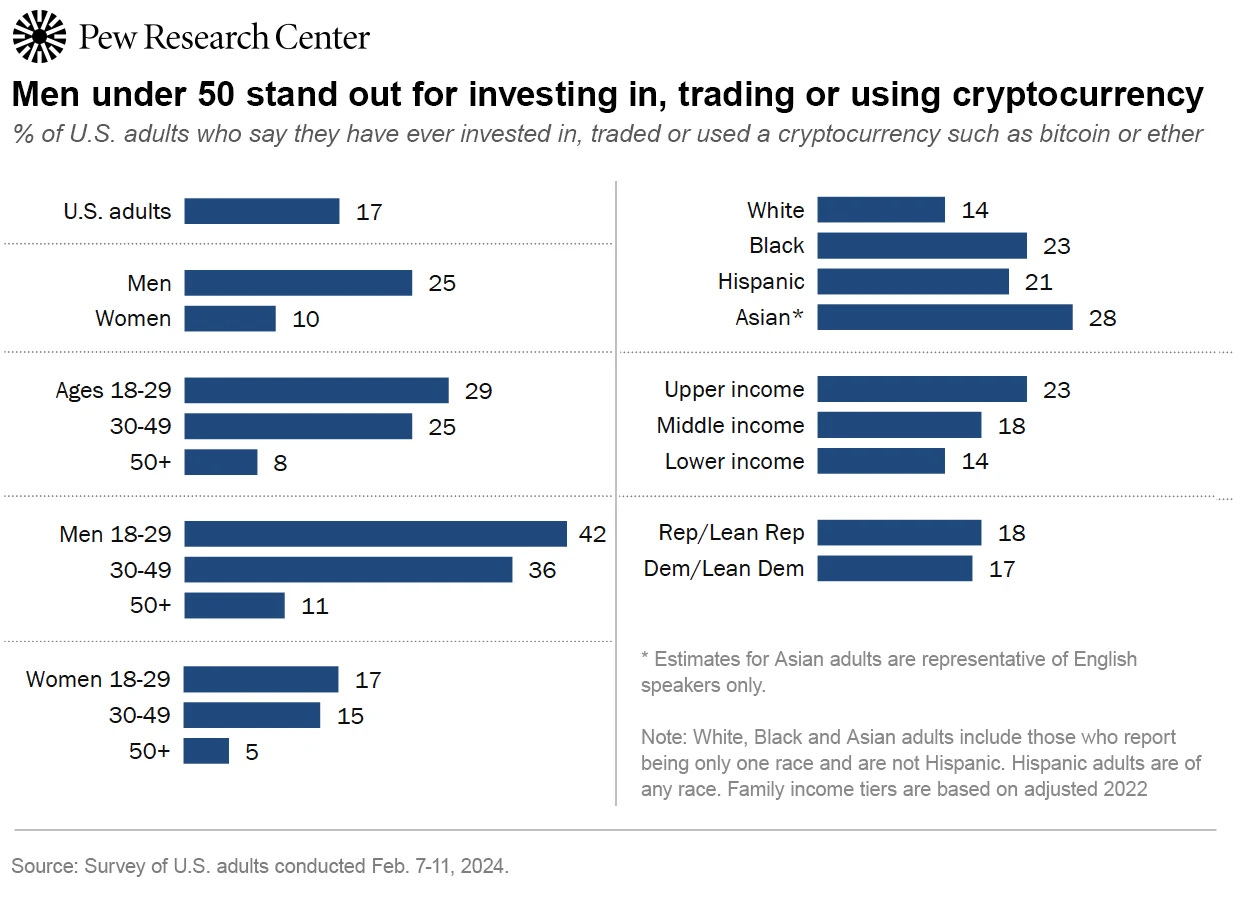
Cryptocurrency is the most stark example of the gender divide, with 42% of men aged 18–29 have used, traded, or invested in crypto, compared to just 17% of women the same age. While the gender divide is not nearly as stark, about half of young adults use TikTok daily, placing the social media platform near the center of their social and cultural lives.
So when politics turns to regulating or banning these technologies, it is personal to young men. Messina’s analysis on this is right. If one party is associated with using your favorite apps and the other with banning them, the emotional alignment is obvious even with a limited understanding of policy and regulatory particulars.
Biden Sought to Regulate Digital Life
The Biden Administration clearly became associated with regulatory posture hostile to technology. In 2024, President Biden signed legislation requiring TikTok’s Chinese parent company to divest or face a potential U.S. ban. While this was not strictly a ban, the action was widely framed in public debate as an attempt to “ban TikTok.”
At the same time, the administration pursued aggressive regulatory approaches toward cryptocurrency through agencies like the SEC, and issued a sweeping executive order on artificial intelligence focused on safety, oversight, and risk mitigation. Even before addressing the nuances of whether these policies are well-designed or useful, the protection and safety framing strongly reinforces the nanny party perception.
Polling shows that voters perceived that shift clearly. In 2024, 60% of Democrats said the government should do more to regulate tech companies, compared to just 45% of Republicans—a notable divergence from 2020, when the parties were roughly aligned.
More detailed polling shows the same pattern across specific technologies: Democrats are significantly more likely than Republicans to support increased regulation of AI (72% vs. 52%), social media (51% vs. 33%), and cryptocurrency (62% vs. 41%). Even beyond regulation, Democrats are more supportive of restricting online content and support government limits on false information online.
Taken together, this creates a coherent perception: Democrats are the party that wants to manage, moderate, and regulate digital life.
Tech Is Often Where Young Men Work
That perception that Democrats are anti-tech is especially damaging with young men because for many, technology helps shape their identity and is tied to their career aspirations. The tech industry remains heavily male-dominated. Men make up roughly 74% of workers in computer and mathematical occupations, and about 77% of computer science bachelor’s degrees go to men.
If Democrats are seen as hostile to tech and innovation in the name of safety and protection, it challenges young men’s livelihoods. The Democratic politics of scolding is then both cultural and economic push away from the party.
Innovation and Democratic Values Can Go Together
Importantly, none of this means Democrats should abandon their values or even regulation. Americans of all ages, genders, and political stripes have concerns about the future of technology and don’t want to see crypto scams. We certainly do not want politicians using shady crypto deals to line their own pockets.
However, there is a way to pursue tech sector regulation that is from a pro-innovation perspective. One that encourages and fosters the industries where young men spend their lives and generates national prosperity, but establishes clear rules of the road within the industries.
There is also evidence that pro-innovation framing could help Democratic politicians. Polling on crypto policy, for example, shows that voters respond more positively to candidates who emphasize fostering innovation alongside reasonable rules, rather than restrictive enforcement alone. Given the strong male skew in crypto participation, this kind of positioning could disproportionately resonate with young men.
Messina’s prescription follows naturally from this data: Democrats don’t need to become anti-regulation, but they do need to stop sounding anti-technology. The goal should be competence, not condemnation. Protect consumers without belittling them. Address harms without implying that participation itself is suspect.
I would argue that the opportunity is even greater. Third Way published “Young Men In 2025: Not Sold On Trump, Alienated By Democrats” based on extensive focus group research. The key takeaways are that men are looking for:
From the memo, young men are looking for:
Economic opportunity + ability to provide
Respect and recognition (not being talked down to)
Validation of masculinity and traditional roles
Cultural moderation and less judgment
Authentic, plainspoken leadership
Simple, concrete policy messaging
Substance over pandering
Notably, the 3,200-word memo does not include the words “innovation”, “technology”, or “crypto.” The focus is on cultural issues, but a Democrat adopting a pro-technology and innovation posture would help address nearly all of these issue areas and can be a key part of the playbook for winning back the votes of young men.