
Ignore the Revolving Door Project. Voters Want Business Leaders in the Administration

I view the Biden Administration staffing choices as an absolutely vital part of understanding the relationship between Democrats and the technology community. In my first post on staffing, I focused on the reasons why the Biden Administration closed the door to tech talent, and the costs of this unsuccessful attempt at intra-party coalition management.
In my next post, I took a close look at the implementation of the CHIPS Act, when the administration, especially at Commerce, overruled the outside critics and hired the people with the industry expertise needed to successfully implement a revolutionary industrial policy bill.
In this final post on the topic, I will show the results of polling we conducted at Chamber of Progress that captured voter attitudes about private sector experience in a presidential administration.
What We Found
First, the timing of the polling is important. The polls were conducted in late October of 2024, right before the presidential election. We fielded an online sample of 1,379 respondents over web panels from October 24 to October 26. The responses were weighted to education, age, gender, race, and 2020 election results to reflect a likely voter electorate. The margin of error is +/- 3.2%.
Groups like the Revolving Door Project specialize in urging Democrats to staff their Administrations solely from government, academia, and nonprofits – not the private sector. But it’s crucial to understand that voters, especially the swing voters Democrats need, see business experience as an asset, not a liability, in keeping the economy strong.
Americans Value Private-Sector Experience in Government
First, we asked voters whether executive branch appointees should have business experience or not. The results weren’t even close. Across party lines, voters nationally said yes. This is a +40 issue among Democratic voters, and even stronger among Independents. In other words, the electorate overwhelmingly sees value in having private-sector talent at the policymaking table.
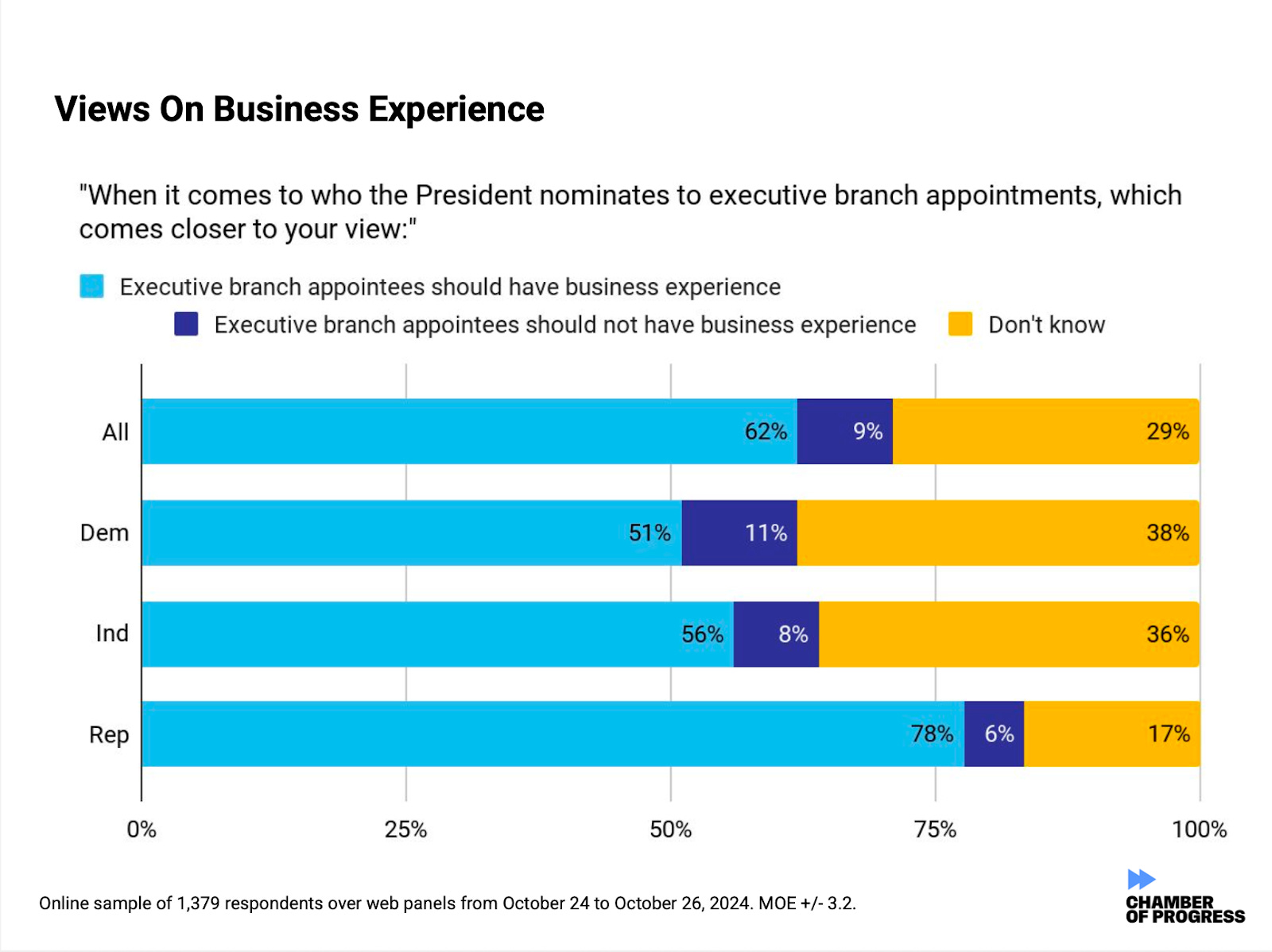
Crucially, this isn’t just Republicans skewing the numbers. While GOP voters were most enthusiastic (78% in favor), there is a prevailing belief across party lines that business experience in government helps keep the economy strong, which is reflected in voters’ priorities.
When forced to choose, more voters think Democrats like Joe Biden and Kamala Harris don’t consult with business leaders enough, rather than too much. For example, only 9% said Harris works with businesses “too much,” whereas 31% said she does it “too little”. The public clearly isn’t clamoring for less engagement with industry – if anything, they want more.
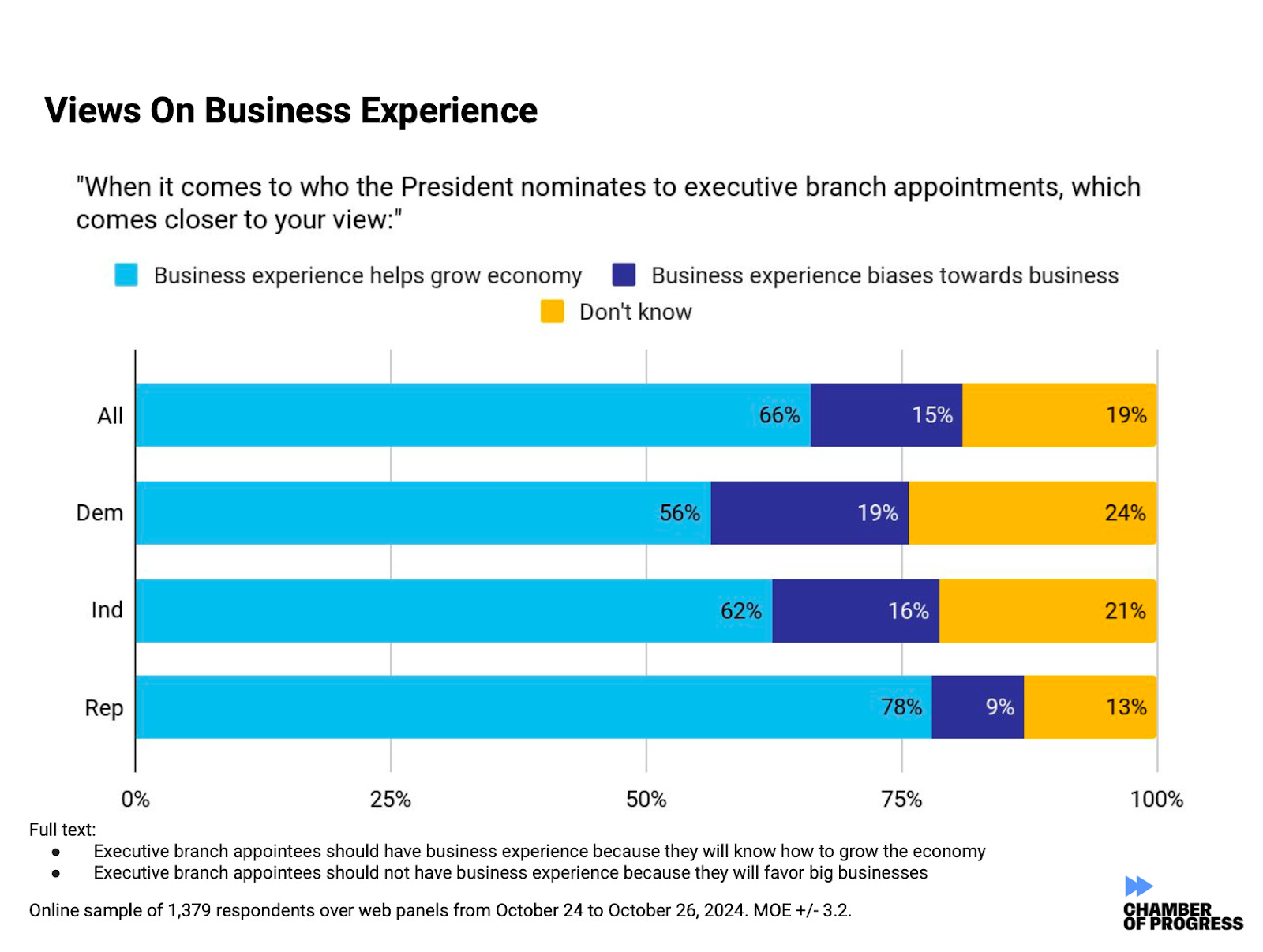
The critique from groups like the Revolving Door Project – that any hire from the business world is inherently suspect – is out of touch with voter sentiment. In fact, voters expect competent administrations to include voices from tech and business. The October poll data showed that the vast majority are confident a business-savvy official will use their knowledge to help grow the economy – which is exactly what voters want from their government.
Independents Prefer Business Experience More than Democrats Do
The polling also revealed a fascinating split in how partisan audiences view different professional backgrounds for officials. Democratic partisans tend to prefer officials drawn from government, labor unions, academia, or nonprofits, reflecting the party’s traditional ties.
But independents - swing voters - put far more stock in business experience as a positive credential for a policymaker.
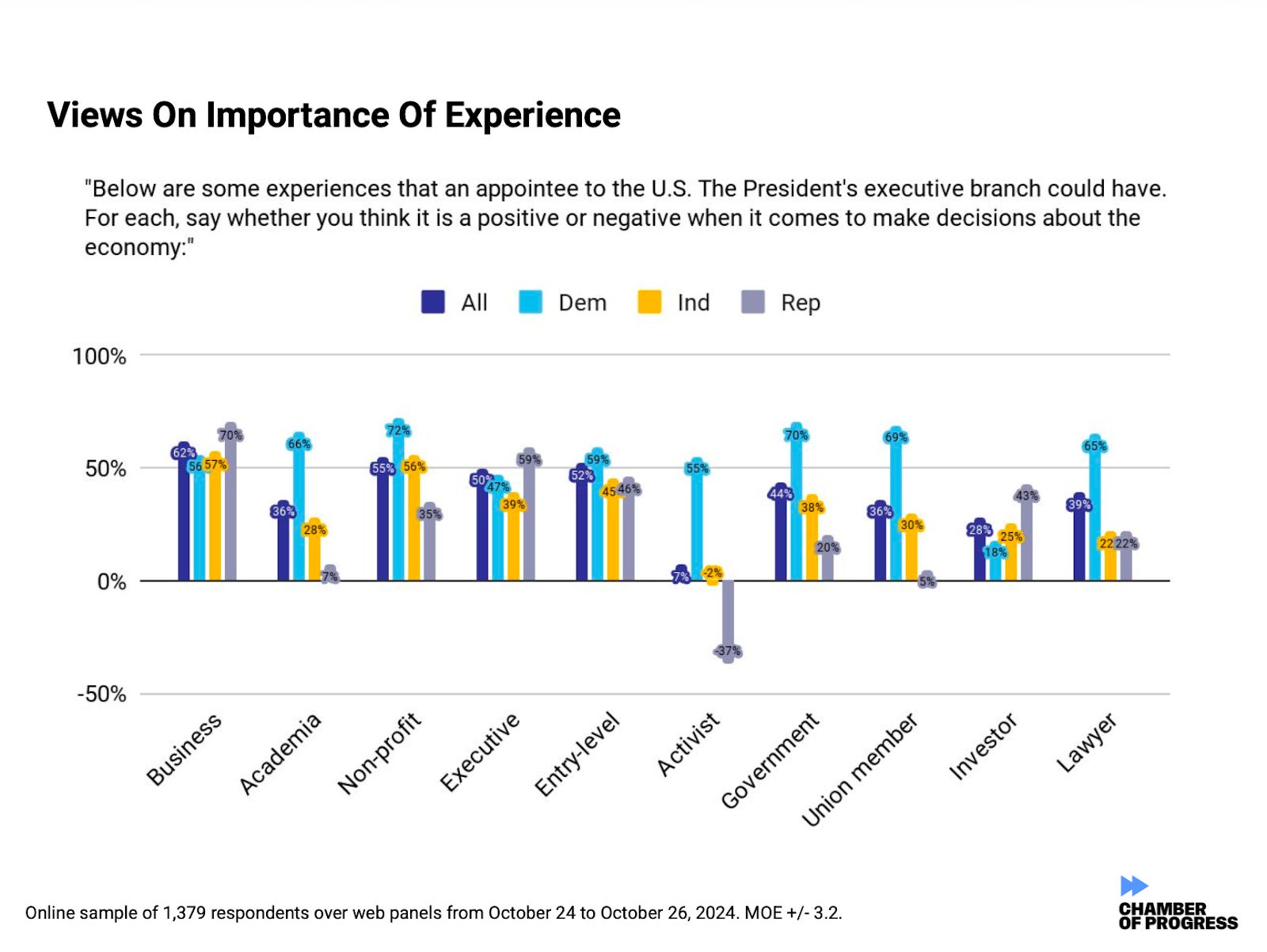
In the survey, independents rated a business background as one of the most positive attributes an appointee could have for making economic decisions – higher than having worked in academia, government agencies, or activism. By contrast, backgrounds that excited the Democratic base (such as being a union leader or a career government official) impressed independents much less, or even registered as negatives in some cases.
This gap matters because independent voters often decide elections. If Democrats staff an administration entirely with insiders from government or advocacy circles, they may feel good ideologically, but they risk sending a signal to the middle of the electorate that says: “We value insular experience over real-world business success.” That’s not a winning message with swing voters.
This is especially important with the tech industry, where Democrats often act as if they get a free pass for railing against “Big Tech” while still claiming to support innovation.
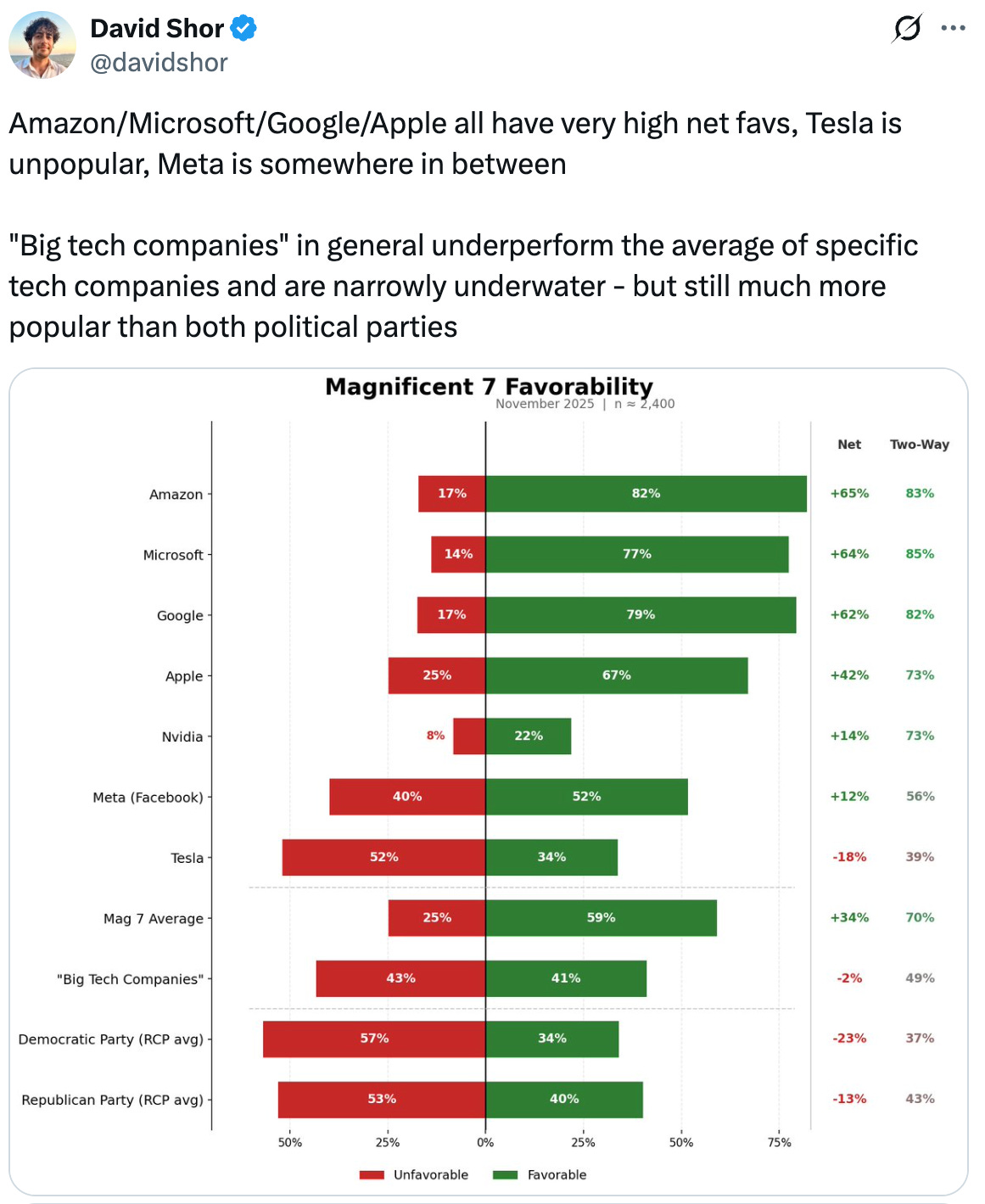
As data analyst David Shor recently pointed out, major tech companies like Amazon, Google, Apple, and Microsoft enjoy very high favorability with the public – on the order of 60% favorable to only 25% unfavorable. Voters are not reflexively anti-business or anti-tech; on the contrary, they admire these companies’ success and see them as important players in the economy. And voters see employees of those companies as vital assets to the government.
A Strategy to Win Back Swing Voters
Shor notes that Republicans have their own “moderate coding” signals (e.g. populist rhetoric on certain issues), whereas “if you’re talking about winning the votes of people who identify as politically moderate, it’s probably good to do things that code as moderate — which means…business-friendly ones if you’re a Democrat.”
This isn’t just theory – history backs it up. The last two Democratic presidents who succeeded in winning two presidential terms with broad coalitions, Bill Clinton and Barack Obama, both welcomed prominent businesspeople into their administrations. Clinton famously declared “the era of big government is over” as he sought partnership with industry, and Obama’s team included tech and business figures alongside academics.
Our polling bears out the wisdom of these coalitions and is still relevant today; President Obama has the highest ratings for his level of engagement with industry leaders.
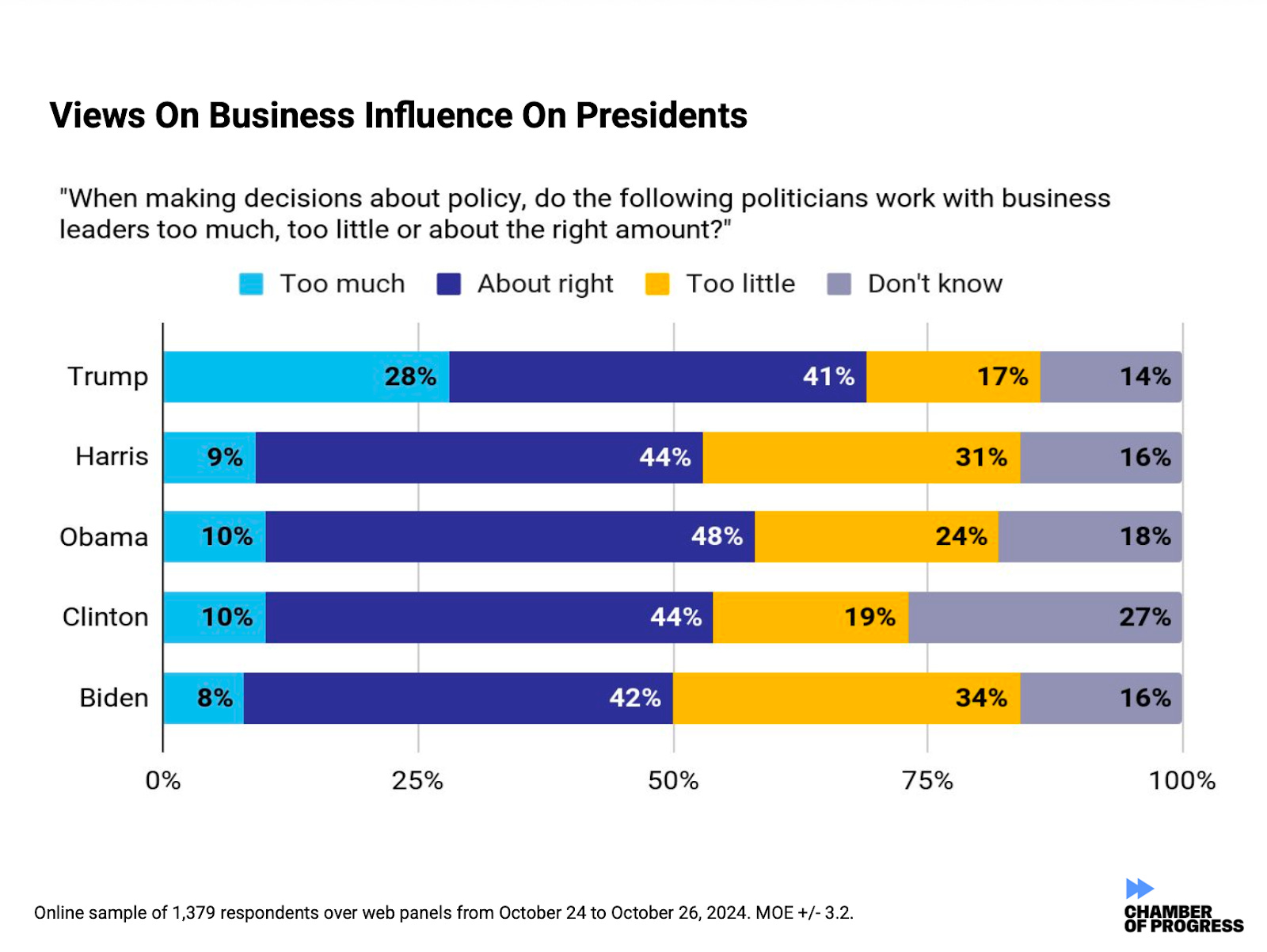
Biden, by contrast, made a conscious effort (under pressure from the party’s left flank) to minimize private and tech sector experience in his appointments. Voters noticed and led him to be rated as not engaging with business leaders enough. It did not, however, help him build a strong progressive working-class coalition.
As commentator Matt Yglesias observed, it’s ironic to blame Clinton and Obama’s business-friendliness for driving away working-class voters, when those presidents were actually more successful with working-class and rural voters than the more “pure” anti-corporate Biden administration.
A Coalition for Growth and Progress
The polling data should serve as a wake-up call. Voters want a government that’s in partnership with the private sector to deliver results, not one that’s insulated from it. They want leaders who understand how to create jobs and manage large organizations.
The next Democratic president can and should make a point of welcoming proven innovators and business leaders into the administration. Not only will this help enact policy that keeps the economy strong, it will also serve as a visible sign to swing voters that Democrats are focused on competence and prosperity rather than purity tests.