


Most people know what a trade deficit is: when a country imports more goods and services from other nations than it exports to those same countries.
The technology industry is America’s top export, and our tech industry leads the world. The United States began the Biden Administration with unmatched global leadership in technology, but instead of defending and accelerating that advantage, it was treated as a political liability.
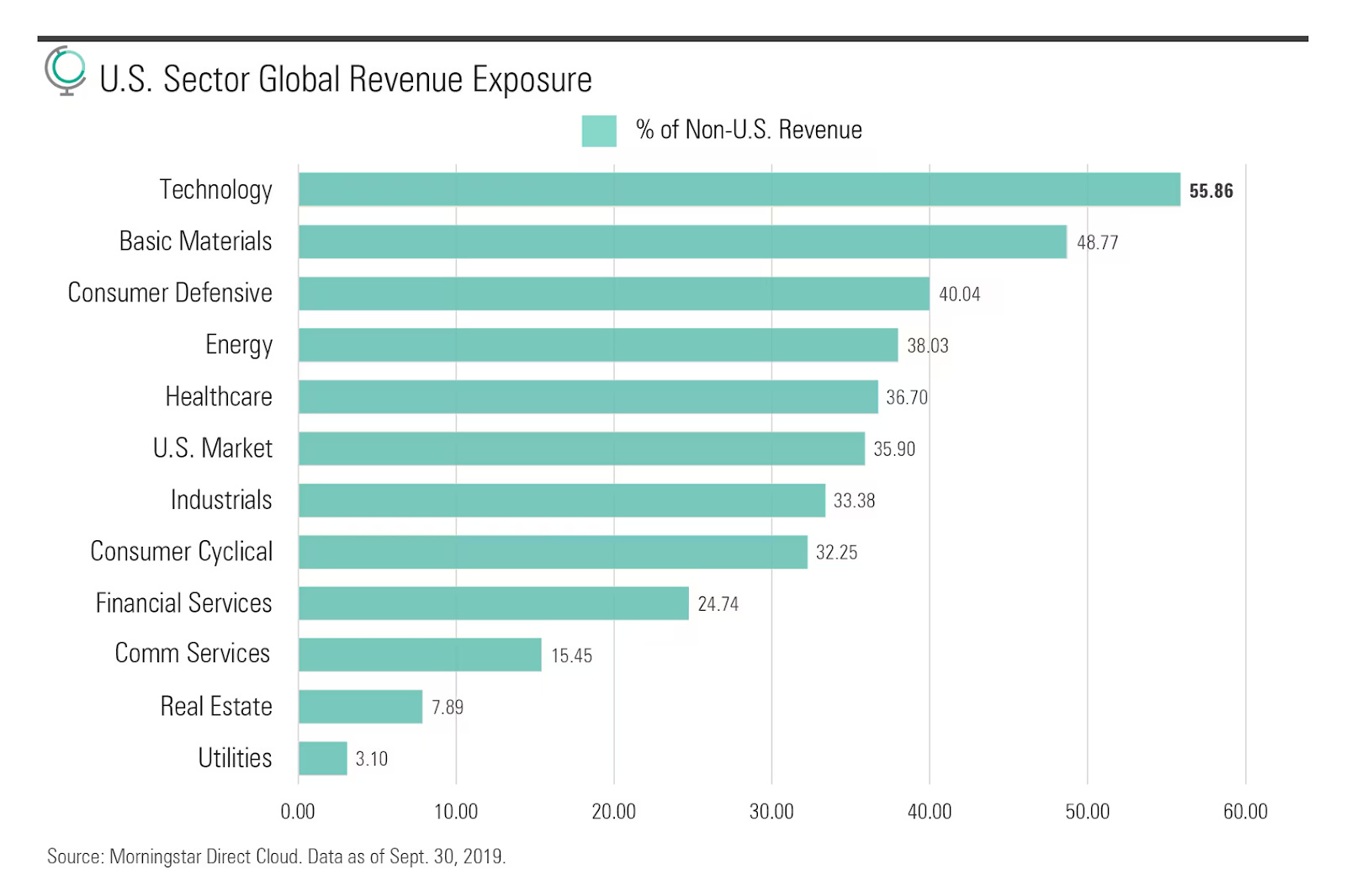
That choice created a digital-policy version of a trade deficit - call it a Digital Deficit - where American leaders squandered a dominant national asset by failing to fully leverage the world’s strongest tech industry.
The Biden Administration’s Digital Deficit wasn’t a matter of exports minus imports. Instead, it was about failed leadership and missed opportunities.
In my next series of posts I will look at the areas this Digital Deficit caused the Biden Administration to miss opportunities to capitalize America’s extraordinary tech prowess
This Digital Deficit appeared in three particular areas:
The Administration’s failure to stand up for U.S. tech leadership on the global stage;
Its failure to use tech to make the government work better;
Its lack of a strategy to create more tech jobs and opportunities;
And its failure to embrace new innovations that could save lives and help consumers
Foreign Regulators Target Silicon Valley Giants
The wealth and position of US tech firms makes them easy targets for foreign regulators looking to extract some of that wealth and bolster their own domestic tech industries. Under the Biden Administration, when U.S. tech companies faced aggressive competition and heavy-handed regulation from foreign governments, the administration often failed to stick up for U.S. tech leadership.
Instead of defending American firms, the Biden team frequently stood by, or even aligned with, foreign regulators’ actions. This lack of support not only harmed individual companies like Apple, Google, and Meta, but also threatened broader U.S. economic and security interests.
From Europe to Asia, foreign regulators launched unprecedented offensives against America’s top tech firms during the Biden Administration. Nowhere was this more evident than in the European Union’s regulatory efforts. The EU rolled out sweeping new tech laws, most notably the Digital Markets Act (DMA) and Digital Services Act (DSA), explicitly aimed at reining in “Big Tech” platforms.
Under the DMA, five major U.S. companies – Alphabet (Google), Amazon, Apple, Meta (Facebook), and Microsoft – were officially designated as “gatekeepers,” subjecting them to strict antitrust rules and obligations. These rules force U.S. firms to open up their platforms at the risk of hefty fines.
European regulators argued such measures were needed to curb monopolies, but conspicuously no major European firms were targeted. A bipartisan group of U.S. lawmakers pointed out that Brussels “inexplicably failed to designate any European retailers, content-sharing platforms, payment firms, and telcos” under the DMA.
At the Pentagon during the Biden Administration, my colleagues and I grew increasingly concerned about the national security implications of major Chinese tech and software companies dominating the tech infrastructure of our US allies.
Even as we voiced these fears to our NATO Allies across Europe, Chinese tech champions such as Alibaba, Huawei, and Tencent escaped EU scrutiny entirely.
American lawmakers warned that this imbalance “threatens to upend the U.S. economy, diminish our global leadership in the digital sphere, and jeopardize the security of consumers”.
Beyond laws like the DMA and DSA, foreign authorities also slapped American tech firms with record fines and back-tax bills. EU courts revived a €13 billion tax demand against Apple for allegedly unpaid taxes in Ireland, despite Ireland not levying the taxes.
These actions by Europe were clearly designed to constrain U.S. tech companies or extract revenues from them, prompting the Trump Administration to label the approach as “overseas extortion”.
A Silent Biden Administration
One would expect the U.S. government to push back forcefully against discriminatory treatment of its companies. Yet during President Biden’s term, the response was largely muted. When the EU enacted its revolutionary DMA in 2022, explicitly targeting Silicon Valley, U.S. officials stayed silent. Under Biden, there was an implicit transatlantic consensus: U.S. regulators like the FTC and DOJ turned up the heat on Big Tech at home, while European regulators went after them abroad, with the encouragement of Biden Administration officials.
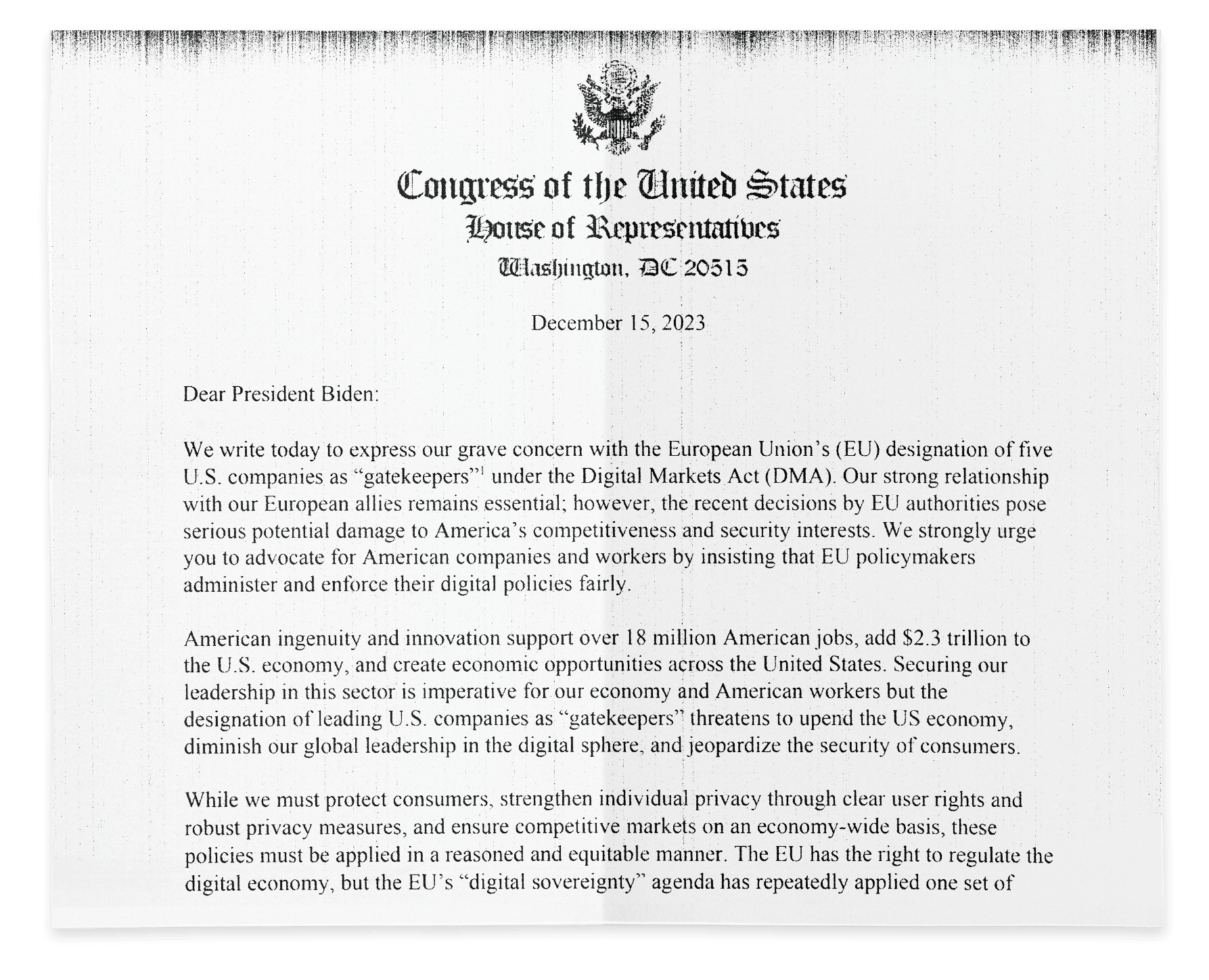
A bipartisan letter from Congress in late 2023 urged President Biden to address the EU’s targeting of American companies. Those 21 House members warned that Europe’s digital regulations “damage American economic and security interests” and pleaded with Biden to ensure the rules are applied fairly. Yet there was little indication of any strong action from the White House.
In fact, no Administration objection was raised when the EU designated only U.S. companies (and a single Chinese firm, TikTok’s owner ByteDance) as DMA gatekeepers.
In some cases, Biden officials even hampered U.S. defensive tools. A notable example was the U.S. Trade Representative (USTR) under Biden withdrawing support for key digital trade protections at the World Trade Organization. For decades, America pushed for trade rules ensuring free flow of data and no forced data localization, which protected U.S. tech firms operating abroad. But in 2023, USTR Katherine Tai abruptly dropped these demands.
Data localization laws require companies to store data within a country’s borders, imposing steep compliance costs on U.S. cloud and internet businesses, and makes no sense in a world where information resides in the cloud and can be transported around the world in milliseconds. Backtracking on opposing such burdens “heralds a new era where U.S. firms might face serious challenges accessing foreign markets,” Robert Winterton wrote.
Senator Ron Wyden cautioned that stepping back from U.S. leadership in digital trade could “enhance China’s leverage” to push its own state-controlled tech standards globally. Unfortunately, the Biden team’s stance ceded ground in exactly this way, abandoning the defense of U.S. interests related to technology on the world stage.
An Uneven Playing Field in Global Tech Competition
Beyond regulation, U.S. tech firms also face intense competition from foreign companies, often on an uneven playing field. Here too, critics charge that the Biden Administration failed to support American companies effectively. A glaring example is the reciprocity gap with China.

Beijing has systematically walled off its internet market, with The Great Firewall blocking U.S. companies like Facebook and Google from operating in China’s vast online space. Meanwhile, Chinese tech companies freely access U.S. markets and users. Under Biden, this imbalance widened. The Chinese-owned app TikTok exploded in popularity in the U.S., competing directly against American social media platforms and opening Americans to potential security and data protection risks, even as apps like Instagram and YouTube remain banned in China.
While India outright banned TikTok on national security grounds, the Biden Administration hesitated, opting for drawn-out negotiations and half-measures. After Congress passed a law requiring a TikTok ban or sale, the Biden Administration allowed the app to continue operating without meeting the conditions of the law, effectively kicking the can for enforcement to the Trump Administration. This showed lack of resolve to protect U.S. tech leadership: foreign competitors benefiting from open U.S. markets while U.S. firms get shut out abroad.
The U.S. antitrust crusades made it harder for American firms to innovate through acquisitions and mergers, even as Chinese and European firms faced fewer barriers. Antitrust overreach at home became a gift to overseas competitors. The Biden Administration’s “big-is-bad” approach to tech mirrored Europe’s and ultimately served the interests of foreign competitors by hobbling America’s most successful companies.
A New Path Forward
If Democrats want to close the Digital Deficit that opened during the Biden Administration they must once again stand up for American innovators on the global stage.
This doesn’t mean a complete lack of regulation, but this means insisting on truly fair application of laws like the DMA. European and Chinese firms must face the same scrutiny as those in the United States, and our companies should not be punished for providing the best product available around the world.
The Biden Administration’s term will be remembered by many in Silicon Valley as a time when US tech was left to fend for itself against a hostile international environment.
America cannot afford to let its most dynamic industry be pulled down by foreign regulation or unfair competition. Standing up for US tech leadership in the world will send a powerful signal to Silicon Valley that Democrats want a better relationship with tech and we can ensure America continues to shape the future.
The DMA dinged American companies because lax regulations and the “move fast break everything” incentives in Silicon Valley let tech companies grow fast and way larger than what any company in Europe could muster under the various countries in the EU and the sound regulations on the books there.
Tech companies also use Ireland as a tax haven. That’s a major issue.
U.S. tech leadership has bent the knee to Trump to allow the man to act on his horrid agenda. Maybe it’s time that the sun sets on American tech leadership.