
A Jar of Dirty Water Is Not an AI Policy


Voters are not irrational for worrying about AI. They are seeing powerful tools that can write, code, design, synthesize information, and manage workplaces, while requiring increasing capacity and infrastructure to handle the workload.
Democrats can and should take those concerns seriously while being optimistic about innovation and without assuming that there is a zero-sum choice between embracing technology, a modern workforce, and environmental protection.
But credibility matters. Democrats cannot build a serious AI agenda while making unserious arguments about the infrastructure AI requires.
The latest example came when Rep. Alexandria Ocasio-Cortez held up jars of brown water during a hearing, saying the water came from Morgan County, Georgia, near a Meta data center, and calling for a moratorium on data center construction along with investigations into data centers and water quality.
Residents deserve clean water. Any specific complaint deserves testing and remediation if issues are found. But a jar of dirty water is not a hydrogeological study, and seeking a viral moment in a hearing is not real evidence of a new data center causing groundwater pollution.
Data centers are not new. They have powered email, websites, payments, search, cloud services, and streaming since the commercial internet took off in the 1990s. The United States already has over 3,000 fully operational data centers. If data centers were producing a national groundwater contamination crisis, the evidence would not be hiding in one viral hearing prop.
The problem is that these bad arguments can make Democrats easy to dismiss as not serious about AI and its potential. Democrats are viewed as the party that trusts and relies on science evidence to make informed decisions, and relying on poorly reasoned and easily refutable arguments about the environmental impact and water usage of data centers undermines their strength in this area. If Congressional Democrats want to earn the trust of voters to be put in charge of the regulation of an incredibly important emerging industry, they need to be able to clearly tell the difference between evidence and vibes.
Polling shows that people are especially worried about utility bills and energy demand. The energy question is where Democrats have the biggest opportunity. Ratepayers don’t want to be stuck with the bill for infrastructure built to serve tech companies, but the solution is to work with the AI companies to make sure they don’t have to, which requires good faith engagement with the companies themselves.
Microsoft, Google, Meta, Amazon, OpenAI, and others are making extraordinary and increasing capital expenditures because compute is central to their business models and strategies. By building strong working relationships with the tech industry, Democrats will have the leverage to pass legislation and establish voluntary commitments to secure power rates for large-load customers that protect household consumers, community benefit agreements, transparent water reporting, transmission investment, and new clean power and storage. As the chart shows, power is a small fraction of the future cost of the AI buildout, so earning the goodwill of Democratic politicians by making clean energy investments that benefit communities is very much in their interest.
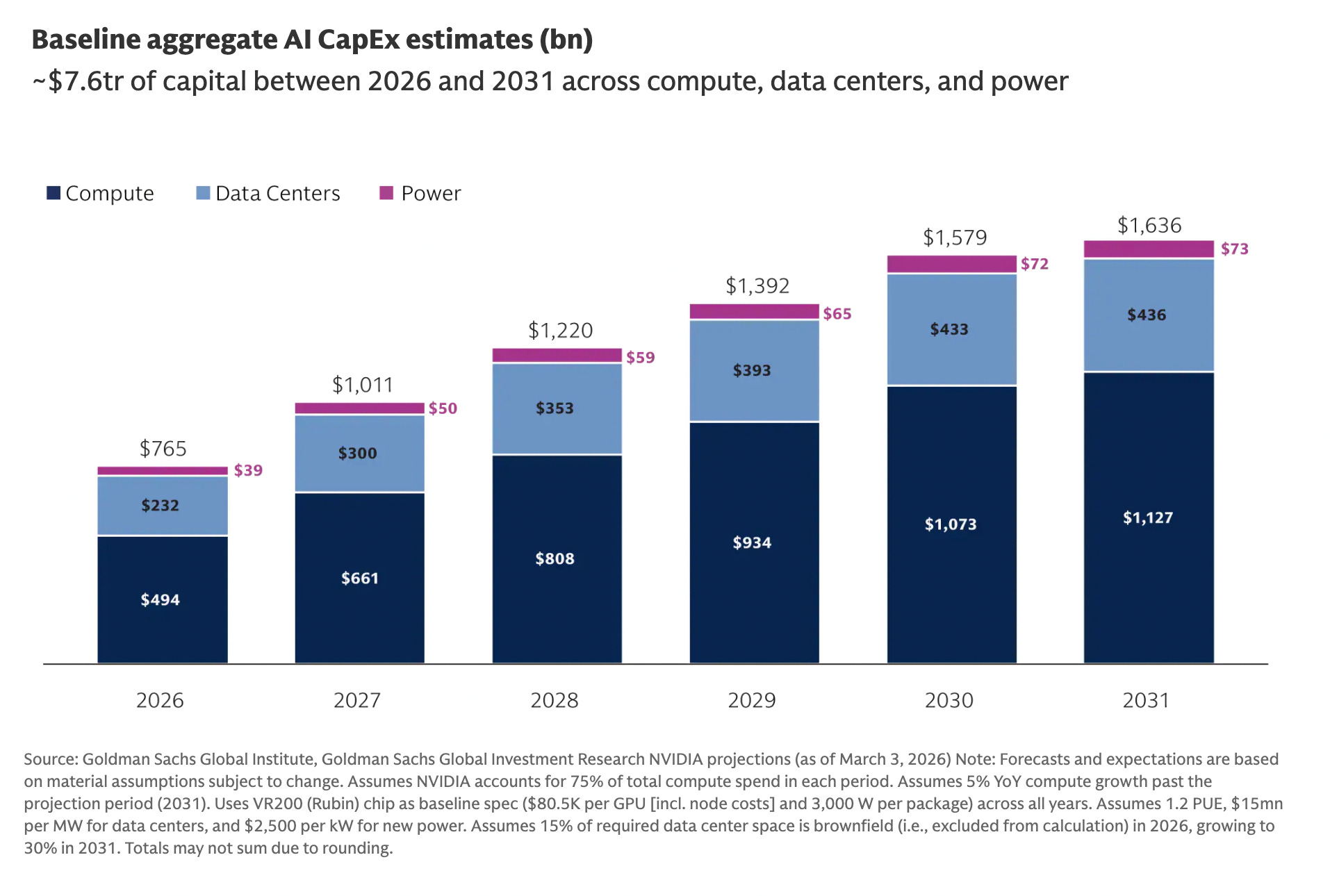
For Democrats, jeopardizing a $7 trillion five-year investment in American communities and the opportunity to vastly improve our green energy infrastructure is not worth the political points that can be scored with unscientific and easily-refuted claims of environmental harm.
The cooperative approach has the advantage of being good politics. Chris Gibbs, chair of the Ohio Democratic Party’s rural caucus, states it well in an interview with the Washington Post:
“There are folks that believe that if the Democratic Party would become a party of no data centers that a Democratic Party could … run the table,” Gibbs said that would be shortsighted, however, and that the better path is to help communities strike better deals with tech companies so they benefit more financially from the centers’ presence.“Just to be the party of ‘no’ all the time I don’t think is good for the Democratic Party’s future,” Gibbs said.
Climate Power and Blue Rose polling found voters oppose data centers powered by fossil fuels but support clean-energy-powered data centers by a wide margin.
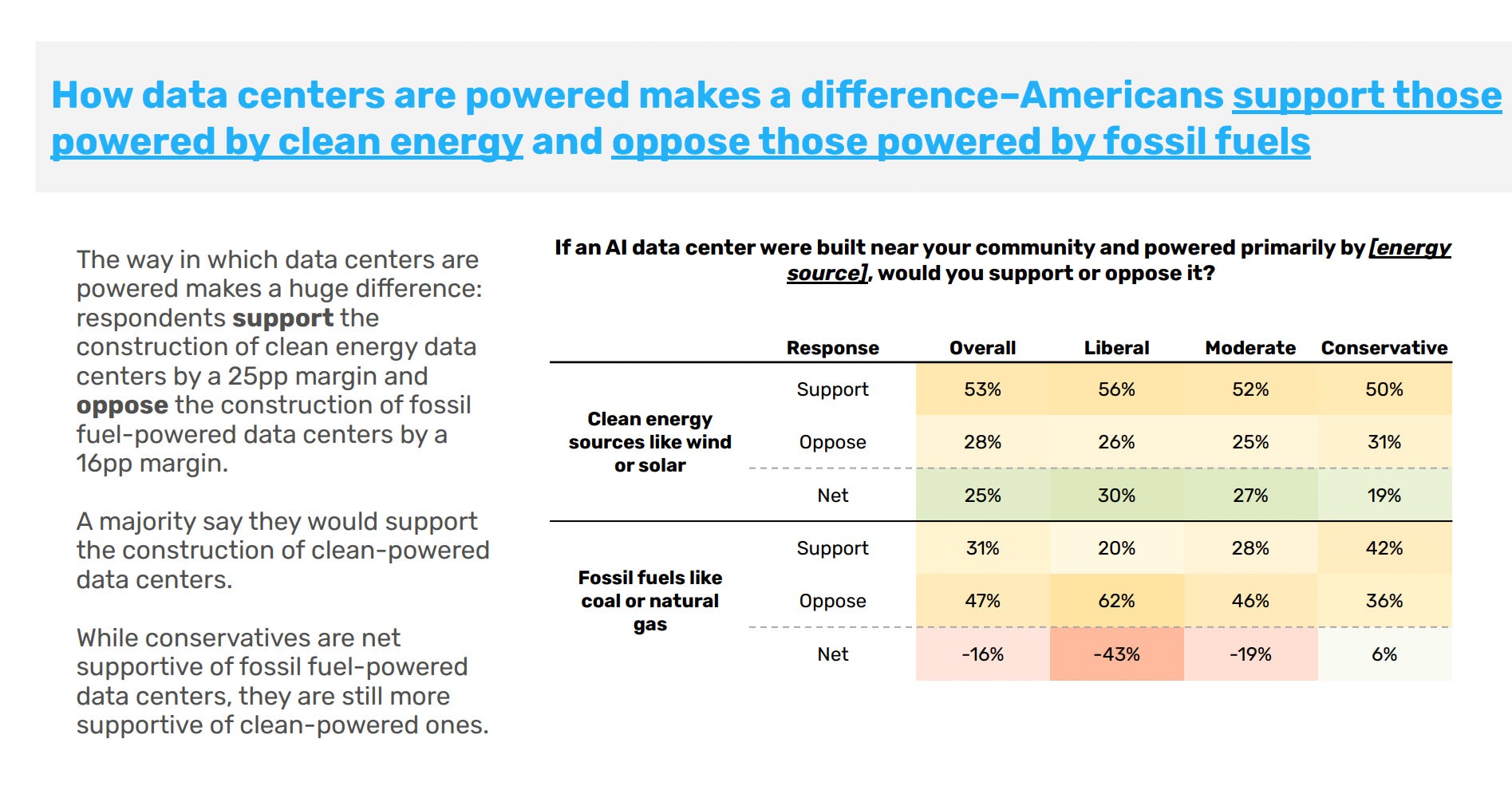
Research on AI Data Centers, Costs, & Pollution Blue Rose Research | Climate Power February 2026
Navigator found that a “protect consumers and our environment” frame significantly outperforms a “slow or stop construction” frame.
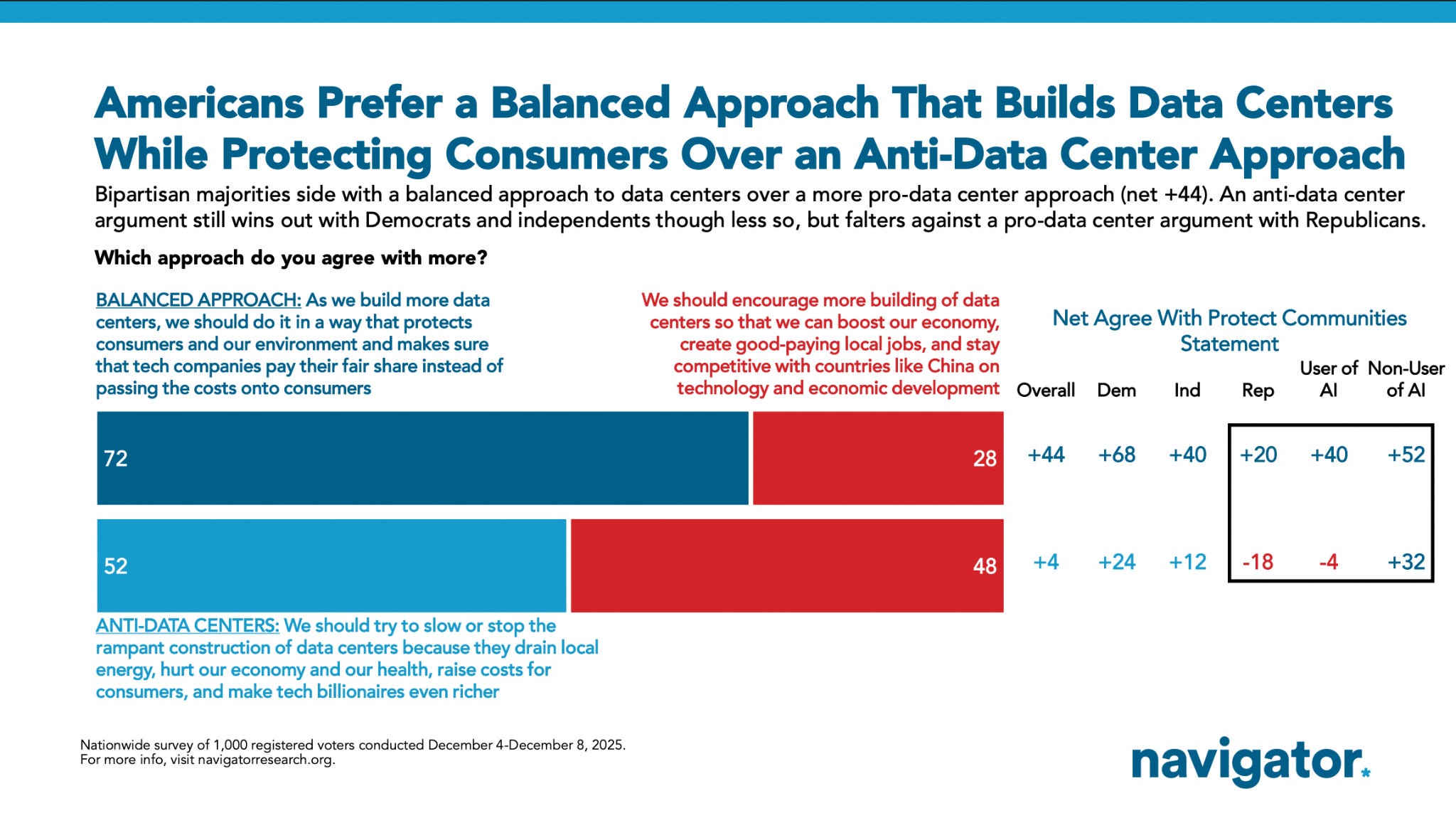
Some companies are already moving in this direction. Microsoft has said communities should not face higher power bills or tighter water supplies because of AI infrastructure, and has outlined commitments around full electricity costs, water use, property taxes, local jobs, and workforce training. Google is also making voluntary commitments to take the protection of water supplies seriously. Democrats need to make sure that we are the ones earning those commitments and holding companies accountable to their promises.
Environmental protection is a key area of alignment between tech CEOs and Democrats, and working with companies to promote clean energy production can serve as a reminder of the party that is most aligned with their values on environmental protection. Bill Gates’ Breakthrough Energy and the Bezos Earth Fund are high-profile examples of tech founder institutions focused on clean energy.
Democrats do not need to flatter billionaires to enlist private capital to help build the clean power, storage, and transmission Democrats and Silicon Valley leaders have wanted for decades.
Ezra Klein and Derek Thompson have pushed Democrats toward abundance politics that asks whether government can actually build what it promises: homes, transit, clean energy, infrastructure, and opportunity. AI infrastructure should be part of that same test. Democrats can insist on environmental standards and consumer protections while demonstrating that we can be the party that can build.
The point is to be serious about AI. Serious about its potential and serious about addressing legitimate concerns.
Addressing those concerns while being the party of innovation requires credibility. When Democrats lean on shaky claims and viral theatrics, they weaken their ability to win the real fights.
Thank you for this thoughtful, nuanced, and decently-documented essay.
I don't hold out hope that our grandstanding politicians will take this to heart, but hopefully people that elect them and hold them accountable will. As you've suggested, I also fear that these pols are doing more harm than good, and that's really worrisome in such a serious context!