
The Lose-Lose Politics of Anti-Tech Populism


The Biden Administration’s tech policy appears to have been guided in part by a political theory: that taking a confrontational posture toward the technology industry would help Democrats reconnect with working-class voters who had drifted away from the party. This view reflected a strain of what I’ve called “faculty lounge populism”, a style of anti-corporate politics popular among left-leaning activists, academics, and Democratic staffers that assumed ordinary voters shared the same hostility toward large technology companies.
But the expected political payoff never materialized. Anti-tech populism did not generate gains among working-class voters, while it strained relationships with long-standing Democratic allies in Silicon Valley and parts of the broader tech ecosystem. In venture capital terms, the strategy produced value destruction – burning existing support without generating new political returns. What was intended as coalition expansion instead became lose-lose politics: no new working-class voters gained, and weakened support from allies in the tech sector and innovation economy.
In this series of posts on the lose-lose politics of anti-tech efforts of the Biden Administration, I will look at how the policies meant alienating Silicon Valley without winning back the working class.
The White House made anti-tech policy a working‑class signal
The Biden administration tried to sell novel antitrust crackdowns and “big is bad” policies as a pro‑worker, pro‑consumer crusade based on a type of faculty lounge populism meant to reassure working‑class voters that Democrats would fight corporate power. But the strategy intensified alienation among Silicon Valley executives even as Democrats kept bleeding support among non‑college voters.
The premise of the Biden posture was explicit in the administration’s own language. The White House Competition Council framed market concentration as a direct threat to workers and household budgets, quoting Biden: “Capitalism without competition isn’t capitalism; it’s exploitation,” and arguing that reduced competition “drives up prices for consumers and drives down wages for workers.”
The policies matched the message. In Biden’s executive order on Worker Organizing and Empowerment, he explicitly points to “technology developments” as a barrier to unionization, stating:
In the past few decades, the Federal Government has not used its full authority to promote and implement this policy of support for workers organizing unions and bargaining collectively with their employers. During this period, economic change in the United States and globally, technological developments, and the failure to modernize Federal organizing and labor-management relations laws to respond appropriately to the reality found in American workplaces, have made worker organizing exceedingly difficult.
In his New York Times editorial board interview during the 2020 presidential campaign, Biden said that he was “not a fan of Mark Zuckerberg”, said that Section 230 (of the Communications Decency Act) should be revoked, and made the case that the technology revolution will require heavy government regulation. Doing this interview is a signature campaign event for any candidate, so you can be certain that these answers were what the campaign thought would be the most compelling to win working class support.
The anti‑corporate/anti‑tech posture was repeatedly framed as a worker‑aligned fight against exploitation and rip‑offs, which is exactly the rhetoric Democrats reached for as their working‑class brand eroded.
Coalition management: progressives up close, unions at the center
Personnel is policy, and Biden’s antitrust staffing was a concession to the party’s left flank. Reuters described Lina Khan’s ascent to FTC chair as a “victory for progressives seeking a clampdown on tech firms,” underscoring that the administration chose a figure celebrated by the left and feared by much of industry. Jonathan Kanter’s confirmation to lead DOJ Antitrust likewise drew praise from the anti-corporate organizations aligned with Senator Warren.
By election season in 2024, the political meaning of Khan’s antitrust project was plain and had became a flashpoint between Silicon Valley and the left wing of the party. The intra-party political fight came at a cost as Kamala Harris looked to take over the reins of a national presidential campaign and formulate a winning message.
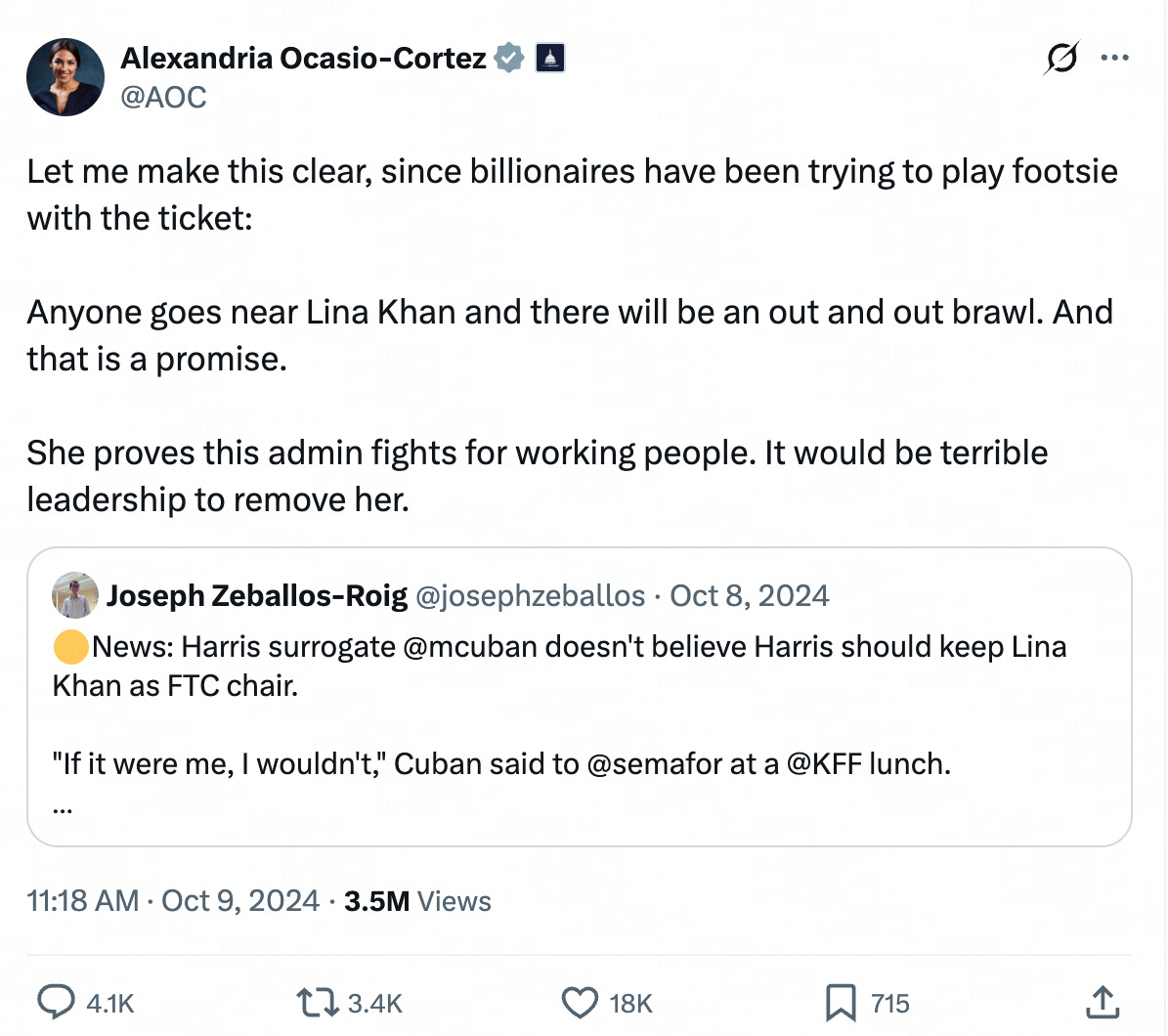
Even as voters viewed Harris as too liberal, she was unwilling to signal a shift from the Biden Administration on tech regulation and staffing. It isn’t hard to see why Harris was unable to credibly signal a shift when the left wing of the party is publicly saying they would fight her on if she did. During the campaign sprint to the finish, Alexandria Ocasio‑Cortez was warning of an “out and out brawl” if Harris removed Khan.
Before he dropped out, Biden’s team was encouraging him to address his blue‑collar problem by urging him to “pick fights” with corporate “villains” and rely on labor institutions to communicate benefits as they portrayed Biden as unusually pro‑union in symbolism and outreach. They were sure that Democrats could tolerate antagonizing the tech community since it would pay dividends with the working class.
The numbers show the loss: non‑college voters didn’t come back
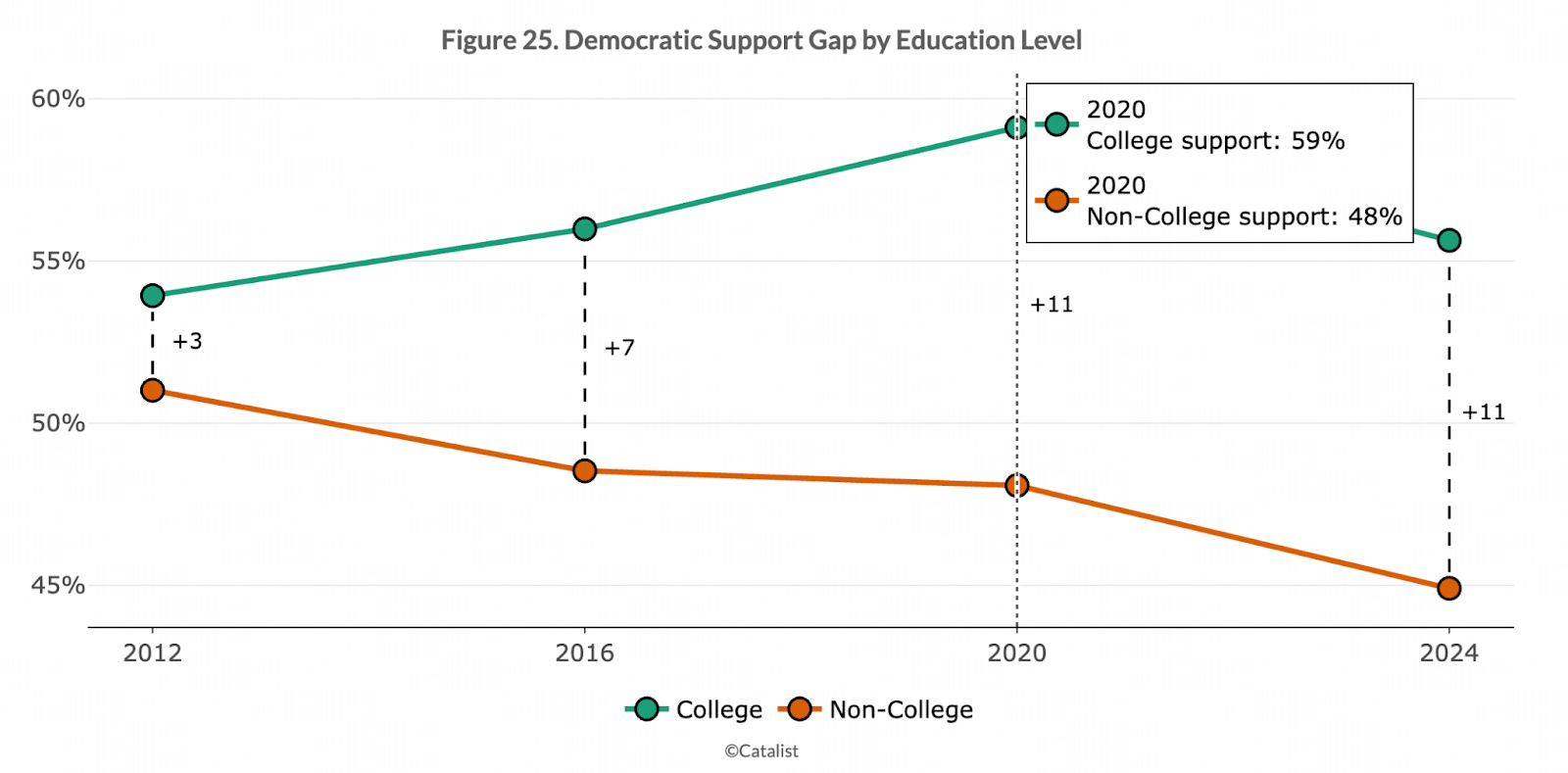
The core failure of the strategy is visible in the education divide. Juan David Rojas captures the decline in working class support from Obama to Biden and the electoral college hit that came with the loss of support:
Yet despite Biden’s larger 4.5 percent victory, Obama secured 332 electoral votes compared to his Democratic successor’s 306 electoral votes. While it’s technically accurate to describe the discrepancies as an undemocratic feature of the Electoral College, a less flattering reason derives from Democrats’ hemorrhaging of working-class voters. Obama won 51 percent of voters without college degrees, including 40 percent of working-class white voters. In contrast, Biden won 48 and 38 percent of the same groups, with Kamala Harris securing only 45 percent of all non-college voters in 2024.
The slide continued as Harris replaced Biden on the ticket. Pew’s validated‑voter analysis of 2024 shows Trump beating Harris among non‑college voters 56%–42%, while college graduates favored Harris 57%–41%.
Working class voters simply don’t buy the argument that technology companies and corporations are the cause of their economic issues. This is best summed up by Mitch Landrieu, a leader of the extensive election post-mortem conducted by American Bridge, “not one person in all of our focus groups mentioned the word ‘oligarchy.’”
Instead, their surveys found “a candidate focused on taking on big corporations and the wealthy” received 43 percent, while a “candidate focused on fixing the economy so those who work hard can get ahead” earned 52 percent.
Writing for Vox, Eric Levitz says that:
The problem is that voters…do not consider regulating the companies a priority. When Gallup asked Americans what their country’s most important problem was this month, only 1 percent named “corporate corruption” while 0 percent picked “technology.”
Silicon Valley shifted and Democrats paid a political price
While the Biden Administration’s theory that aggressive tech regulation would lead to working class gains at the ballot box backfired, the backlash from parts of the tech community from being targeted became a clear problem. The most obvious issue was Elon Musk choosing to spend nearly $300 million to get Donald Trump elected president. He spent an unprecedented sum of money that bought ads, organizational structure, and paid canvassers to Trump’s campaign.
However, the primary issue is not simply a matter of campaign contributions. After all, Kamala Harris also raised a large sum of money from the tech industry during her 2024 presidential run.
The Silicon Valley loss is the failure to capitalize on voter’s favorable view of tech companies, innovation, entrepreneurship and business success by embracing the most dynamic and successful industry in the country. A campaign season filled with article after article about why the tech community is abandoning your party is bad for general election candidates trying to signal that you are the right candidate to build a prosperous economy.
Venture capital titans Marc Andreessen focused his pro‑Trump arguments on the view that policy under Trump would better serve tech’s future on startups. Democrats had been the party of innovation and progress for a generation. They gave up their advantage on that issue while getting nothing in return.
Why Lose-Lose Politics matters
It is difficult to prove causation in politics: inflation, immigration, culture war dynamics, and candidate‑specific factors moved votes in 2024, but it is clear that the advisors pushing President Biden and his Administration thought that taking on the tech industry would generated a winning issue with working class swing voters, and it is clear that logic was a political loser.
The administration advertised antitrust policies as worker‑friendly populism, yet Democrats failed to regain non‑college voters. At the same time, highly-visible members of the tech world defected – financially, rhetorically, and organizationally – toward Trump and Republicans by painting Democrats as out of touch with the private sector and anti-success. Swing voters took notice and it helped put Donald Trump back in the White House.