


In the wake of our 2024 losses, a repeated refrain of Democratic political strategists and politicians has been that Democrats need to orient our politics around “villains.”
But a new memo from Winning Jobs Narrative Action has a compelling finding: great stories need villains, but the stories are about the heroes.
Or, as the memo puts it, “Star Wars is not about Darth Vader.”
That insight applies to our tech policy too.
I love the original Star Wars trilogy. As a kid, I watched them over and over again. Don’t get me wrong, Darth Vader is a cool villain, but when I played Star Wars games with my friends and cousins, we all wanted to be Luke Skywalker or Han Solo. Growing up in small-town Iowa, the farm kid from a backwater planet who grows up to be the hero had special resonance.
Even for non-Star Wars fans, the epic adventure hero story is well understood. Harry Potter is about Harry and his friends, not Voldemort. The Lord of the Rings is about Frodo, not Sauron and Gollum. The Hunger Games is about Katniss, not President Snow.
The hero gives people someone to root for. As the WJN Action memo puts it:
Our view is that Democrats should embrace aspirational populism — a people-focused approach that positions working people as the heroes of the story, centers their goals and aspirations, names the obstacles standing in their way, and offers tangible solutions that will equip them with the tools and opportunities to build a good life.
In WJN’s testing, aspirational populist messages outperformed adversarial populist alternatives by an average of 43 percent across taxes, energy affordability, and housing affordability.
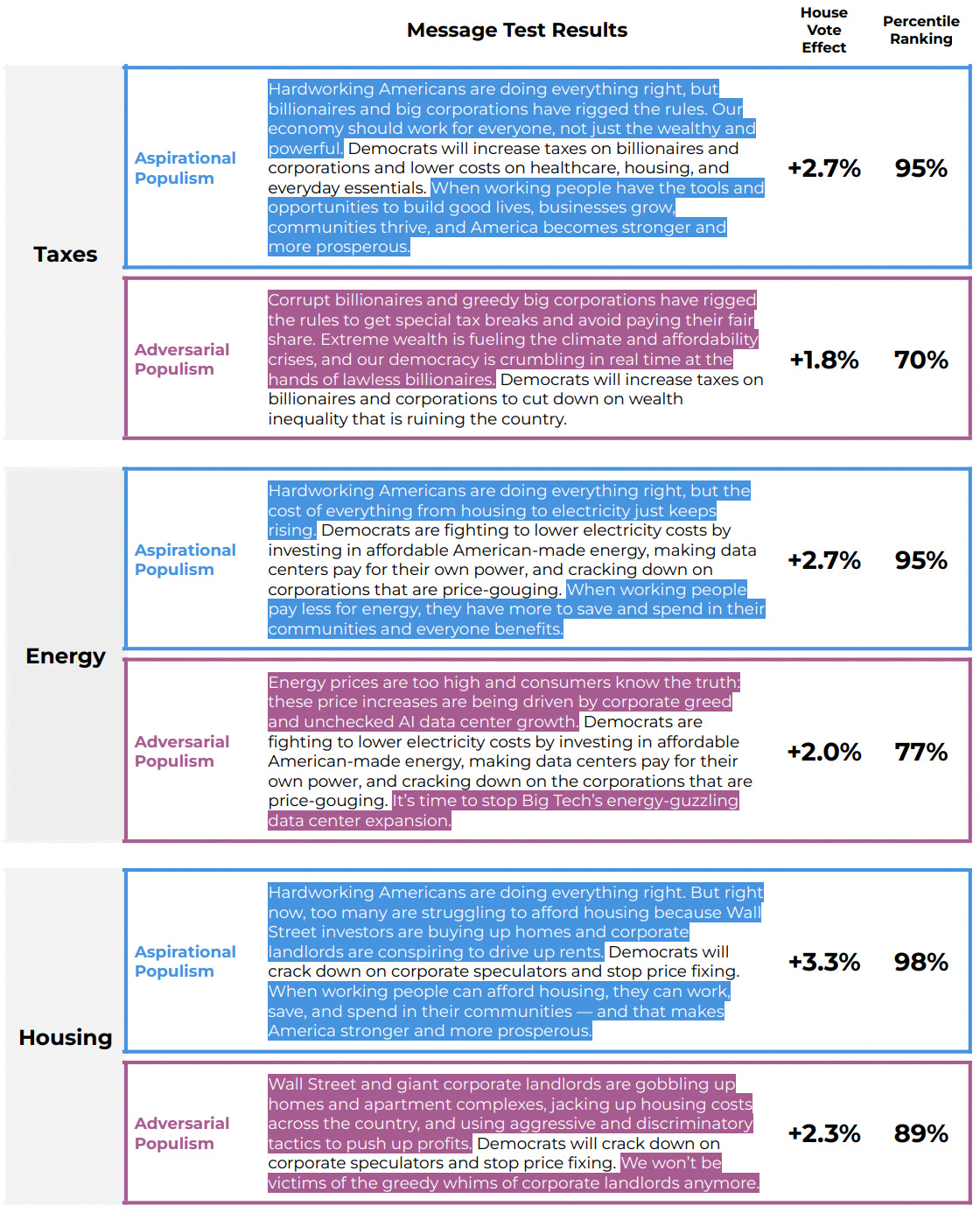
That is exactly the lesson Democrats need to apply to tech.
I Have A Bad Feeling About This
Too much Democratic technology policy over the past several years has been focused on making Vader the main character. Especially following Trump’s inauguration with many tech executives prominently positioned on the dais, the loudest Democratic story became about “Big Tech oligarchs.”
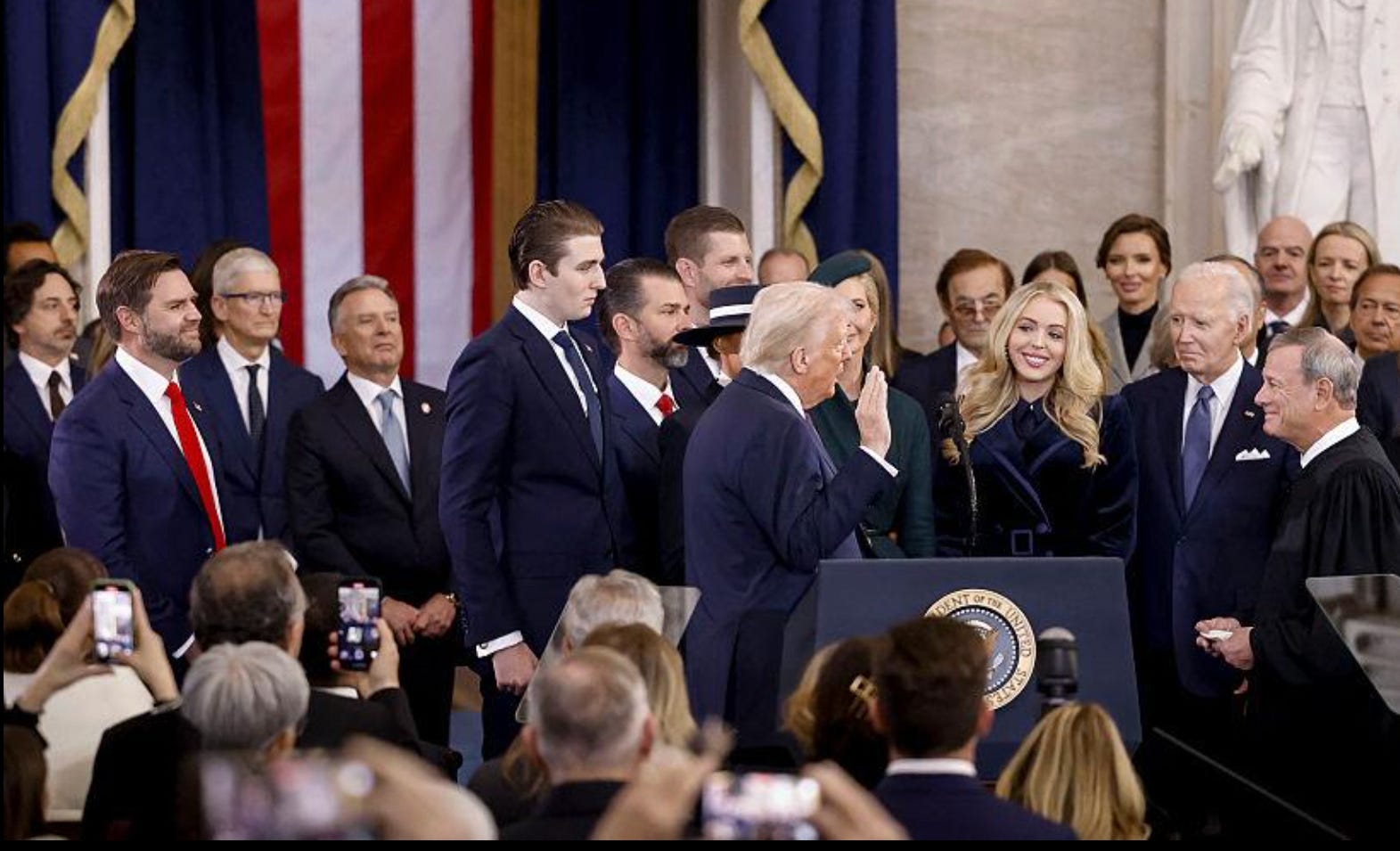
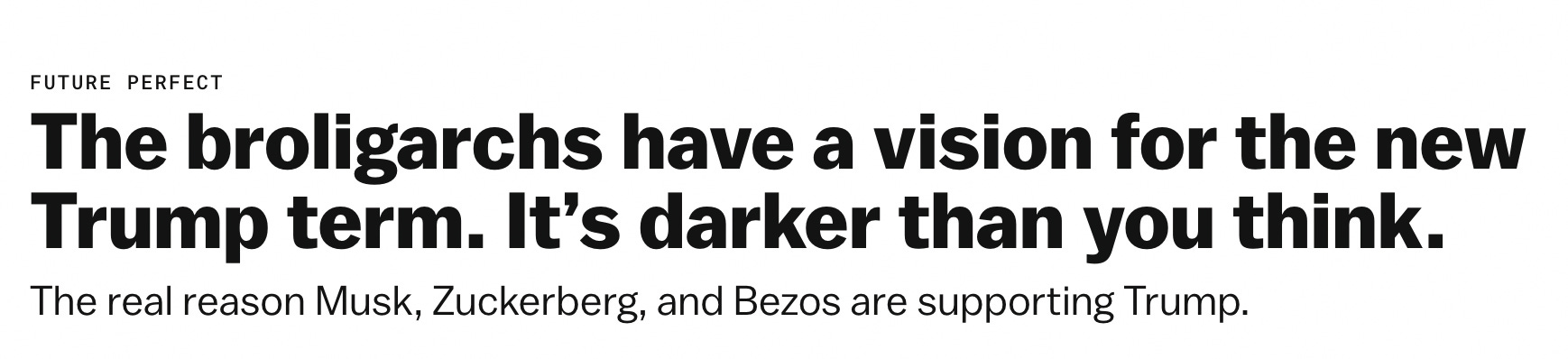
Senator Warren focused on “Big Tech as the villain” narrative, saying “Big Tech billionaires have a front row seat at Trump’s inauguration. They have even better seats than Trump’s own cabinet picks. That says it all.” Journalists at left-leaning outlets started referring to them as “broligarchs” and made them the central characters in the villain story.
WJN Action’s memo calls this “adversarial populism,” and argues against it:
Presently, too many Democrats rely on adversarial populism, a villain-focused approach that puts bad actors at the center of the story instead of hardworking Americans. While this approach can pinpoint pressing problems and call out those who benefit from them, it is often counterproductive — framing voters as victims rather than heroes and failing to offer a positive, forward-looking vision for the future.
When our story becomes a crusade against tech companies and tech leaders, voters hear a party more interested in punishing villains than creating opportunity. With tech, this is especially problematic because voters generally have a positive view of tech companies, so even if their CEOs can act like cartoon villains, a policy centered around punishing tech companies is doomed to fail.
That is the limitation of the Warren/Sanders style of anti-tech populism. Elizabeth Warren helped define the modern Democratic antitrust fight around breaking up major tech companies like Amazon, Facebook, and Google. Bernie Sanders recently released a report titled “The Big Tech Oligarchs’ War Against Workers.” Working families are demoted from heroes of the journey to the victims in a story about the villains you should fear.
Again, actual villains are a necessary component to the aspirational populism narrative. There are scams to stop, children to protect, privacy abuses to prevent, fraudsters to punish, and market abuses to police. But adversarial populism underperforms because the narrative is negative, hostile to business, and too focused on punishment instead of the working people Democrats are trying to help.
On tech, Democrats should ask a different question. Instead of “How do we punish the broligarchs?” we should ask, “How do we make sure working people can use technology to build a better life?”
Do. Or Do Not. There Is No Try
That is why the Jon Ossoff and Ruben Gallego style of populism is more promising.
Ossoff is not soft on addressing potential tech harms. He has pressed Apple, Google, Meta, Amazon, and X over online child exploitation and backed legislation like the REPORT Act, Kids Online Safety Act, and COPPA 2.0. He has also taken on overdraft fees, warning Georgians about “exorbitant fees” if a checking account is accidentally overdrawn.
Ossoff is framing these policies as a families-first story. The hero is the parent trying to keep their kid safe online. The hero is the worker trying to avoid getting nickel-and-dimed by a bank. The villain matters only because he is standing in the way of normal people trying to live decent lives.
Gallego offers an even clearer example. When I heard him speak at WelcomeFest in Washington DC, I was struck by how he spoke from his experience talking to constituents, telling their stories. He naturally understood that those constituents were the main character in the story and their framing was far more persuasive than citing statistics.
He talks about crypto as something that caught the attention of young Black and Latino men in his working-class Arizona district. As he put it, if constituents are interested in a new technology, “then you should show interest in it too.” He has called for rules that provide consumer protection, but also argued that the United States should seek a “first-mover competitive advantage” and bring “money,” “brain power,” and “business” here.
Gallego’s famous “big-ass truck” line gets at the same point. “Every Latino man wants a big-ass truck. There’s nothing wrong with that,” he said. “You get your troquita, start your own job, and you’re going to become rich, right?”
While the real-life version may not be quite as dramatic as saying that you can get an X-Wing, save your friends, and help destroy the evil Empire…but you can see the aspirational populism rhetoric at work.
Mark Kelly’s AI for America roadmap is another version of the same politics. His plan asks AI companies to be “good partners” and invest in workers, the economy, and America’s energy future, but the point is not to punish AI. It is to make sure “this powerful technology benefits all Americans, not just a few big companies.”
The hero in Kelly’s story is the worker who needs new AI skills, the apprentice learning a trade, the community college student training for semiconductor jobs, and the community that wants data centers to bring reliable power, clean water, and good jobs instead of higher bills. His roadmap backs AI literacy training, bootcamps, union apprenticeships, community college credentials, public-private partnerships, domestic supply chains, and clean energy infrastructure so America can lead in AI while workers and communities share in the gains.
Voters do not want Democrats to tell them their aspirations are embarrassing, selfish, or insufficiently progressive. And while Gallego and Kelly in particular have compelling and inspirational personal stories, voters don’t want to be told that they are the victims and only the heroic leader can save them. They have seen that mentality from Trump and we should not try to recreate it.
Voters want a party that understands why a new technology, a better job, a small business, a pickup truck, a house, a career path, or an investment opportunity might represent freedom and dignity; in other words, a party that will give them the opportunity to be the main character in their own journey.
Democratic tech policy should not be a Vader story. It should be a Luke story.
Tech oligarchs actively bending the knee to Trump and working with him is a major problem, and progressives trying to focus on tech oligarch harms are doing important work.
Musk is more than a “cartoon villain”. He leveraged is wealth & oligarch status to form DOGE which gutted key services, including USAID. People are literally dying because of the gutting of USAID. Alongside this, more recently, Musk has been using his platform, X, which it feels like we barely even tried to lift a finger to stop him from purchasing, to spread & incite racial hatred both at home and abroad.
Zuckerberg’s Meta preemptively changed rules before Trump’s inauguration in ways that would harm vulnerable users.
https://www.eff.org/deeplinks/2025/01/metas-new-content-policy-will-harm-vulnerable-users-if-it-really-valued-free
Apple bending the knee and using their gatekeeper status to delete the ICEBlock app from the App Store was ghoulish. People were using it to try and avoid winding up in Trump’s ICE concentration camps and detention centers. If we had AICOA on the books, people would likely have been able to fully side-load a version of ICEBlock after Apple’s censorship move, and use it to protect themselves.
Post-Trump, we will have to contend with how Big Tech and its oligarchs facilitated a large quantity of very real, tangible harm that extends way past online child safety issues and overdraft fees. Letting them go because polls say people like them would just lead us to a First Order after the Empire.
On another topic, I bristle at the “troquita” stuff because:
1) The trucks discussed are the kind that have blind spots that make them massive safety hazards https://carbuzz.com/news/the-abrams-m1-tank-has-better-visibility-than-a-ford-super-duty/ and their sheer size is deadly for both other cars and pedestrians. I agree, it is definitely *not* an X-Wing.
https://www.nytimes.com/interactive/2026/06/21/us/trucks-suv-pedestrian-crashes.html
and
2) The “machismo” culture Ossoff was speaking to about their troquitas is one that is very much not elegant, nor civilized. They would likely not be kind to me, an LGBTQ+ person, and that makes me wary of the kind of coalition that Ossoff wants to build.