


The anti-tech populists gained traction during the Biden years by effectively turning an intellectual critique into governing leverage, by aggressively engaging in intra-party Democratic battles over administration staffing, legal enforcement, and the shaping of policy.
But Democrats have misread the movement if they assume its leading figures and the advocacy ecosystem around them are invested in helping Democrats win elections.
Their own statements, coalition choices, and self‑described missions point to a different priority: winning victories for their pet causes, imposing Democratic purity tests, and even embracing Republicans in the name of “horseshoe politics”.
It’s time for Democrats to understand that these people do nothing to help Democrats win and build lasting governing majorities.
Incredible Influence and Access, Without Providing Support
Start with Matt Stoller, the American Economic Liberties Project (AELP) research director profiled by Politico. The profile centered on Stoller’s willingness to praise and boost Republican Sen. Josh Hawley’s anti‑monopoly agenda when Hawley was already radioactive to much of the Democratic coalition over Hawley’s actions around certification of Biden’s victory over Trump in the 2020 election and the January 6th riot at the US Capitol.
Politico described Stoller as “known for” a dogmatic trust‑busting worldview so urgent that “nearly any other cause or political relationship should be sacrificed” to it. And the profile reports Stoller’s ideal political end state as one where opponents compete to “out‑anti‑monopoly” each other to the point that “burning nominal allies” is portrayed as an acceptable price of movement success.
The extremely online Stoller was open about his admiration for Hawley, praising him on X even as the Biden Administration was coming to power. This should have caused Stoller’s Democratic allies to be extremely wary of his political instincts and goals. Instead, he was embraced. His 2023 Politico profile states:
Stoller also holds remarkable sway in Biden’s Washington. Tim Wu, the Columbia law professor who until recently served as Biden’s point person on competition in the White House, says Stoller — who, per Wu, maintains a “direct line to the White House” — helps Biden avoid something that has plagued past Democrat presidents: Crafting good policies no one understands.
Despite this lack of investment in Democrats’ success, the Biden Administration embraced Stoller’s group. It also hosted a December 2021 “town hall” featuring top National Economic Council officials Brian Deese and Bharat Ramamurti alongside Wu. The Biden White House treated this movement as a partner: Lael Brainard, as NEC Director and chair of the White House Competition Council, delivered prepared remarks at AELP’s Anti‑Monopoly Summit and thanked the organization for bringing key constituencies “to the table.” The 2024 version of the event featured Assistant Attorney General Jonathan Kanter as the Keynote Speaker.
The Anti-Corporate Watchdog that Only Barks at Democrats
Jeff Hauser’s Revolving Door Project (RDP) fits the same pattern through a different policy lens. Hauser has embraced Senator Warren’s argument (updated from the Reagan Administration) that “personnel is policy,” making appointments and ethics rules the main battlefield for structural change.
Hauser’s approach is explicitly comfortable with creating friction inside the party: a profile in The Forward noted that his combative style annoys some fellow Democrats, but he accepted that as the cost of enforcing his worldview about conflicts and corporate influence.
A Democratic operative put it this way to Politico:
“While Democrats spent the past four years organizing to beat Donald Trump, Jeff was instead out there doing opposition research on potential Democratic appointees for a then-fictitious administration.”
That posture is visible in Hauser’s relationship with Gary Gensler. In a 2021 statement, Hauser had “applauded the nomination and confirmation of Gary Gensler,” then publicly castigated him for choosing “a paradigmatic Wall Street attorney” in Alex Oh as SEC enforcement director and demanded the SEC chair “do vastly better.”
RDP and a coalition of progressive organizations sent a letter to Gensler demanding that the highly-respected Oh, with both government and private sector experience, be forced from her job. Within days of being announced for the role, Oh resigned, specifically citing the “distraction” she would cause because of the pressure from these outside groups.
Hauser does not use language of a party‑adjacent group prioritizing his goals within the coalition, rather he uses the language of an umpire grading Democrats in power against an activist rubric and broadcasting the grade. By his own scorecard, he said Biden had earned a “C” compared to Trump’s “F.” Yet, since Democrats are the only ones listening to his grades, he focuses his time and energy on attacking Democrats; creating an entire website attacking Biden’s Commerce Secretary Gina Riomando for being willing to meet with and hire tech expertise to implement major initiatives like the CHIPS Act.
These elite populists used their influence to pressure the Biden Administration and helped steer Democrats toward a brand of anti‑tech politics that often read as out-of-touch, niche, and electorally misaligned. I have described this Biden‑era approach as “faculty lounge populism” rooted in elite academic and nonprofit networks, casting Big Tech as the villain while assuming ordinary voters shared the same priorities.
When Kamala Harris became the nominee, Hauser used his influence to try to shape the campaign in the interest of his organization:
“It’s an obvious missed opportunity to make some noise in a populist way amidst a populist moment,” said Jeff Hauser, executive director of Revolving Door Project, a progressive watchdog. “I think she is ceding that populist energy to [Donald] Trump, and it’s an enormous miscalculation.”
This campaign analysis rings hollow when voters viewed Harris and the Democratic Party as too left-wing on economic and cultural issues, and too focused on holding positions that are popular with elites, but not everyday voters.
Democratic Politics Should be Led by Those With a Stake in Their Success
The Biden Administration too often treated anti-tech advocates as an auxiliary to their efforts to build a strong and effective party coalition. Democrats must realize that they are a movement with its own agenda and scoreboard, with very little interest in Democratic coalition needs or focus on winning elections so that their allies can govern instead of imposing purity tests on the party out of power.
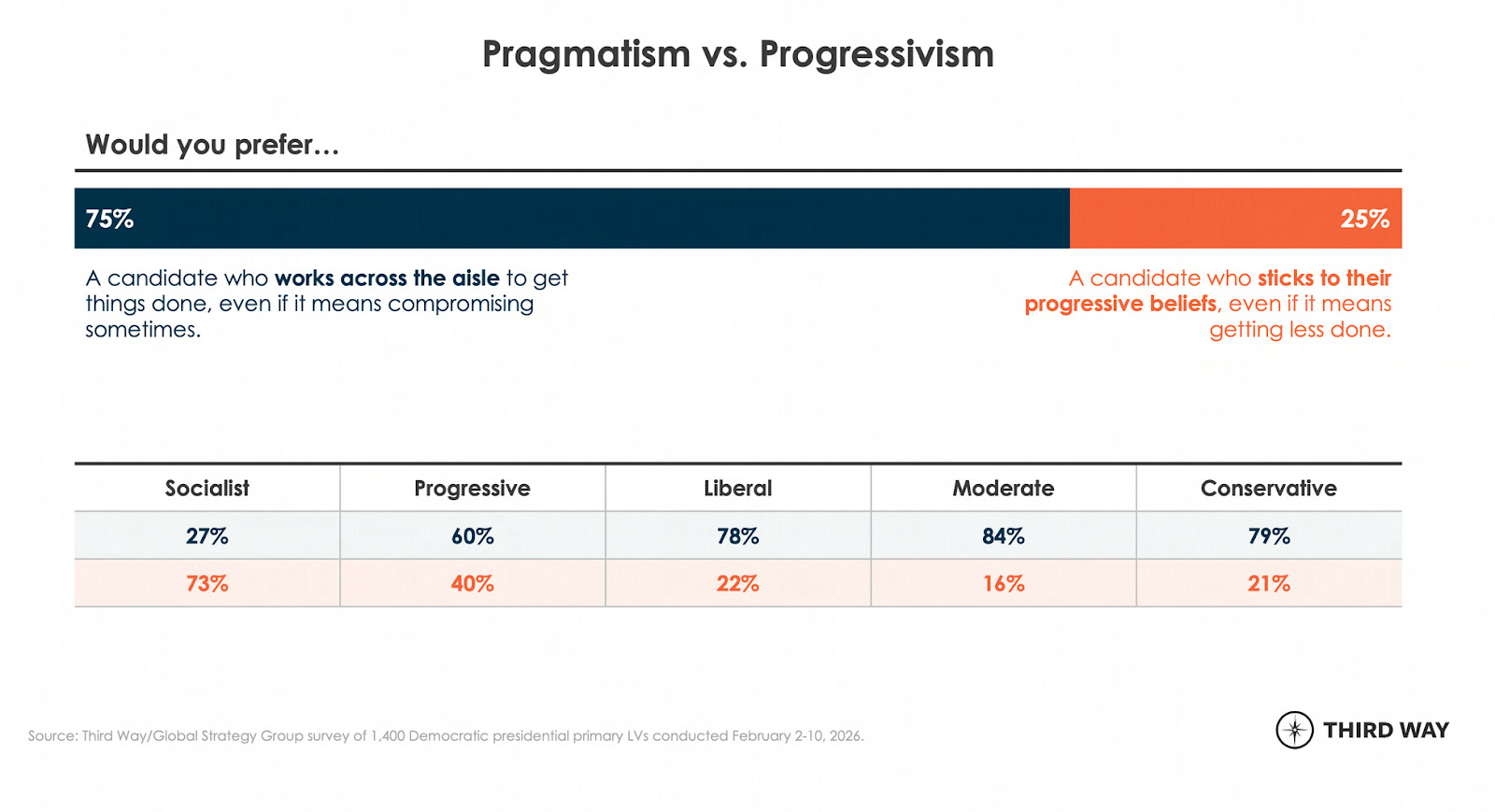
Third Way’s poll of Democratic primary voters clearly shows that the left wing of the party is by far the least willing to compromise for the sake of winning and getting things done. At the same time, they only make up a tiny fraction of the Democratic Party. The “socialist” and “progressive” categories only make up 17% of the Democratic electorate, while the “liberal” and “moderate” make up 77% of the party.
Stoller’s willingness to build a bipartisan “realignment” around anti‑monopoly politics, even if it meant praising Hawley and “burning nominal allies”, makes it abundantly clear and should lead those of us with a vested interest in revitalizing the party to keep him on the sidelines of that effort.
The anti-tech, anti-business movement is not going away, but rather than hand them the keys to campaign and govern, Democrats should ignore them and utilize the expertise of the national leaders of American innovation. It is what voters want and will help Democrats win and govern effectively.