
The Left’s Cope: Real Anti-Tech Populism Has Never Been Tried


In the 2020 Democratic primary, voters treated Joe Biden as the moderate choice.
And then Biden governed as something else. Especially at the regulatory agencies responsible for regulating technology companies, Biden installed a team that was intent on implementing a populist agenda on technology that pitted the administration against Silicon Valley.
Their theory was that this anti-tech posture would be very popular, especially with the working class, and would rebuild a strong foundation of support under Biden and the Democratic Party.
When this agenda turned out to not move the needle and Biden became less popular, especially with the very working class voters the Biden team was expecting to win back, the far left came up with a cope: the anti-tech push would have been popular if it had better marketing and had Harris not run away from it when she replaced Biden as the nominee in the 2024 election.
The essential myth of the 2024 cycle is that real anti-tech populism has never been tried.
In reality, we know that the Lose-Lose Politics of anti-tech populism caused voters to see both Biden and Harris as too far to the left, and it should be rejected as a political strategy as Democrats revise their national brand to be more popular and win nationwide.
Bidenomics: Party Unity Through Populist Economics
Once in office, Biden moved quickly into an economic program much more explicitly left-leaning than the Obama Administration. A key element of this economic and regulatory posture focused on anti-tech populism.
This governing turn was largely driven by who shaped policy and what intellectual tradition they represented. Biden’s economic team elevated figures closely linked to the Warren-style “corporate power” critique: the White House named Bharat Ramamurti as an adviser for strategic economic communications. Ramamurti’s Roosevelt Institute bio notes he previously served as “the top banking and economic policy advisor for Senator Elizabeth Warren” and ran a “Corporate Power” program.
And Biden’s anti-tech posture was embodied most clearly by his choice to elevate Lina Khan as FTC chair. Just a few months into his presidency, Biden has assembled what WIRED magazine called a “Big Tech Antitrust All-Star Team”.
Tech regulation: From Antitrust to Anti-Bigness Politics
Bidenomics showed up very clearly in tech and competition policy. Biden issued and executive order to launch a “whole-of-government” competition agenda aimed at “overconcentration, monopolization, and unfair competition.” Under his appointees at the regulatory agencies, enforcement escalated into marquee actions: DOJ sued Google for monopolizing ad-tech markets and Apple for monopolizing smartphone markets.
By design, this push did not focus on traditional consumer-welfare antitrust policies intended to drive down costs for working families, it looked much more like “big is bad.” But part of the challenge that the Biden Administration had in selling this concept is precisely because they were using anti-monopoly arguments and agencies as a mechanism to try to address the size and power of tech companies, which is something else entirely.
While opinions varied widely about whether this highly-visible and aggressive use of regulatory agencies was a good idea, there was little doubt that it was taking place. The major cases brought against Apple, Amazon, Google, and Meta prompted breaking news headlines, industry insights, legal analysis, and press releases.

This is far from an area of the Biden Administration that was kept quiet or swept under the rug. Khan herself made the case that her tenure at the FTC made big, visible changes on tech regulation:
“I think our record speaks for itself, I think all of the ways that we are delivering enormous benefits for the American people speaks for itself, and I’m just enormously proud of the just win after win that we’ve been able to deliver for the American people.”
The Cope: Biden Administration Didn’t Sell the Policy
In spite of the high profile lawsuits and cult celebrity status of Khan, the argument among the anti-tech advocates outside of the administration is that the Biden Administration is not really marketing their positions clearly enough for the public to understand.
Matt Stoller, the research director of the American Economic Liberties Project, argued that despite having the right policies and instincts in at the regulatory level, the Biden Administration was “incoherent” in making the case for itself as an explanation for a poll showing a 59% disapproval rating for Biden’s handling of the economy.
On an anti-trust case, he took issue with press secretary Karine Jean-Pierre not articulating a price-fixing critique.
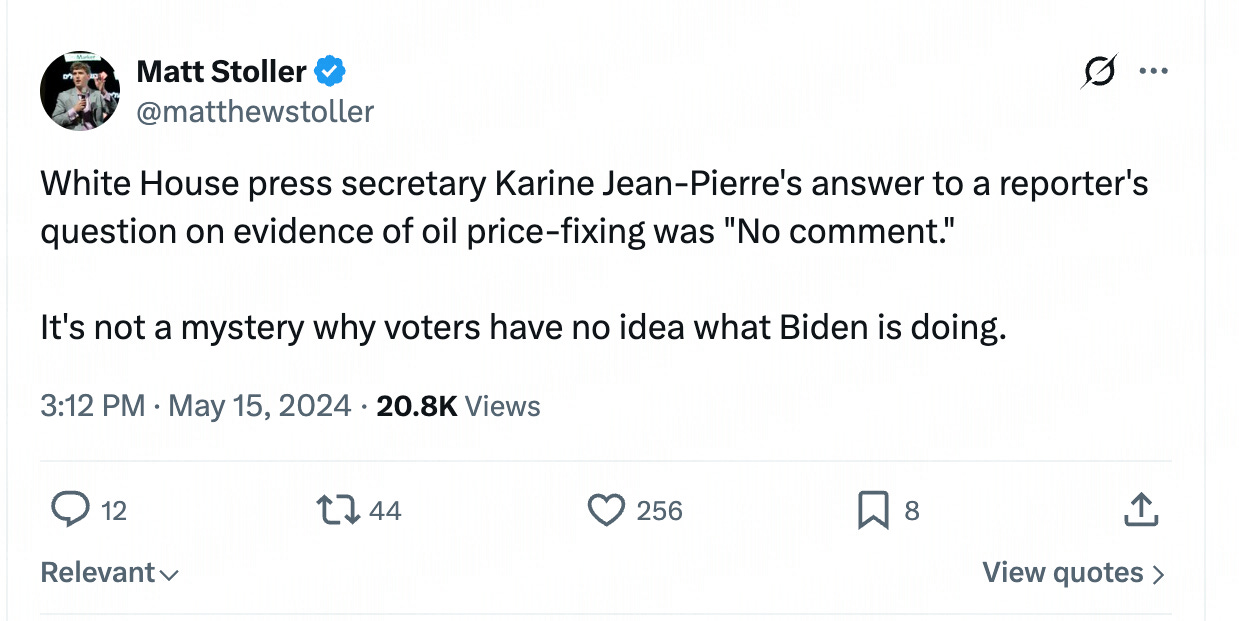
In a subsequent tweet, he writes, “Jean-Pierre is just insanely bad at the job.”
Similarly, Martin Sandbu, an economics commentator at the Financial Times, wrote in his post-election piece:
“There is nothing here to suggest that the policies themselves were not the right ones…Two largely uncomfortable conclusions emerge […] “vibeonomics” undermined economics: those voters tempted by populist economic promises were not being sold Biden’s effective economic populism hard enough to shift the vibes.”
Yet the arguments that the problem was that the public and working class voters didn’t know about what the Administration was up to ring hollow in light of Lina Kahn’s celebrity. According to the American Economic Liberties Project, the Wall Street Journal alone has published 122 pieces attacking Khan’s FTC. Jacobin states that “the spotlight on Khan has been relentless since well before her term as FTC chair began in June 2021.” Khan’s tactics at the FTC led to the resignation of a commissioner, and a prominent Wall Street Journal article giving her reasons for departure.
Fundamentally, the complaints about “bad marketing” are just a cope for the product itself (in this case, Biden’s policy record) being bad. Voters were rejecting what the Biden Admin was selling, and it wasn’t a failure of bad marketing.
After Harris lost, the left denied that their policies had been tried and demanded more populism
Despite rejecting his moderate and return-to-Obama image on economics, when Biden became unpopular, the economic populists just acted as if he had not shifted at all.
Cenk Uygur, founder and host of The Young Turks, leveled this criticism of both Biden and Harris immediately prior to the 2024 election:
When I criticize Joe Biden or Kamala Harris as simple servants of the donor class, a lot of people assume I’m supporting Trump because they think politics is two dimensional. But it isn’t—and until the Democrats figure out that they’re playing the wrong game on the wrong field, they’re going to keep getting surprised by the populist wave Donald Trump has caught.
After Donald Trump beat Kamala Harris in 2024, the postmortem from the left was striking: the left wing of the party did not view it as a reckoning for Bidenomics, they simply pretended that Biden had governed as the moderate he appeared to be during the campaign.
There was no acknowledgement that his regulatory agenda was executed by the team that Warren and Sanders picked. To the extent that there is any recognition that Biden governed as a populist, they fault Harris for failing to double down on a populist agenda during her truncated campaign.
Bernie Sanders’ indictment of the Democratic Party after Harris’ defeat was brutal:
It should come as no great surprise that a Democratic Party which has abandoned working class people would find that the working class has abandoned them…. Will the big money interests and well-paid consultants who control the Democratic Party learn any real lessons from this disastrous campaign? Will they understand the pain and political alienation that tens of millions of Americans are experiencing? Do they have any ideas as to how we can take on the increasingly powerful Oligarchy, which has so much economic power? Probably not.”
Jacobin was even more explicit, claiming Harris “ran away from a winning economic populist message.” They speculated that her campaign messaging and policies were not based on her actual beliefs or out of a desire to move closer to the median voter.
Rather, they write that “perhaps criticism of landlords and price gougers proved uncomfortable for Harris’s big-money backers and top advisors, like her brother-in-law Tony West or former Obama campaign manager David Plouffe, who have occupied roles as Uber’s senior vice president of policy and chief legal counsel, respectively.
The Nation similarly argued that the economic left was being used as a scapegoat for the loss:
“Why, after every electoral loss, is the left always the scapegoat? It’s easier to blame activists for pushing a progressive agenda than confront the real issue: the Democratic Party has long been shaped by far more powerful forces—corporate interests, lobbyists, and consultants—whose influence has neglected the real crises facing everyday Americans. We see this cycle again and again.”
The Electoral Problem: Harris Was Already Seen As “Too Liberal”
The issue that the populist critique of the Biden Administration and Harris campaign fails to acknowledge is that both politicians were very closely associated with the anti-tech populism that their champions had put in place during the Biden Administration.
We also have evidence that the economic policies were unpopular. By November of 2021, well before inflation hit its peak a year later, 55% of voters disapproved of Biden’s economic performance, which was 6 points more than Donald Trump’s highest disapproval rating on the economy.
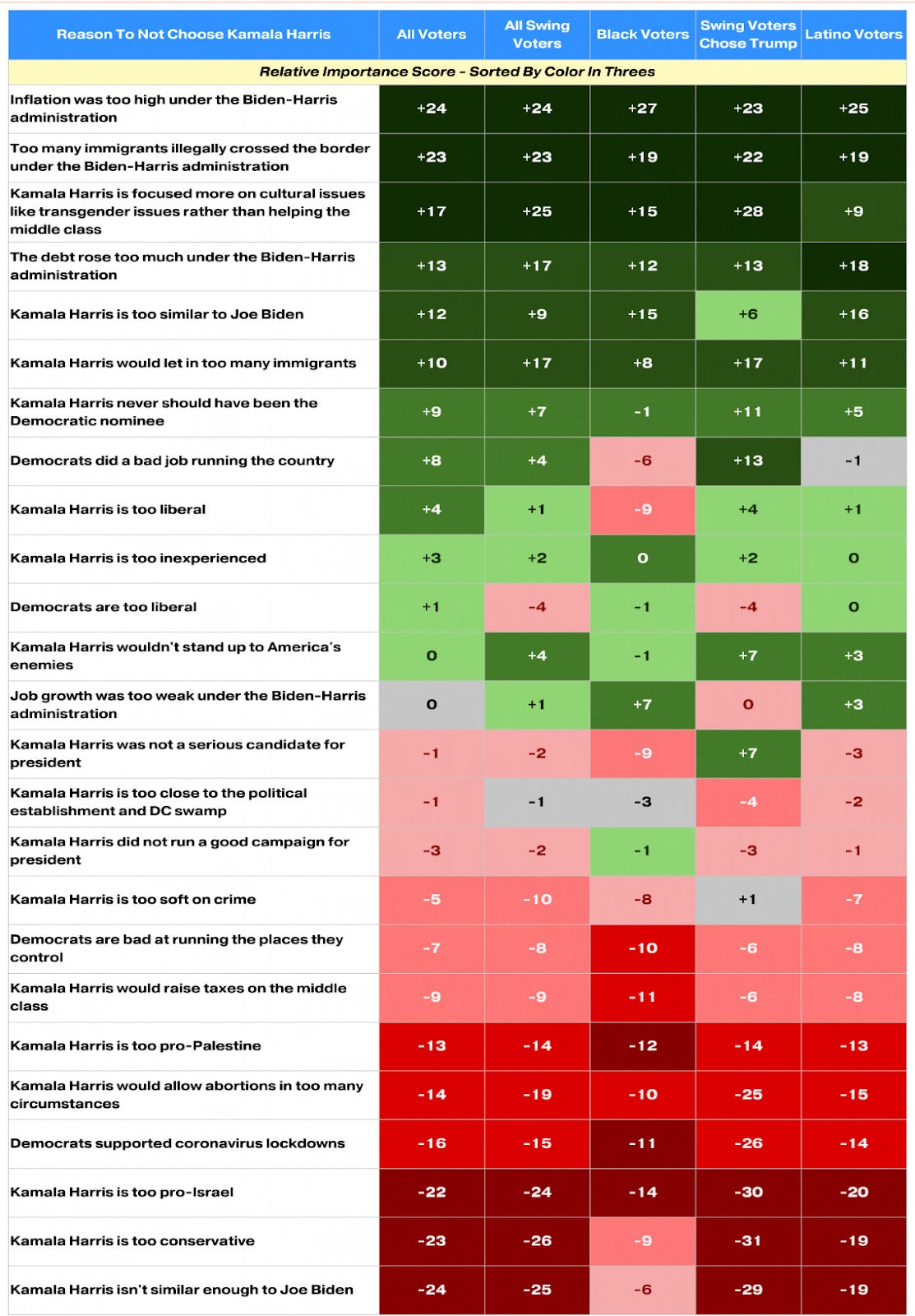
Blueprint surveyed 3,262 national and swing state 2024 voters fielded over web panels from November 06 to November 07 and weighted to education, age, gender, race, and 2020/2024 election results. The margin of error is +/- 2.1. The swing state oversample included 1,883 voters.
The Blueprint Poll taken immediately after the election vividly shows that Kamala Harris was viewed as too similar to Biden and too liberal. The lowest-ranked concerns were that she wasn’t enough like Biden and that she was too conservative. Voters’ reality simply does not match progressives’ cope.
While the pundits pushing for Harris to embrace Biden’s economic populist vision or move even farther left, the reality is that she never “shook the Etch-A-Sketch” as Matt Yglesias put it. To voters, her campaign looked very much like a continuation of the Biden campaign and administration policies that she inherited when he dropped out.
As I have written about previously, we know that the Biden Administration version of anti-tech populism simply does not move working class voters toward Democrats.
The issue is not that we didn’t lean in hard enough to tech-bashing and anti-business policies. Biden championed these positions throughout his presidency and when they proved to be unpopular with voters, the populist left just pretended it never happened or we just didn’t explain it well enough.